


- Education Department has proposed a policy that would financially punish "low earning outcomes" colleges.
- The federal agency now flags "lower earning" schools during the student federal loan application process.
- None of Utah's 16 public higher education institutions are currently flagged.
Last December, the Department of Education launched an “earnings indicator” designed to provide college-bound students and their families with information about a school’s post-graduation earnings status.
The earnings indicator — which works in conjunction with the Free Application for Federal Student Aid, or FAFSA — flags specific colleges whose graduates are, on average, earning less than average high school graduates.
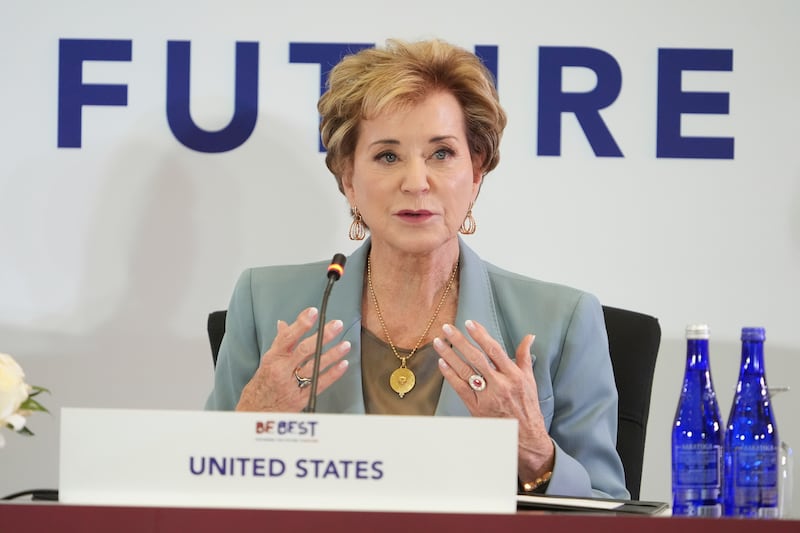
The feature, according to Education Secretary Linda McMahon, empowers prospective students to make data-driven decisions “before they are saddled with debt.”
The average student debt in the U.S. hovers near $30,000 — with 2024 college graduates owing $494 more per person in loans compared with the prior year, according to U.S. News & World Report.
Now the Trump administration is hoping to place a money squeeze on colleges with low earning outcomes.
Last Friday, the DOE issued a Notice of Proposed Rulemaking to establish a postsecondary education accountability framework “that will break the cycle of low return on investment for students and taxpayers,” according to a DOE release.
The proposal, according to the department, is part of President Donald Trump’s “One Big Beautiful Bill” act and seeks to place the nation’s post-secondary institutions on the hook for low earning outcomes, regardless of tax status or sector.
“As the federal student loan portfolio approaches $1.7 trillion and more students are left financially worse off than if they had never attended college, now is the time for a hard reset in higher education,” the release noted.
“The Act presents a once-in-a-generation opportunity to rein in unsustainable student loan borrowing, better align postsecondary education with workforce needs, and bring uniform accountability across the higher education system.”
Trump administration: Education accountability ‘grounded in common sense’
Under the DOE’s proposed rule, if the “typical graduate” of an undergraduate program does not earn as much as a high school graduate, the program will no longer be eligible for federal student loans.
The agency’s sought-after policy is not limited to certificate or undergraduate degree programs. Graduate programs must similarly lead to earnings above those of an average bachelor’s degree holder.
Programs that routinely fail to provide students with a positive ROI — or return on investment — would lose access to federal student loans and, in certain cases, Pell Grants, according to the DOE.
“The Trump Administration’s proposed accountability framework is grounded in common sense: if postsecondary education programs do not leave graduates better off, taxpayers should not subsidize them,” said Under Secretary of Education Nicholas Kent in the Ed Department release.
“This consensus-backed framework will drive meaningful change in postsecondary education, ending years of regulatory whiplash and addressing student debt that has left too many students worse off.”
The public can formally comment on the DOE’s proposed change over the next several weeks — and the department reports it may make changes to the rule in response to the comments. Public comments on the proposed rules can be submitted through the Federal eRulemaking Portal at www.regulations.gov.
DOE will not accept comments submitted by fax or email — and all public comments must be in on or before May 20.
Red flags for ‘lower earning’ schools
The DOE’s proposal to hold colleges and universities accountable for low earnings outcomes comes amid ongoing debate about the value of higher education.
Does finishing college still promise a worthwhile ROI? The answer is split.
Many point to research revealing lifelong benefits offered by a college education. Others are less enthused, citing rising national tuition costs and uncertain job opportunities.
The recent DOE actions are formulated to give loan-seeking students a clearer picture of post-graduation earning outcomes — while simultaneously placing financial pressure on “low earning” programs.
Statistically speaking, not many U.S. colleges have been flagged as “lower earning.”
“More than 2% of undergraduate students nationwide,” according to a DOE report, “attend an institution where graduates earn less than a high school completer on average.”
But the report added that those same “low earning” institutions receive approximately $2 billion in federal student aid annually.
In Utah, several institutions are flagged by the DOE data set as “lower earning.” Almost all are small, for-profit cosmetology schools.
None of Utah’s 16 public institutions of higher learning are currently flagged as “lower earning.”
And no institutions of higher learning sponsored by The Church of Jesus Christ of Latter-day Saints — including Utah’s Brigham Young University in Provo and Salt Lake City’s Ensign College — are flagged as “lower earning.”