


A version of this article was first published in the Right to the Point newsletter. Sign up to receive the newsletter in your inbox every Wednesday morning and vote in subscriber-only polls.
When the USDA unveiled a new logo for meat raised in the United States, it was accompanied by a new slogan: “Tastes Like Freedom.”
To which author and nutritionist Marion Nestle replied on her “Food Politics” blog, “Tastes like freedom? You have to love the Orwellian rhetoric.”
That’s an understandable response. “Tastes like freedom” isn’t even an original phrase — it was, for example, printed on a banner that hung over the stage during a mock debate between Bill O’Reilly and Jon Stewart in 2012.
But also, there’s reason to love this campaign. It’s one of the good things the Trump administration has done that gets overlooked because of the not-so-good things consuming all the oxygen in the room.
The campaign seems like something Democrats, Republicans and independents could all get behind. And the American cattle in the promotions could give Chick-fil-A’s billboard-climbing cows a run for their money with a little more zest.
U.S. Secretary of Agriculture Brooke Rollins said the campaign is designed to raise awareness about standards that went into effect at the first of the year, requiring that any meat or eggs that carry a “Product of USA” label be born, raised, harvested and processed here in the U.S.
You might think that was always the case, but in the past, some “products of the USA” came from outside the U.S. yet qualified for the label because they were processed or packaged here. “Cattle laundering” is apparently a thing. And some American ranchers have been trying to capitalize on disdain for mystery meat by selling directly to consumers.
But as of Jan. 1, meat and eggs that say “Product of USA” must be verifiably so, although that labeling is voluntary, not mandatory. As for anything that doesn’t have that label: Let the buyer beware, as the saying goes.
Meanwhile, as America’s 250th birthday approaches, get ready for a lot more “Tastes like freedom” promotions. Sign me up for the patriot milkshake.
MAHA takes aim at bad hospital food
Hospital food has long been the subject of jokes and even the occasional scientific study that finds what’s being fed to patients isn’t especially healthy.
It seems like common sense that “we shouldn’t be giving people who are sick Jell-O, Cheerios, rubber chicken and sugary drinks,” as Health and Human Services Secretary Robert F. Kennedy Jr. recently said while directing hospitals to up their food game.
To be fair, some health care systems, including Intermountain Health, have already been doing that. But those who haven’t have been put on notice that they could lose funding if they fail to make their food offerings align with federal dietary standards. And administration officials are also calling out hospitals for having vending machines with junk food and sodas.
While MAHA (Make America Healthy Again) and President Donald Trump are reportedly at odds over some of the administration’s actions, including Trump’s nomination of Dr. Erica Schwartz to lead the Centers for Disease Control and Prevention (and other Americans are at odds with MAHA generally), the war on hospital food was a long time coming.
The mainstreaming of tattooed ladies
Over at American Storylines, Daniel Cox has an interesting analysis of who’s getting tattoos in the United States — and who’s not.
About a third of Americans reported having a tattoo in 2023, according to Pew Research. “But the real story isn’t how many tattoos we’re getting, but who is getting them,” Cox said, noting that “an astounding 56 percent of women ages 18 to 29 report having a tattoo.” Higher numbers are seen among young women who identify as left-leaning or LGBTQ.
In contrast, only 26% of men in the same age group had tattoos, a gender gap that Cox describes as “eye-popping.”
Americans overall are more accepting of tattoos than they were when Groucho Marx sang about “Lydia the Tattooed Lady,” but it does seem like this is further evidence of how young men and women are becoming culturally and politically estranged.
Recommended Reading
Dr. Francis Collins, the former director of the National Institutes of Health, was an atheist when he entered medical school; later he converted to Christianity. In a book excerpt published in Deseret Magazine, he explains some of the thinking that led to the change.
“There is no need for a sense of doom for people of faith, and no need to reject science. God as the creator of the whole universe, using natural laws that make evolution possible, is still an entirely consistent, beautiful and intellectually satisfying formulation.”
Divine discovery: Are faith and science in conflict?
Whatever you think of New York City Mayor Zohran Mamdani, he knows how to speak to Gen Z. Witness his video announcing a new wealth tax in New York City. Jay Evensen took a look at that proposal and a similar one in California and warns of unintended consequences.
“People like sticking it to the rich. Even some wealthy people support being taxed more. Mitt Romney has said the rich should pay more, but he focused mainly on closing loopholes and entitlement reforms, not taxing net worth. Such measures have dismal performance records. Why? Because money, being cowardly, flees those who want to punish it and seeks the path of least resistance.”
Wealth taxes are popular but ineffective
Asma Uddin has her eye on advances in neurotechnology that will truly change lives for the better, but which also offer legitimate causes for concern.
“The pattern is familiar: A technology earns trust by treating real suffering, and that trust then carries it into uses that were never part of the original deal. Consumer neurotechnology is already following that path. And like every other kind of personal data, once brain-related data becomes useful, it becomes valuable.”
The last private place is your mind. That’s starting to change
Tweet of the Week
The Boston Herald got the rest of the story. Ajay Haridasse, the runner in distress, was running his first marathon and was in Mile 26 when his legs said no more. One of the men who stopped to help him was on track for his fastest marathon ever. Instead, he got a forever friend. Good trade-off, don’t you think?
End Notes
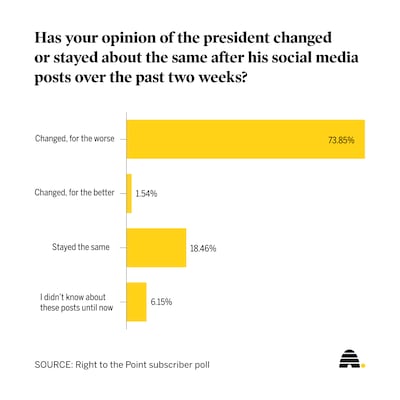
In last week’s Right to the Point poll, we considered President Trump’s latest controversial social-media posts, from the Easter morning one demanding Iran open the Strait of Hormuz to Trump’s personal attacks on Tucker Carlson and other podcasters to the AI image of the president that many people saw as blasphemous.
The posts did not land well, with most respondents saying that their opinion of the president changed for the worse.
Finally, I will never see a “pet relief” sign again without thinking of it in this context. Thanks, Shannon Bream. We all could use some pet relief.