


“Someone to talk to.”
That is how McGeorge Bundy, national security adviser to Presidents John F. Kennedy and Lyndon B. Johnson, once summed up the “special relationship,” the partnership between the American and British people.
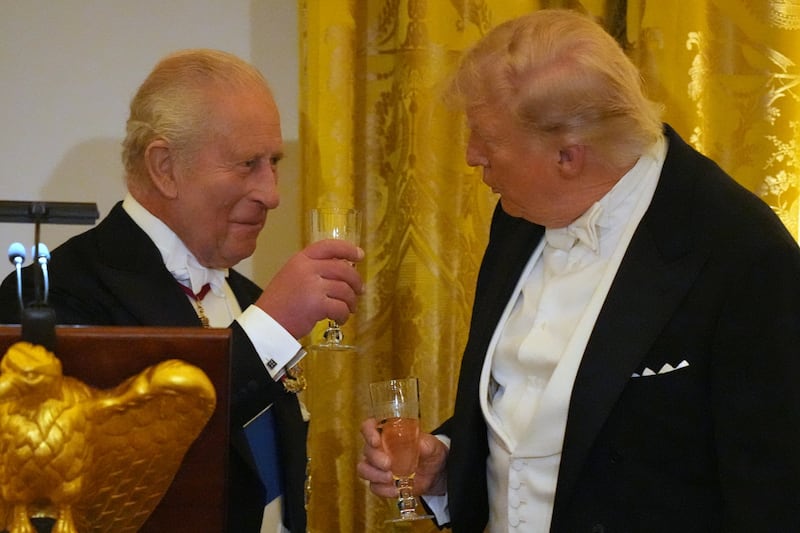
The April state visit of King Charles III and Queen Camilla of Britain (more properly the United Kingdom, including Northern Ireland) and the Commonwealth (formerly the British Empire) provides an opportunity to repair relations frayed mainly by the war in Iran.
The first visit by reigning British monarchs to the U.S. was by King George VI and wife Queen Elizabeth in June 1939, in response to a shrewd, farsighted invitation by President Franklin D. Roosevelt.
Our “special relationship” was formalized and announced by Roosevelt and U.K. Prime Minister Winston Churchill during the darkest days of World War II. The two leaders met on navy vessels off the coast of Newfoundland in August 1941. Churchill returned to meet with Roosevelt in the White House and address a joint session of Congress in December of that year, shortly after Pearl Harbor.
The first of these historic meetings resulted in the Atlantic Charter, defining broad, positive human goals of freedom and basic economic security. The follow-up session resulted in commitment to the concept of the United Nations, which moving forward signified the Allies’ goals in World War II.
This close partnership between Britain and the U.S. — forged during the frightening and frustrating first phase of World War II in Europe — has endured to the present despite sometimes strains. The evolution of the Anglo-American special relationship underscores important events of that global total war, and the Cold War and post-Cold War eras that have followed.
Prime Minister Tony Blair paid a high political price for his loyal support of the administration of George W. Bush in the 2003 invasion of Iraq. Yet Blair survived politically, and led his Labour Party to another general election victory. More important, the Anglo-American military alliance, and the durable wider NATO structure, was never really seriously threatened.
During the mid-1960s, the Johnson administration pressed extremely hard for at least token direct military participation in the Vietnam War. Australia and New Zealand — both members of the British Commonwealth — did provide forces. In the case of Australia, there was considerably more than a token commitment.
Britain remained out of that war, for understandable reasons. In hindsight, this lack of support by a close ally was an early indication of the questionable nature of the American military escalation.
The most serious Anglo-American and wider Atlantic alliance crisis was over the Suez Canal in 1956, not current Mideast conflicts. Britain, France and Israel launched a coordinated surprise military attack to retake the waterway and associated territory from Egypt’s nationalist government.
President Dwight Eisenhower was completely opposed, as well as offended by lack of consultation. His administration forced an abrupt halt to the operation. No crisis since has so seriously threatened the alliance.
Economics strengthens alliance cooperation. Prime Minister Margaret Thatcher’s deregulation of the economy in the 1980s pays powerful dividends today. Canary Wharf — formerly grim docks and working-class housing blocks in eastern London — has been transformed into a mammoth global commercial center.
Massive modern skyscrapers dominate the horizon, complemented by fashionable retail outlets. Thatcher’s heavy-handed style earned her the sobriquet of “Big Sister,” but her forceful deregulation and opening of the economy were crucial to contemporary British prosperity and strength.
Current unpredictable turmoil underscores the importance of this steady ally.