

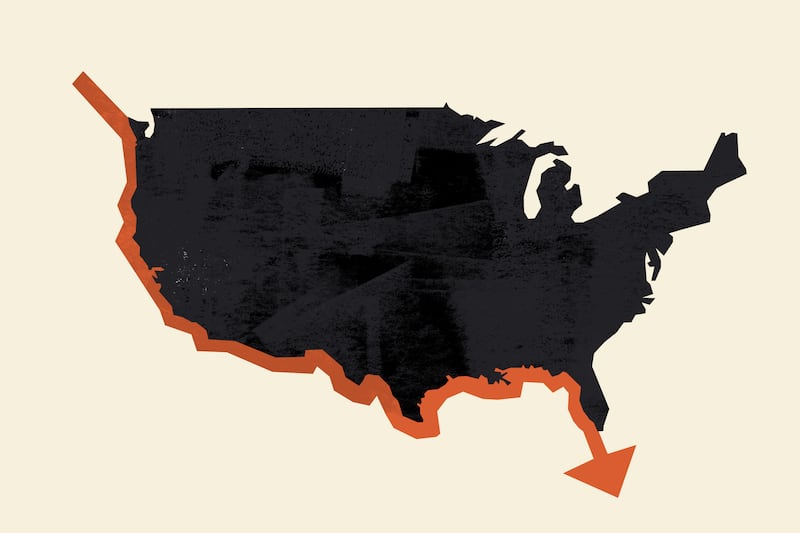

“To be blunt,” writes Nicholas Eberstadt, the Henry Wendt Chair in Political Economy at the American Enterprise Institute, “America is not well positioned to pass the ‘stress test’ that depopulation will unforgivingly impose.”
Make no mistake, a shrinking population is coming, perhaps faster than anyone realizes. The birth rate keeps retreating, and immigration, once thought to be the one thing that could save the nation, is unpopular at the moment.
And, apparently, few people in Washington are doing much about this.
“In fact, the U.S. may actually be less prepared for an eventual depopulation today than it was a generation ago,” Eberstadt writes in a new report titled, “Can a depopulating America still flourish?”
The answer seems to be getting less optimistic as the 21st century proceeds. Eberstadt notes with elegant understatement, “Our country has developed a whole range of undesirable new habits — political, social, and economic — over the past several decades.”
As long as the population was growing, we could seemingly afford these excesses. “We cannot count on that luxury under depopulation.”
About that debt
Let’s start with the national debt, which is fast approaching $40 trillion. Add to that household debt, which reached $18.8 trillion in the fourth quarter of 2025.
To actively compile debt with the hope that a shrinking future population can deal with it is not an act of faith. It is irresponsible.
The obvious solutions are fiscal rigor combined with austerity, plus an increase in fertility and family life, with its many attendant virtues. But the first two are unlikely to interest politicians who rarely attack problems that remain several elections away. And the third has fallen out of style in a consumerist society that has forgotten the benefits (to men, women and society at large) accompanying the responsibilities and joys of parenthood.
Some experts see the coming population collapse as a glass half full. Generally, their arguments focus on the idea that fewer people will be good for the environment or that food and housing will be more plentiful.
Eberstadt agrees that a shrinking population does not have to equate to disaster. He argues this is so for the same reason that the world continued to prosper and improve despite what many had labeled as a condition of “overpopulation.” Human ingenuity, the world’s greatest resource, has helped the human race defy doomsday predictions.
Whether it can compensate for the best solution — an increase in babies — remains to be seen.
“As we have moved from the agrarian era through the industrial revolution to the service economy, and now into the ‘knowledge economy,’ the relative contributions to material progress from human resources (as opposed to land and natural resources) have progressively increased — and within human resources, the contribution from muscle power has been completely overshadowed by the contribution from brain power,” Eberstadt writes.
Time to get serious
He cites the development of artificial intelligence as one example of progress that could save us. It seems “unlikely to be the last ‘big new thing’ generated by human ingenuity,” he said.
But if we’re going to truly cope with his new demographic reality, Americans have a lot of work and thinking to do. We have to get serious at a time when ignorance and silliness seem to be winning.
The Social Security Administration assumes the United States will grow by another 100 million residents by the end of this century. Eberstadt cites statistics that show how unlikely this is. Instead, the population will begin to decline long before that.
Immigration may postpone a decline in real numbers until 2056, but immigration is tough to predict. Eberstadt notes the Congressional Budget Office predicts the United States will have 1 million or so more deaths than births each year by 2046. But immigration restrictions could move that up considerably, perhaps as soon as 2038. That is a possibility “almost no one in Washington expects, and no one is prepared for.”
A worldwide problem
The United States is not alone in facing this problem. As Eberstadt wrote separately in January, “Tumbling birth rates have already thrown China into depopulation, with over four deaths for every three births in 2025.”
Several nations have tried incentives for couples to procreate. In the United States, the Trump administration will deposit $1,000 into accounts of any children born after Dec. 31, 2024, and before Jan. 1, 2029. A year ago, the administration was considering several other ideas. So far, no nation has found a surefire way to succeed.
Eberstadt suggests the nation’s energy would be better spent finding ways now to prepare for the reality of a shrinking population. As always, “Coping with these exigencies under emergency conditions is a much less attractive way of getting business done.”
Human beings are indeed the world’s greatest natural resource. It follows that large families — the best engines for creating this greatest natural resource — remain the best solution to this problem. Absent that, the road looks rough, indeed.