

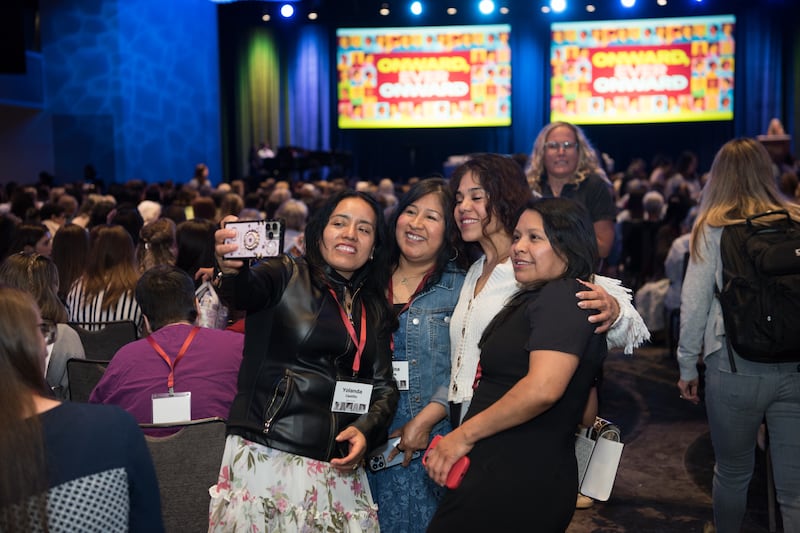

As a woman staring down the barrel of her 41st birthday, I came to the Northeast Area Women’s Conference last week for female members of The Church of Jesus Christ of Latter-day Saints struggling with typical midlife fare. Even though I look fairly youthful for my age, I’m getting wrinkles and, it pains me to admit, they scare me. You think you know yourself, but then you glimpse your crows feet in a picture and it threatens to topple you. You don’t realize how much of your identity is tied to your looks until they start changing without your permission.
With the recent loss of my parents in 2022 at 58 and 59 years old, I’m contemplating more than the loss of my youth. I live in an aging neighborhood and many of my fellow church congregants are in their 70s and 80s. At their stage of life, they are no longer working, actively caring for children, buying new homes or sculpting their bodies. Many are battling illness and loss of independence, and I find myself wondering how I’d cope with losing the roles and activities which now define so much of my life.
The obvious answer most often raised as Latter-day Saints would be to remember my divine and unchanging identity as a child of God. President Russell M. Nelson taught that our most important identities are as children of God, children of the covenant and disciples of Christ. But what I’ve found in my midlife fumblings is that your sense of identity as a child of God can only go as deep as your relationship with him. If God is distant and abstract to you, so too will be any sense of yourself that’s derived from him.
“I am a child of God” is life-changing as an internalized reality, but useless as an unlived platitude.
One of the most valuable parts of gathering with so many women who are striving to live their covenants with God is seeing what it looks like to internalize your divine worth amid widely varying circumstances. Two of the speakers, Amy Antonelli and Elissa Gifford, didn’t marry until age 50. Listening to them discuss their remarkable careers in humanitarian service opened a new neural pathway in my spiritual brain. I know what it’s like to pursue discipleship within the context of motherhood and marriage, but hearing how these women ministered with real love to strangers around the globe — and changed their lives through that love — demonstrated, in a concrete way, how God’s work for women is serious and meaningful at every stage of life.
Women need these mental pictures of who they can become through their relationship with God because the world is constantly trying to force its own pictures down our throats. This visual onslaught meets my midlife anxieties around aging and death with denial, cramming my feeds with celebrities and influencers who, though technically advancing in years, are somehow maintaining the face and lifestyle of someone in their early 30s. It might seem like a truism that life’s cameras only ever fall on the sexiest women, but the depressing upshot in so much of modernity today is that your power and influence are a function of your youth and beauty.
By contrast, gathering with Latter-day Saint women in New York City provided countless examples of women who, through their commitments to Christ, changed lives. My co-panelist Jenny Reeder, a church historian, battled leukemia in graduate school. She explained how she drew on the stories and examples of pioneer women who loved and served others in their own hardships and continued serving others through written notes from her hospital bed. Now her scholarship as a historian of 19th century Latter-day Saint women reaches every woman in the church.
We’ve perhaps all heard stories about how women found strength to help and serve through their relationship with God. But gathering with women who have done it — seeing the peace, strength and joy they’ve developed despite real hardships and loss — makes it feel possible for the rest of us.
At the same recent gathering, Jane Clayson Johnson testified of the help and peace she has found from the Savior despite enduring the recent loss of her child. This is what it looks like to have oil in your lamp and a relationship with God that is real enough to give meaning to your own identity as a child of God.
The mental picture I’ve carried of myself since my 20s of a young woman making decisions about marriage, family and career is fading because, in 2026, those decisions have all been made and that young woman’s hair is now graying. I’m no longer someone whose “entire life is ahead of them.”
Now I’m someone with significant parts of their life already behind me and a finite amount of mortality ahead. The women’s conference theme of “Onward, Ever Onward” also reminds me that life continues beyond our mortal experience, and the decisions I make now will determine who I am, and what I care about, in the eternities.