

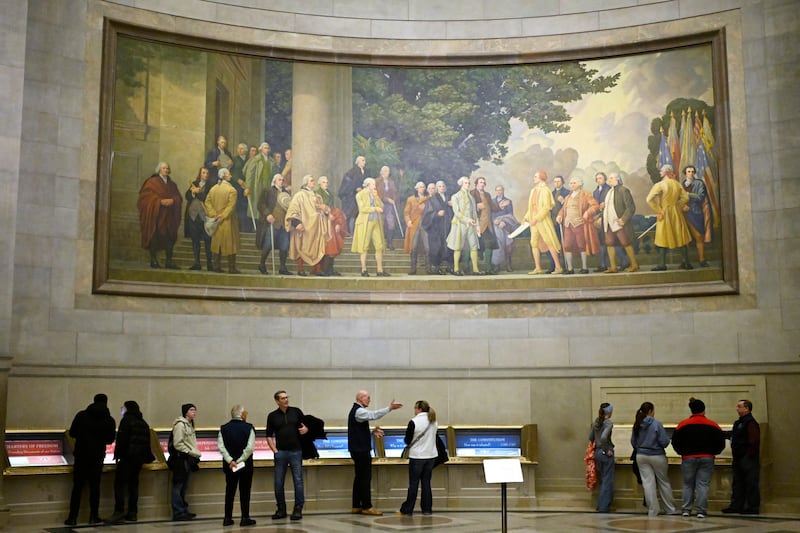
“Why would Thomas Jefferson write the words ‘We hold these truths to be self-evident that all men are created equal’ if he didn’t really mean it?”
This question comes up every semester when I teach my high school seniors about the Declaration of Independence. The question isn’t asked with disdain, but with genuine curiosity.
They have a point. Jefferson enslaved people. Many others who signed the Declaration denied rights to various minority groups. The gap between the standard of equality and the reality of 1776 is impossible to ignore. So, why would the Declaration make such a bold claim if it wasn’t going to be upheld?
When this question is asked, I don’t ignore it, but I struggle to answer it. Was the declaration written just to be a persuasive document to gain support for independence? Or did Jefferson and the other members of the Declaration’s drafting committee write it down believing in its truth? I have always clung to the latter interpretation, not because it gives an excuse for the founders’ hypocrisy, but because it’s much more comforting to believe that the founders at least hoped for true equality.
Clarity on this question finally came during a course in my master’s program in Constitutional Government, Civics, and Law at UVU. The class focused on the Declaration of Independence and traced its ideas throughout American history.
The Declaration of Independence shaped American history
My colleagues and I studied the declaration not only as a creation of 1776, but also as a text that moved with history. It has been used by many Americans to demand that our nation live up to its own words. We studied Frederick Douglass’s heavy question, “What to the Slave is the Fourth of July?” and analyzed Abraham Lincoln’s insistence that the declaration’s claims should be universally applied. We discussed Martin Luther King Jr.’s position that the declaration is a “promissory note” written to all Americans past and present. We examined the “Declaration of Sentiments” and saw how women purposefully used Jefferson’s words as a template to petition for their suffrage.
Examining these powerful examples throughout American history, I realized that the Declaration of Independence was not just a persuasive document. In fact, the declaration has been a beacon of hope for marginalized communities. Across history, Americans did not reject the declaration because its claims fell short. Rather, they grasped its promises and used it as a powerful leverage for change.
This realization completely transformed how I view the Declaration of Independence, and how I teach it. The declaration was not just an outline for breaking apart from England. It set a moral standard. And instead of focusing on the distance between the declaration’s ideals and the reality of the time, Americans have used the promise of equality to work toward bridging the gap. The power of the declaration is not in its perfection, but in its claim that equality is self-evident, even if society refuses to recognize it.

The Declaration of Independence is a beacon of light
Like a lighthouse, the declaration has stood as a beacon of light toward which Americans have steered, even in the midst of injustice and cruelty. And I am so thankful they have. Because of this, America has ended the hideous institution of slavery. Because of this, legalized segregation has been knocked down. Because of this, women have gained the right to vote. And most importantly, because of this, Americans continue to fight for the equality that comes from our natural shared humanity.
The Declaration of Independence is our moral compass. It wasn’t written because equality was already in place, but because it is worth fighting for
As we are approaching America’s 250th anniversary, this understanding matters. Have we perfected the ideals of the Declaration of Independence? No. But that does not make the declaration irrelevant. Instead, it reinforces its significance. The enduring legacy of the declaration is that it gives each new generation something to celebrate and something to work toward. It invites us to honor the knowledge that equality exists, while challenging us to expand the application of it.
So, the next time my students ask that daunting question, I will answer confidently. The Declaration of Independence is our moral compass. It wasn’t written because equality was already in place, but because it is worth fighting for. And now, 250 years later, the responsibility is on us. We must carry on the work of those who showed us that America could, and needs to, become what it declared itself to be in 1776.