

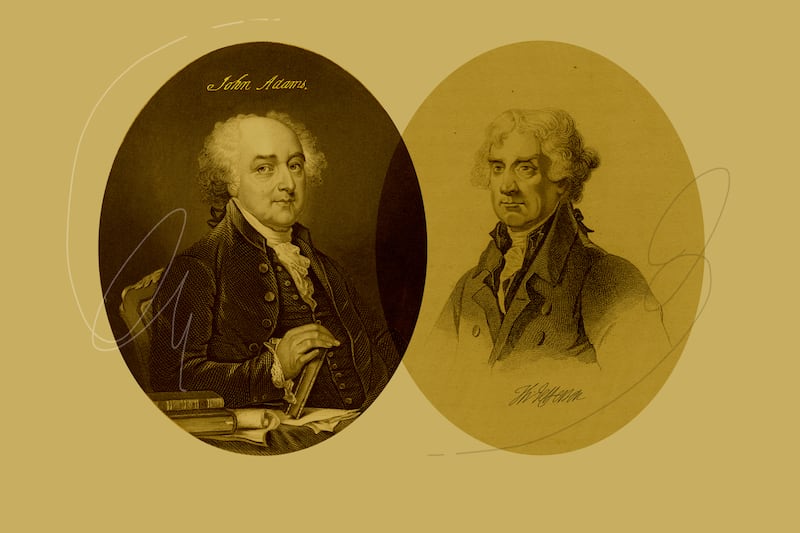
As we celebrate the 250th birthday of American independence, we also mark 200 years since the deaths of John Adams and Thomas Jefferson, who died hours apart on July 4, 1826 — the 50th anniversary of the Declaration of Independence.
Even the most casual observers were struck by the uncanny timing of their simultaneous passing, a curious coincidence that many attributed to the hand of providence and others saw as a sobering sign for the young republic.
Dubbed the “Atlas of Independence” and the “Apostle of Liberty” respectively, Adams and Jefferson were indispensable though not interchangeable. American independence could not have happened as it did without them both. They are appropriate monikers, as Adams carried the weight of revolution on his shoulders, while Jefferson was its chief evangelist.
The men were close in life and even closer in death, but not necessarily in legacy. Their famous friendship, falling out and reconciliation did not leave them on an equal historical footing.
Because Adams has lived in the shadow of the early Virginia presidents (especially Washington and Jefferson), his legacy has not been imprinted on the American civic psyche in the same way. Everyone accepts that without George Washington there is no nation, without Jefferson there is no declaration, and without Madison there is no Constitution. But few Americans have ever understood the degree to which John Adams was the foundation and catalyst for all those contributions.
It was Adams who nominated and advocated for Washington to be commander in chief of the Continental Army; it was Adams who handed the assignment to Thomas Jefferson to draft the Declaration of Independence; and it was Adams who provided the template for American constitutionalism.
His outsized contribution was famously captured by Jefferson, who referred to Adams as the “Colossus” on the floor of Congress. Of our first four presidents, Adams alone was known as an orator, a firebrand who could captivate juries, committees and even the entire Congress for hours at a time.
Adams exuded an unmatched enthusiasm for the work of independence. In a letter to his wife, Abigail, he foresaw Independence Day as a festival for future generations, marked by “pomp and parade, with shows, games, sports, guns, bells, bonfires and illuminations from one end of this continent to the other.”
Adams, indeed, saw a future worth celebrating. So did Jefferson. It’s just that they saw it so differently.
Much of their difference revolved around their opposing views of human nature. Jefferson believed in the capacity of ordinary American farmers to render better moral judgments than the educated elites, who have “been led astray by artificial rules.” In contrast, Adams felt Americans were just as susceptible to vice and folly as any other people and therefore needed institutional structures to rein in popular passions. “There never was a democracy yet,” he maintained, “that did not commit suicide.”
Whether we see the world through rose-colored Jeffersonian glasses in which good people create good governments, or through the realist lens of Adams in which good governments help to foster virtuous people, the fact is that modern America lies at the intersection of Adams and Jefferson. We see ourselves and those who agree with us as reservoirs of virtue but maintain a much darker view of the innate goodness of others.
Notably, at no point in their years of letter writing did they change one another’s minds about the role of government, the French Revolution, or the nature of man. They never intended to. They simply sought to understand.
Ultimately, Jefferson has cast the longer shadow because of his idealistic vision. Optimism always inspires more than realism. Thus, though Adams tells us what we need to know, Jefferson tells us what we want to hear — what we most want to believe about ourselves.
As they resumed their correspondence after a frosty 15 years, Adams extended his hand and his heart to his fellow founder in 1813 with these words: “You and I ought not to die before we have explained ourselves to each other.” From that moment until their well-choreographed deaths in 1826, they did exactly that — explain themselves to each other and to us.
“We are both too old,” Jefferson mused, “to change opinions which are the result of a long life of enquiry and reflection.” Moreover, he added, “we differ as rational friends, using the free exercise of our own reason, and mutually indulging its errors.”
And when the errors of reason negatively affected public opinion, these “rational friends” supported one another.
Adams acknowledged, for example, that some of his early writings “laid the foundation of that immense Unpopularity, which fell like the Tower of Siloam upon me.” By contrast, he told Jefferson, “Your steady defense of democratical Principles, and your invariable favourable Opinion of the French Revolution laid the foundation of your unbounded Popularity.”
Acknowledging that Adams had at times been treated unfairly, Jefferson encouraged him to “leave such explanations as would place every saddle on its right horse, and replace on the shoulders of others the burdens they shifted on yours.”
As they reflected on the government they were instrumental in creating, Jefferson reminded his friend that “nothing new can be added by you or me to what has been said by others, and will be said in every age, in support of the conflicting opinions on government.”
“Conflicting opinions” notwithstanding, they both considered the government that grew out of what Jefferson described as the “long and perilous contest for our liberty and independence” to be “competent to render our fellow citizens the happiest and the securest on whom the sun has ever shone.”
As Jefferson suggested to Adams, their difference of opinion about the imperfections of government, “matters little to our country which, after devoting to it long lives of disinterested labor, we have delivered over to our successors in life, who will be able to take care of it, and of themselves.”
The correspondence they exchanged in their retirement years is an unrivaled record of revolutionary political thought, at once an archive of our common past and a civics road map to our shared future. Notably, at no point in their years of letter writing did they change one another’s minds about the role of government, the French Revolution or the nature of man. They never intended to. They simply sought to understand.
And in that, their example stands supreme and supremely relevant. The ability to maintain friendship, to recognize the importance of the larger cause, to acknowledge that there were things more important than themselves and their immediate opinions, to believe that ideals can be reality and reality can be ideal — this is why we should remember these two titans on Independence Day.
In life and in death they are the reason the Fourth of July is quite unlike any other day.