


Around 10 months ago, I stood under a tent at Utah Valley University, ready to watch a debate. As president of UVU’s Turning Point USA chapter, I organized a Comeback America Tour stop featuring Charlie Kirk on Sept. 10, 2025. I had anticipated a lively, civil exchange of ideas that would edify everyone on campus.
Instead, I witnessed the ugliest consequence of an age that has forgotten how to see the other side as human. A devoted young father, beloved son and political inspiration for my generation and generations to come was assassinated.
Charlie Kirk was not killed over a policy disagreement. He was murdered because too many people were conditioned to see him not as a fellow American or neighbor, but as an ideology.
Disagreement is healthy for a free society, even vital, so long as it remains civil.
This is the deadly logic of dehumanization. When we strip anyone of their full humanity, reducing them to nothing more than an ideology we deem a threat, we make violence not only thinkable, but justifiable.
Research published in “Current Opinion in Behavioral Sciences” confirms that dehumanizing language against out-groups directly facilitates violence, creating a “ripple effect” that feeds acts of harm by those who believe they are acting morally. We forget one of the most basic and earliest lessons we are taught as children is that we are all equally human.
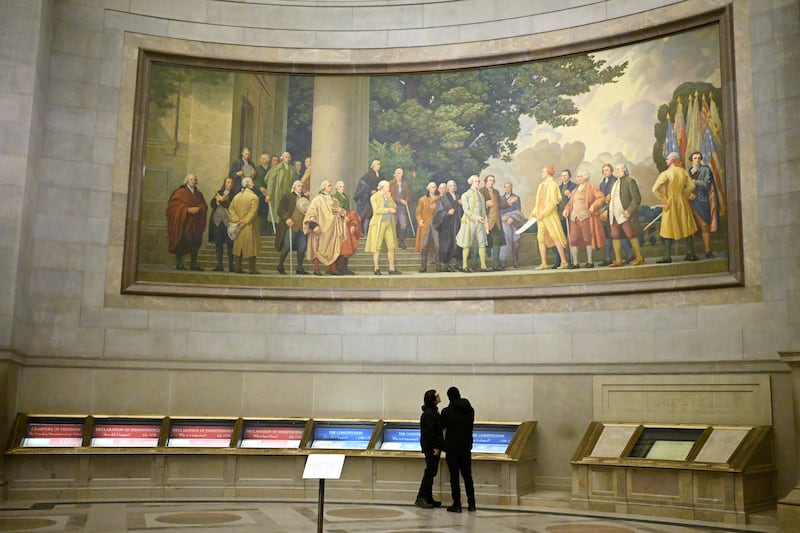
The Founding Fathers understood this truth when they declared that we are all “endowed by our Creator with certain unalienable Rights.” Disagreement is healthy for a free society, even vital, so long as it remains civil. But when political opponents are no longer seen as fellow citizens, history shows what follows.
Regimes across time have first labeled their enemies as barbarians, vermin or even slaves before the killing began. America is not and has not been immune.
The pattern is as ancient as history itself. The Egyptians portrayed foreigners as embodiments of chaos threatening the divine order, which justified conquest and subjugation as sacred duty.
The Greeks branded outsiders “barbarians,” and Aristotle argued that some peoples were “slaves by nature,” fit to be ruled because they were less than fully rational. These were not abstract theories. They normalized the enslavement and exploitation of entire peoples.
While in the ancient world this dehumanization took the form of conquest, slavery and cosmology, today it has evolved into propaganda, ideology and power. Abraham Lincoln recognized that “a house divided against itself cannot stand.” He recognized that a country cannot endure if it is fundamentally divided, not by differences in opinion, but by the notion that those who oppose us are dehumanized enemies rather than human opponents. He also provided that it is possible to be powerful without dehumanizing our opponents.
This is not a call for us to be passive in our convictions or to simply bend our values. Rather, it is possible for us to recognize dehumanizing rhetoric for what it is and still stand firmly in our convictions and demand civil discourse as the venue for our debate.
For decades, popular culture, university campuses and major newsrooms have gradually normalized the framing of political opponents as existential threats.
Media attacks on political thought began when America was founded with intense partisan criticism aimed at George Washington in the 1790s. Conservatives are not “wrong”; they are “fascists,” “MAGA extremists,” “Nazis” or a “threat to democracy.” Hillary Clinton’s “basket of deplorables” dismissed tens of millions of Americans as morally irredeemable. President Joe Biden repeatedly framed anyone who supported President Donald Trump as the greatest danger facing the nation.
However, it would be irresponsible to deny that many of those on the right have done the same thing, portraying liberals and progressives as “traitors,” “child groomers” or radical enemies bent on destroying America from within. Some conservative voices have framed the Democratic Party not as misguided opponents but as an existential threat, “the enemy within.”
We must call on every American, regardless of party, to reject the language of dehumanization.
This is not healthy debate, it is demonization. It creates a permission structure for radicals who conclude that punching, harassing or even assassinating “fascists” is not violence but a moral necessity.
Genuinely evil and dangerous ideologies, including racism and fascism, unfortunately exist. We shouldn’t pretend otherwise. The answer to them isn’t silence or censorship. It’s going back to something simpler: recognizing inherent human dignity while also expressing disagreement. Disagreement helps a free society grow. Dehumanization destroys it.

I went to that tent 10 months ago expecting an argument. Instead, I witnessed the destination that dehumanizing rhetoric has always been traveling toward. Charlie Kirk should not have been reduced to an ideology, nor should anyone else. We must call on every American, regardless of party, to reject the language of dehumanization.
Only then can we honor Charlie’s legacy, defend our convictions without apology, and restore the debate a free society requires. We should do it now, before someone else learns this lesson the way I did.