

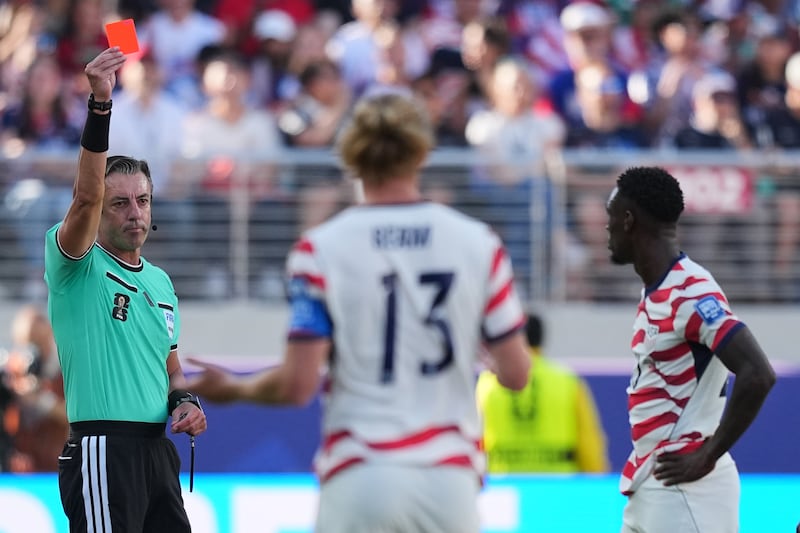

FIFA on Monday rejected Belgium’s appeal to keep U.S. star player Falorin Balogun on the bench ahead of their Monday evening match after the organization reversed the red card against him after a call from President Donald Trump.
Trump spoke Monday in the Oval Office about the controversy over the red card reversal.
The United States men’s soccer team is set to take on Belgium in the round of 16 but would have had to do so without Balogun after he received a controversial red card in the Bosnia-Herzegovina game that normally would have made him sit out the next match.
The U.S.-Belgium game is set for 6 p.m. MDT and will be played at Lumen Field in Seattle. The U.S. is hosting the World Cup, along with Canada and Mexico.
The penalty itself caused debate over whether the referee’s call was too harsh. The referee watched a video replay in slow motion before making the decision.
Trump reportedly called FIFA World Cup president Gianni Infantino on July 1, urging him to review the penalty. On Sunday, FIFA reversed Balogun’s suspension and Belgium was allowed to appeal.
FIFA announced Monday, just hours before kickoff, that the appeal was denied. The Royal Belgian Football Association said in a statement that it was “astonished” by the decision to let Balogun play and the appeal was deemed “inadmissible” by FIFA.
Here’s what to know:
Balogun’s red card creates debate
The U.S. team celebrated a 2-0 win, but players and fans were angry about the second-half red card. It brought into question whether other global stars, like Argentina’s Lionel Messi, have avoided a similar punishment.
The red card was debated over whether it should have been deemed an intentional tackle against the Bosnia player or an unintentional hard tackle.
U.S. coach Mauricio Pochettino said it was “never intentional.”
“If the intention is to damage the opponent, OK, I understand. But that never was,” he said. “It was a normal action in football that you are fighting for the ball and your feet land.”
The call was criticized by Thierry Henry, a Fox Sports World Cup analyst. He said the referee needed to have common sense.
“Where is the player supposed to put his foot there in that situation?” he said.
Trump’s relationship with FIFA
The president has never claimed to be a soccer enthusiast, but since the World Cup came to North America, with games in the U.S., Canada and Mexico, he’s embraced the global phenomenon.
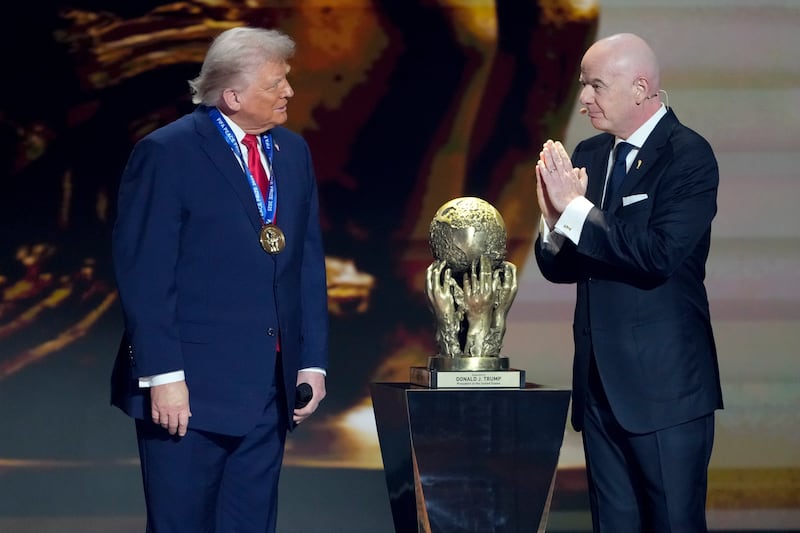
In August of last year, he announced that the World Cup draft would be hosted at the Kennedy Center for Performing Arts in Washington, D.C. Infantino was beside him during the announcement in the Oval Office.
Infantino at the time presented Trump with the World Cup trophy, saying only “winners” are allowed to hold it.
The draw happened in December, which allowed teams to see who they would face off against in the tournament’s early stages. Mexican President Claudia Sheinbaum and Canadian Prime Minister Mark Carney also attended.
Infantino delivered remarks and presented Trump as the recipient of the World Cup peace prize. He said the award goes to an individual who has an “unwavering commitment to advancing peace and unity throughout the world.” Trump said the award was one of the “great honors” of his life.
Trump’s call to Infantino
The New York Times first reported that Trump had given Infantino a call after Balogun received the penalty.
Shortly after the game, Trump administration officials, including Commerce Secretary Howard Lutnick and Andrew Giuliani, the executive director of the White House task force on the World Cup, were engaging lawyers to help the U.S. Soccer Federation appeal the call to FIFA.
FIFA has rules against appeals. However, on Sunday it was announced that the organization reversed Balogun’s suspension and that he’d be eligible to play in Monday’s match against Belgium.
They argued that the referee should not have used slow-motion video replay to determine the penalty.
The reversal is a major decision. The last time FIFA allowed a player to play in a game they otherwise would have been suspended from was in 1962.
What a red card means
Referees use yellow and red cards to enforce the rules of the game, keep the peace and enforce penalties.
Yellow cards serve as a warning to a player over their conduct. It’s a reminder to the player to proceed with caution for the rest of the game. Things like reckless tackles, arguing, wasting time or unsportsmanlike conduct are all things that could earn a player a yellow card. Earning two equates to a red and an automatic ejection from the game.
Referees use red cards for more serious offenses. Players can earn red cards for unsportsmanlike conduct, violent, abusive or offensive behavior, or insulting other players, among other serious offenses.
Players who receive red cards are ejected from the game for the rest of the game. Once ejected, the coach can’t replace them, meaning the team must play with one less man on the field. During the World Cup, they can’t play in the next game.
Belgium’s fury and response
The Belgium team was reportedly given the right to appeal FIFA’s decision to suspend Balogun’s red card, Fox News reported.
RBFA has requested a full explanation from FIFA over the decision, The Athletic reported.
“To be clear, as of this moment, the RBFA has still not received any decision or any explanation from FIFA regarding this matter. It therefore has no alternative but to challenge the player’s eligibility for the upcoming match,” the organization said.
Belgium coach Rudi Garcia mocked the decision, saying he didn’t know that in FIFA offices “the fifth of July was the first of April in Europe.” He was alluding to April Fools’ Day.
“The Belgian federation does not defend itself, it does not protect the national team. She defends football in general, she defends her integrity, her ethics. I think it’s the first time in history of the World Cup that there is this kind of decision,” he said through a translator.
He declined to say whether he thought Trump impacted FIFA’s decision.
RBFA said in a statement that FIFA has “refused to respond” to their legitimate requests. Additionally, they said they have no received any decision or explanation.
“Regardless of the sporting outcome of this match, the RBFA is deeply concerned by the course of events and will continue to fight in the coming hours, days and months in (defense) of the fundamental principles of ethics, fair competition, and the interests of football as a whole,” the organization said.
Critics say it’s going to open the flood gates for appeals and game-time decisions being reversed. In fact, United Kingdom Labour Party of Parliament Noah Law is urging FIFA to delay a player’s red card until after the World Cup is over.
Trump addresses red card controversy Monday in the Oval Office
During a ceremony Monday morning in the Oval Office, Sen. Ted Cruz, R-Texas, thanked Trump for the call.
“On behalf of all Americans, thank you for getting rid of that ridiculous red card,” he said.
Trump remarked that it was “interesting.”
“There was a reason the FIFA trophy sat here for as long as it did,” Cruz replied.
Addressing the media, Trump also said he didn’t think it was a foul and he didn’t tell FIFA what to do and all he did was ask for them to review it again.
“I didn’t think it was a foul, I thought it was two great athletes that crashed into each other and got entangled ... that was not a guy punching somebody in the face or anything, that would be different,” he said.
Trump went on to say that he didn’t tell Infantino what to do and believes that a committee made the decision to reverse the red card. He said had Balogun not been able to play, it would have been a “stain” on the team’s record, and with both teams having their best players on Monday evening, it will be a fair match.
“Let’s say we lost him and we lose the game, it would be a terrible thing. So, I think they made a really brilliant decision. I think the referee’s call was horrible,” Trump said.
Infantino responds
Infantino responded to the online outrage as the controversy continued to play out just hours before the game is set to begin.
He acknowledged the public comments regarding the disciplinary committee’s decision.
“FIFA’s judicial bodies are independent. They operate autonomously, apply the FIFA Disciplinary Code, and decide cases based on the applicable regulations and the specific facts before them. Their independence is essential to the credibility and integrity of football, and this must always be respected,” he said in a statement.
Infantino said he regularly discusses matters related to the World Cup with Trump. On this matter, he said he received a call from the president, “just as I receive calls from heads of state, government officials, football stakeholders and business executives from around the world on many different issues.”
He said he explained to Trump that there was an independent body that would be examining the issue. Infantino said he reads the decisions handed down by the disciplinary committee and sometimes he is surprised by them, sometimes he agrees with the decision and other times he disagrees.
“What I always do, however, is respect those decisions and the autonomy of the bodies that make them,” he said. “Whether we personally like a decision or not is irrelevant. Respect for independent institutions and the rule of law is what protects the integrity of our competitions and the credibility of FIFA at all times.”