



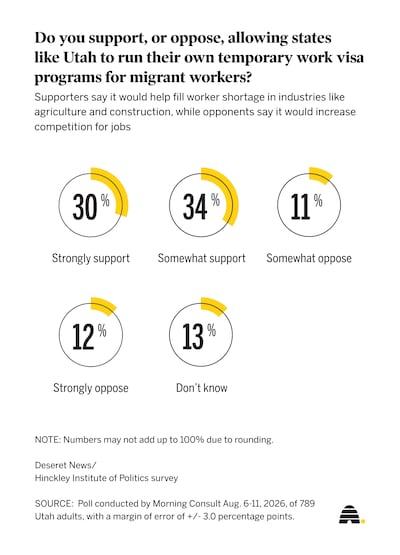
- 64% of Utah voters support letting states run visa programs for migrant workers.
- 60% of Utah Republicans also support it, despite online backlash toward policy.
- 68% support path to citizenship for immigrants in industries with labor shortage.
Utah Sen. John Curtis faced angry online immigration hawks earlier this month when he announced legislation to create a state-led migrant visa program.
Curtis framed it as a bipartisan solution enabling states to address their unique labor shortages. Conservative critics called it a form of “amnesty” threatening American workers.
The bill proposes reforms to one of the nation’s most polarizing issues. But a Deseret News/Hinckley Institute of Politics poll finds Utah voters are in favor of the change.
Nearly two-thirds of Utah voters support allowing states like Utah to run their own temporary work visa programs for migrant workers, according to the Morning Consult survey.
Support was consistent across partisan groups: 64% of all voters supported the idea, and so did 74% of self-identified Democrats, 61% of independents and 60% of Republicans.
The poll reflects the desire of Utahns for an immigration system that strengthens local communities and the state’s economy, Curtis told the Deseret News in a statement.
To be successful, immigration policies must begin by enforcing the law, according to Curtis, while “upholding the distinctly American traditions of freedom and opportunity.”
“Despite what may exist online, these results show Utahns clearly support targeted, practical ideas that transfer decision-making power from the federal government to the states to meet their workforce needs and help restore confidence in our immigration system,” he said.
What would Curtis’ bill do?
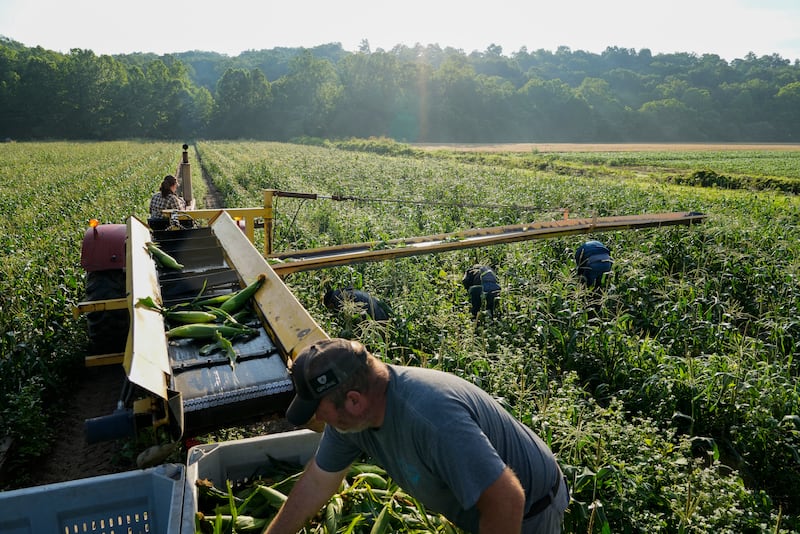
The bill, introduced with Arizona Democratic Sen. Mark Kelly, mirrors a waiver Utah requested as part of the 2011 Compact on Immigration, which never got federal approval.
Curtis’ bill would amend the Immigration and Nationality Act to form a new nonimmigrant classification for state-sponsored individuals coming to work or invest — as well as their spouses and minor children — for up to three years.
States would set criteria for employment, duration and residence, subject to Department of Homeland Security approval. States could also establish interstate compacts so visa holders could move freely within the member states.
The framework requires background checks of visa applicants prior to entry. Once visa holders are approved, states must allow them to apply for occupational licenses. The visa holders may not receive federal welfare benefits.
Upon announcing the bill, Curtis touted what he called “rigorous federal vetting,” which would include background checks of applicants and investigations into complaints of U.S. workers being displaced by the guest worker program.
States can require visa holders to make a deposit refunded upon departure. If federal agencies find more than 3% of visa holders are overstaying, a state must implement a bond of $4,000, and their visa quota will be reduced by 50%.
But in addition to these incentives for compliance, the bill would allow visa holders who have been in the U.S. illegally since Dec. 31, 2016, to gain legal status if they undergo a background check and pay a $1,000 “penalty.”
This legal pathway, while popular with business owners, is politically unfeasible because Americans remain skeptical that an expansion of legal immigration will be followed by enforcement, said Mark Krikorian, executive director at the Center for Immigration Studies.
“The people calling for large-scale legalization are going to have to re-earn the public’s trust because no one believes the promises that if today’s illegal immigrants are legalized that will solve our problem,” Krikorian told the Deseret News.
The underlying problem with the type of legislation proposed by Curtis, according to Krikorian, is it is built on the assumption that employers should be able to base their business models on the existence of cheap foreign labor.
In a continent-wide economy like the United States of America, isolated labor shortages are “market signals” that can be met by businesses doing more to recruit, pay or educate workers that already live here, Krikorian said.
Krikorian, who opposes mass immigration, was not surprised by the poll results. While it may look good on paper, history shows temporary programs become permanent, he said, and state-level immigration policies always impact other states.
Path to citizenship supported
But Utah voters appeared comfortable with the potential long-term implications of the “temporary” visa program.
Nearly 7 in 10 Utah voters said they support offering a pathway to citizenship for immigrants working in “industries with labor shortages,” like agriculture or construction, if they pass a background check and pay a fine.
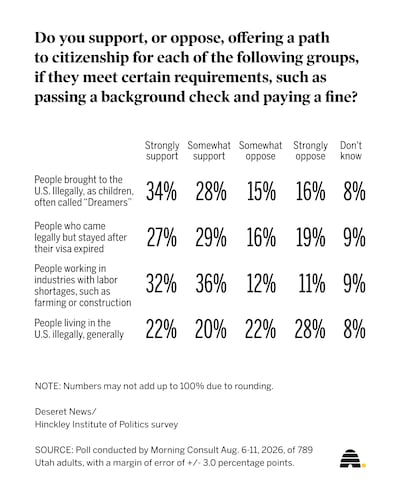
Support remained high among Republicans, at 61%, rising to 65% among independents and 83% among Democrats.
A majority of Utah voters also supported offering a pathway to citizenship to people brought to the U.S. illegally as children, and to those who arrived in the U.S. legally but who chose to stay after their visa had expired.
Republicans in Utah were more split in these cases, with a narrow majority of 51% supporting legal pathways for so-called “Dreamers” and 47% supporting a path for immigrants who overstayed their visas.
However, Republicans were more united on opposing amnesty for immigrants in the country illegally “generally,” or those who do not fit one of the exceptions of being a child at the time of entry, a high-demand laborer or a former visa holder.
The Deseret News/Hinckley Institute poll, conducted Aug. 6-11 among 789 Utah voters, reflects other opinion surveys showing an appetite for nuance on immigration, National Immigration Forum president Jennie Murray said.
Americans, across state and party lines, consistently say they want an orderly system without the chaotic surges under President Joe Biden, and an open process for new immigrants to come here, Murray told the Deseret News.
“The very loud voices on X ... are not representative of where Americans are on the issue,” she said. “Americans want longtime contributors who have not committed felonies to be able to continue to contribute and they want states to be able to decide.”
While immigration will always be a federal issue, the impacts of immigration policy are felt most acutely at the state level, Murray said, adding it makes sense to allow states to take the lead in requesting and overseeing migrant labor.
Despite many voters agreeing on a balanced approach to legal immigration, Murray acknowledged it will be hard for lawmakers like Curtis to make a move until the “moderate majority” wields more power than the partisan extremes.
Curtis’ bill has yet to receive committee consideration. Other bipartisan proposals, like the Dignity Act, have failed to make much progress in the narrowly divided Congress.