

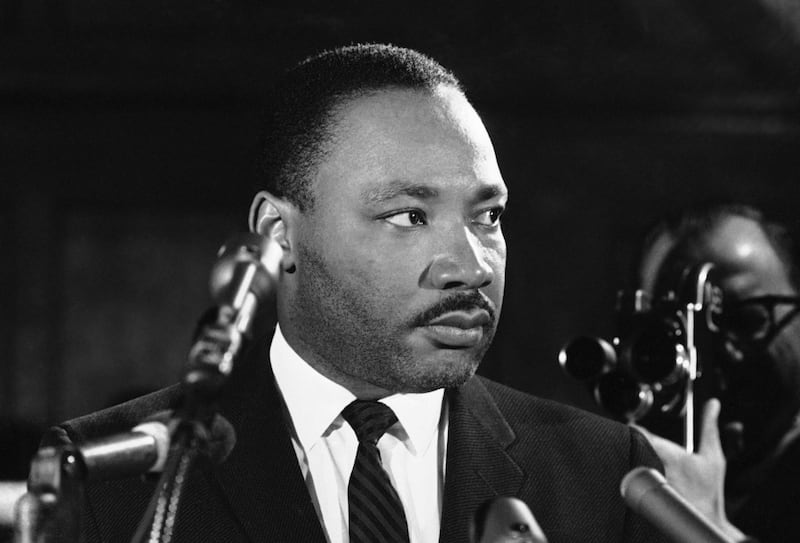
My interest in the life of Martin Luther King Jr. grew throughout my summer in Washington DC. It started at the Smithsonian Castle, where I viewed an original typed draft of his famous “I Have a Dream” speech.
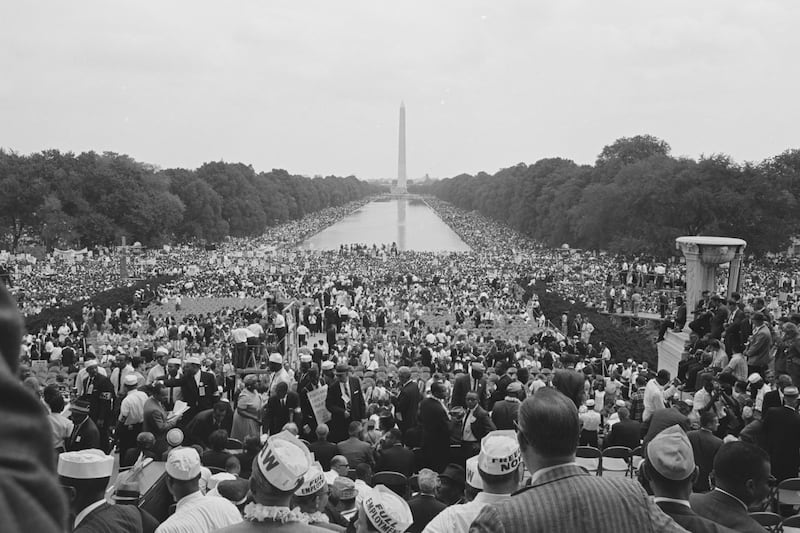
I pored over the words he planned to say, but ultimately did not. I remembered annotating that same speech in my high school English class, and years later, standing at the Lincoln Memorial, I found myself where King stood on Aug. 28, 1963, when he addressed the masses at the March on Washington.
One morning, I woke up early to go on a run to the MLK monument. While there, I listened to some of his speeches and felt the weight of what he was able to accomplish in his lifetime — and what it ultimately cost him. His words that stuck with me most were “make a career of humanity.”
I left that morning with a tear in my eye, more determined to devote my life to serving others, and more curious to understand the philosophies of King. In doing so, I came to revere him as a Founding Father in his own right, and perhaps more importantly, as a devoted follower of Jesus Christ.
A society that punishes moral courage is doomed to fail.
When I decided to check out a book from the library for summer reading, I was immediately drawn to “The Autobiography of Martin Luther King, Jr.,” compiled and edited by historian Clayborne Carson of Stanford University. As I studied the life of King, I came to admire not only his opposition to the plagues of racism, including segregation and the economic disenfranchisement of minorities, but also his rejection of the violence and hatred that often poison social movements for change.
I learned that Martin Luther King Jr. challenged injustice with moral courage while embodying Abraham Lincoln’s aspiration of acting “with malice toward none, with charity for all.” Hope, not hatred, inspired King. This, I believe, is what separates him from many revolutionaries and politicians, both past and present. He sought not the humiliation of his opponents but their transformation.
We all know King faced criticism from segregationists. Many do not know that, toward the end of his life, he also faced criticism from a growing faction within the Civil Rights Movement that rejected his commitment to nonviolence and racial reconciliation.
Though pressured to divide, King remained steadfast, maintaining that he would rather be a man of conviction than a man of conformity. This, his moral courage, is what I admire most. I believe King would approach the polarization we face today by being willing to stand up for what he believed was good and just, no matter the consequence.
He was willing to stand up not only to his political adversaries but also to his friends. And “standing up” never included violence or dehumanization; instead he used “the creative weapon of love.” My impression from my studies of King is that his overall goal was not simply equality. It was the creation of what he called the “Beloved Community,” a society where those with differences are committed to peacemaking while “disagreeing better,” as Gov. Spencer Cox has encouraged.
Some may say it is naive to be so idealistic, but I think a potential diagnosis for the affective polarization in our country is not only a lack of the moral courage King embodied, but a society that discourages it. Simply put, a society that punishes moral courage is doomed to fail.
“Can our society produce another Martin Luther King Jr?” a mentor asked me.
Only if we cease to see those with whom we disagree as a threat to be eliminated, but rather as brothers and sisters to be persuaded. Only if we make room in our circles for those who might have an unpopular opinion or idea. Only if we stop fearing each other and start inspiring one another. Only when we fully realize what King expressed in his Letter from Birmingham Jail, “All men are caught in an inescapable network of mutuality, tied in a single garment of destiny.” Then and only then will we discover another Martin Luther King Jr. in our midst.