

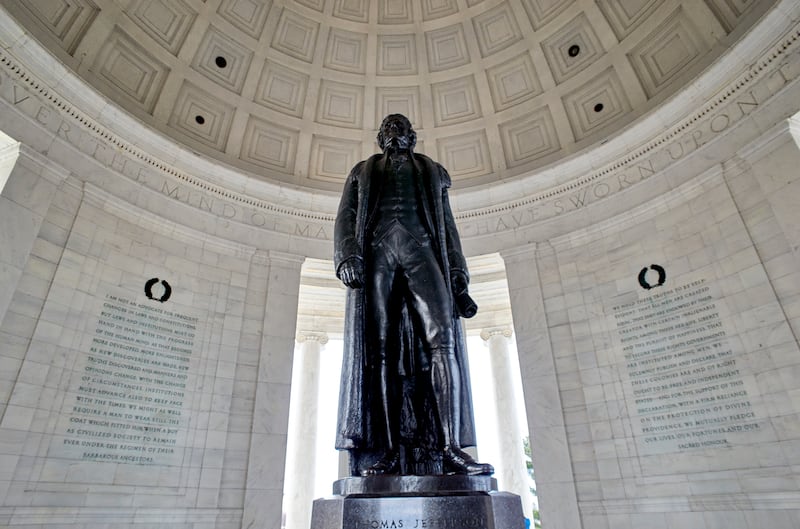

Editor’s note: This piece was adapted from “Thomas Jefferson: America’s Flawed Founder of Freedom,” recently published in We Proceeded On Vol. 52, No. 2 (May 2026): 6-24 by Jay H. Buckley, Brynn Hiatt Tingey and Kate Stahlecker.
Few of America’s founders were as central to the birth of a new nation as the one who drafted the Declaration of Independence — Thomas Jefferson. Yet Jefferson remains criticized as hypocritical for advocating freedom while simultaneously owning more than 610 enslaved people over his lifetime.
Little attention has been paid to how frequently and consistently Jefferson sought to legally abolish slavery throughout his life — something most Americans know little about.
We don’t know all the reasons why Jefferson’s personal actions, driven to some degree by racial prejudice and economic dependence, fell far short of his public rhetoric. But it is also clear that Virginia laws prevented Jefferson from legally freeing those he held in bondage — and until those state and federal laws changed, freeing his slaves would have meant their enslavement by someone else unless they left Virginia and Jefferson provided for their livelihood elsewhere.
Rather than dismissing or celebrating Jefferson uncritically, Americans must understand him as a flawed but pivotal figure. As illustrated below and referenced in the full 19-page manuscript, he consistently opposed the brutal institution of slavery in principle — later claiming he did all he could for a country unready for total abolition.
Examples that follow illustrate his surprisingly prodigious efforts to enact laws increasing individual freedom.
20 examples of Jefferson’s slavery opposition
1. 1769: Jefferson proposed reforming Virginia’s strict 1723 law preventing independent emancipation — introducing a measure to allow slaveholders the discretion to do so. The proposal was fiercely rejected in the House of Burgesses.
2. 1770: He defended Samuel Howell, a mulatto man suing for his freedom, arguing that humankind possessed inalienable natural rights regardless of race. During Jefferson’s legal career (1767–1774), he litigated six similar freedom suits pro bono, paying fees and court costs out of his own pocket. In each, he argued slavery had no legitimate basis in common or statutory law, yet he lost every case.
3. 1774: Jefferson authored “A Summary View of the Rights of British Americans,” which condemned the slave trade and called for the “abolition of domestic slavery.” Realizing he could not win freedom in the courtroom, he appealed to King George to abolish the domestic slave trade and exclude all further importation from Africa.
4. 1776: He proposed in the Virginia constitution that “No person hereafter coming into this country (Virginia) shall be held within the same in slavery under any pretext whatever” — a provision not included in the final ratified version.
5. 1776: Jefferson wrote in the Declaration of Independence: “We hold these truths to be self-evident, that all men are created equal, that they are endowed by their Creator with certain unalienable Rights, that among these are Life, Liberty and the pursuit of Happiness.” Historian Walter Isaacson recently called this the greatest sentence ever written — becoming a moral standard that many other Western democracies have striven for.
Jefferson’s draft blamed King George III for the continued trans-Atlantic slave trade. “(The king) has waged a cruel war against human nature itself, violating its most sacred rights of life and liberty in the persons of a distant people who never offended him, captivating and carrying them into slavery in another hemisphere … determined to keep open a market where MEN should be bought and sold” — all while “suppressing every legislative attempt to prohibit or to restrain the execrable commerce.” This controversial subject was dropped from the final version so the vote for independence could be unanimous.
6. 1777-78: Introduced a bill to the Virginia State Legislature preventing further slave importation. In this bill, “all persons who shall be hereafter imported into this Commonwealth by Sea or by Land whether they were bond or free in their native Country … shall from thenceforth become free and absolutely exempted from all Slavery or Bondage.”
7. 1779: Proposed a law (unsuccessfully) in Virginia for gradual emancipation.
8. 1779: Authored “Virginia Statute for Religious Freedom,” enacted in 1786, which played a critical role in protection for Virginia abolitionist groups such as the Quakers.
9. 1784–87: Jefferson proposed banning slavery in the western territories as part of the Ordinance of 1784 — a provision that failed by one vote. Three years later, Congress adopted the Northwest Ordinance of 1787, prohibiting slavery in the Northwest Territory using Jefferson’s language: “There shall be neither slavery nor involuntary servitude in the said territory.”
10. 1785-87: Denounced slavery and encouraged emancipation in “Notes on the State of Virginia,” while also summarizing his own prejudicial views held by Southerners of the time.
11. 1788: Declined invitation by French journalist Brissot de Warville to join an anti-slavery society, but offered his heartfelt blessing: “You know that nobody wishes more ardently to see an abolition not only of the trade but of the condition of slavery, and certainly nobody will be more willing to encounter every sacrifice for that object.”
12. 1791: Advocated for a Bill of Rights in correspondence with James Madison to guarantee individual freedoms. Cheered in 1794 when the U.S. banned the exportation of slaves.
13. 1794-1826: Freed several of his enslaved community during his lifetime — including Robert Hemings and James Hemings. Joseph Fossett, Burwell Colbert, Madison Hemings, John Hemings and Eston Hemings were also freed in his 1826 will.
(The Virginia law changed from the Revolutionary era until 1805, allowing manumission in one’s will, as long as all other debts had been paid. But still the law was nearly ironclad that freed blacks must leave Virginia altogether).
14. 1803: Jefferson prohibited the buying and selling of enslaved people in the Louisiana Purchase.
15. 1807: Urged Congress to pass legislation to “withdraw the citizens of the United States from all further participation in those violations of human rights which have been for so long continued on the unoffending inhabitants of Africa.” During the ratification of the Constitution in 1787, the states had agreed Congress would not abolish the slave trade for 20 years.
16. 1807: Signed the “Abolition of the Transatlantic Slave Trade Act” into law as president, a measure prohibiting the importation of slaves into the United States.
17. 1809: Argued Blacks’ right to liberty belonged to everyone and did not depend upon equality of abilities in a letter to French Catholic priest Henri Gregoire.
18. 1814: Declined Edward Coles’ invitation to preside over an anti-slavery society, but urged him to take the national lead for emancipation. Coles had inherited a plantation and slaves but had to leave Virginia and travel to the Illinois Territory in order to free them. “The love of justice and the love of country plead equally the cause of these people,” Jefferson wrote, but “the hour of emancipation is advancing; in the march of time, it will come.”
19. 1820: Opposed the Missouri Compromise, which made slavery legal in western territories south of the 36’30” parallel. This arbitrary line challenged the preservation of the Union and created two Americas: one free and one enslaved. Jefferson called the compromise “a fire bell in the night,” opposing any line allowing slavery to exist.
20. 1820s: Advanced gradual emancipation and supported free Blacks leaving the country as viable solutions.