

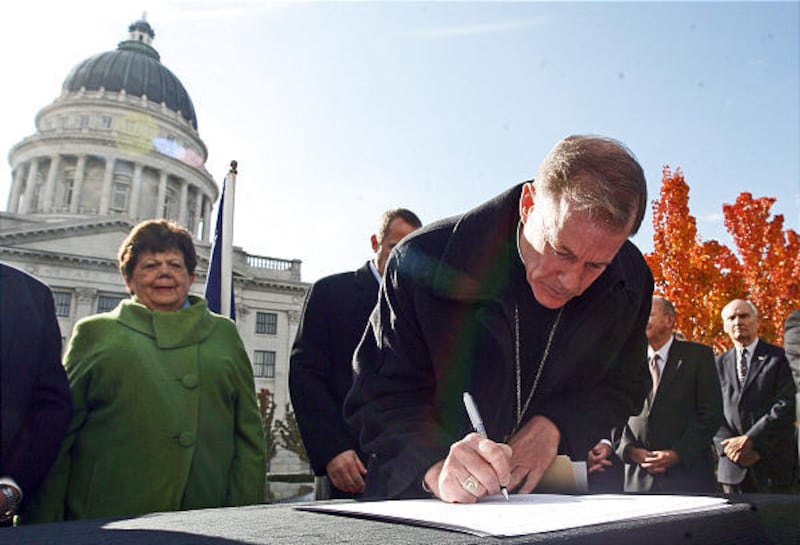


In 2010, Utah political, business and religious leaders came together to author the “Utah Compact,” the fundamental principles they see as guiding immigration policy and enforcement. Sen. John Curtis introduced this framework in Congress but is facing opposition. Is Curtis’ action relevant to this debate?
Cowley: This foundational outline balances the rule of law with keeping families together, and acknowledges the role immigrants play in the economy and community. It has aged extremely well. The provision of state-led visas honors states’ rights while giving them flexibility to meet the needs of their local economies. When the Trump administration dropped off busloads of immigrants in sanctuary states, leaders admitted they didn’t have the resources to manage that burden. This concept puts states in the driver’s seat.
Immigrants are an important component to the tapestry of America. Utahns aren’t seeking eradication of immigration but want balance and safety. Trump led out on border security — great. Now what? Curtis is thinking ahead on how to improve legal immigration, meet our workforce needs and enhance our communities.
Pignanelli: “Everywhere immigrants have enriched and strengthened the fabric of American life.” — John F. Kennedy
As a native Utahn, I am extremely grateful to live in the greatest state among the most wonderful people on the planet. Everyday occurrences remind me of this, as does the history of Utahns’ major accomplishments that captured global attention over the last 179 years. The Utah Compact ranks among these outstanding achievements.
In 2010, the state was swamped with outrageous rhetoric from elected officials and activists that demeaned immigrants, regardless of status. Most Utahns were appalled. This compelled an incredible effort among religious, business and community leaders to craft an approach to promote commonsense immigration reforms that strengthened the economy while securing important talent. The compact changed the trajectory of the discussion, outlining compassionate efficiency that respected the law. As with most tremendous local successes, the compact was effectuated through the skillful, necessary counsel of The Church of Jesus Christ of Latter-day Saints.
The Utah Compact is a manifestation of what is best about our state. Indeed, I have yet to hear a rational objection to it.
As the grandson of Italian immigrants and the great-grandson of Irish immigrants, I have deep respect for those who risked so much to uphold our American principles.
Curtis is commended for once again exuding common sense by sharing the wisdom in this document with Congress and the country.
Lt. Gov. Deidre Henderson is engaged in a standoff with President Donald Trump’s Department of Justice for her refusal to hand over Utah’s voter rolls. The DOJ even threatened to hold Utah’s top election official in contempt. Henderson cites Utah’s privacy laws and the state’s independent election authority, while the Trump administration cites national security. Which will win out, and what will the political implications be in either scenario?
Cowley: Audits show Utah elections are secure. Utah led out on mail-in voting before it was cool or mandated by COVID-19 chaos. Through this experience, Utah has pioneered how to do it right.
Secure elections are foundational to democracy. Only actual citizens should vote. Assertions that showing ID will result in voter suppression are ridiculous and racist. This is what Sen. Mike Lee’s Save America Act gets right. What it gets wrong is ending mail-in voting. Ironically, mail-in voting is how Lee won his 2010 primary. As a lowly staffer, I witnessed his consultants’ inspired strategy encouraging voters to sign up for mail-in voting.
Pushing back against this federal overreach is exactly what Utahns expect, and our laws require. We have a deep-seated distrust of the federal government that stems back before statehood, regardless of what party is in office.
Henderson’s actions are courageous. I am not advocating for her incarceration, but it would be iconic to have mug shot campaign T-shirts. Besides, mug shots for politicians are like Tamagotchis in the early 2000s — all the cool kids have one.
Pignanelli: The United States House of Representatives Committee on House Administration states on its website, “Republicans believe … all lawful votes must be counted according to state law. Article 1, Section 4 of the Constitution explains that the states have the primary authority over election administration, the ‘times, places, and manner of holding elections.’ Conversely, the Constitution grants Congress a purely secondary role to alter or create election laws only in the extreme cases of invasion, legislative neglect or obstinate refusal to pass election laws.”
This important observation by Chairman Bryan Steil and the committee, reflecting the founders’ vision, will prevail and should be shared with colleagues and activists.
The Deseret News revealed Utah was once again named best state in the nation by U.S. News & World Report — a four-peat. We must be doing something right, or are we?
Cowley: This award recognizes success in the economy, infrastructure, business creation, etc. Gov. Spencer Cox correctly observed, “Utah’s success has never been about government. It comes from Utahns who serve, build, innovate and invest in the future.” That’s the secret sauce (no, not fry sauce).
Pignanelli: The incredible legacy of the early pioneers who escaped persecution influences all Utahns positively, regardless of their personal characteristics. This is why we are special.