

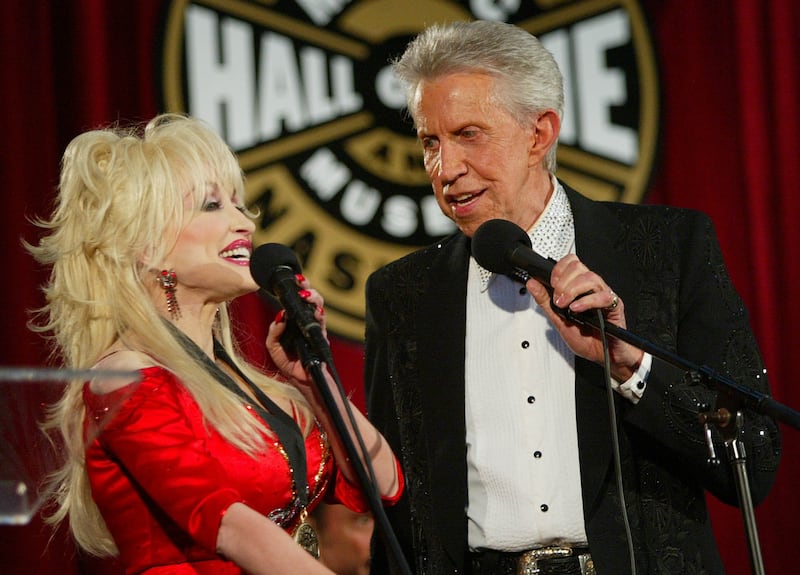

We’re hearing a lot, and will hear more, about the late Dolly Parton — her remarkable personal story of rising from poverty in the East Tennessee hills to international celebrity and wealth; her extraordinary vocal gifts and songwriting talent; her wit and self-deprecating humor; her kindness, compassion and exceptional generosity; her nearly sixty-year marriage to the publicity-avoiding small business owner Carl Dean; her preternatural ability to be loved and admired by nearly everyone (including by people who loathe and detest each other).
When I think of Dolly, though, in my mind’s eye I picture a 22-year-old girl who was still largely unheard of. Let me tell you why.
I grew up in the 1960s in the heart of Appalachia, north central West Virginia, coal mining country. My four younger brothers and I loved country music. We were regular viewers of syndicated country music television shows, such as the Wilburn Brothers and Porter Wagoner. On Saturday nights, we tuned in to the WWVA Wheeling, West Virginia “Jamboree” and, when the radio signal was good, to the WSM Nashville, Tennessee “Grand Ole Opry.”
We followed all the big stars of the era — Loretta Lynn, Hank Snow, Johnny Cash, Marty Robbins, Tammy Wynette, Merle Haggard, Buck Owens, Melba Montgomery, George Jones. Occasionally, nationally known country artists would perform at the Fairmont Theater in Fairmont, West Virginia, 40 minutes or so from where we lived. Sometimes our parents would take us to the show.
In 1968, when I was 12, the Porter Wagoner Show came to Fairmont. Porter wasn’t in the first tier of stars with people like Johnny Cash and Loretta Lynn, but we loved his television show. He himself was a solid, old-school country singer and he often featured top-tier guests. We loved his stage band — the Wagon Masters — featuring the dancing fiddler Mack Magaha, banjo innovator Buck Trent, and upright bass player and comedian Speck Rhodes (with blacked-out front teeth, decked out in a garish red plaid suit).
The show also featured a “girl singer” who performed solos as well as duets with Porter. From 1960 to 1967, it was Oklahoma born and bred Norma Jean Beasler. Shortly before the performance in Fairmont, however, Norma Jean had left the show and been replaced by Miss Dolly Rebecca Parton from Pittman Center, Tennessee, on the banks of the Little Pigeon River.
Young Dolly was the hillbilly girl from central casting — petite, hourglass figure, big hair, bubbly personality, and the voice of an angel. We had seen her on TV and had in the house her new album with Porter, “Just Between You and Me,” but seeing and hearing her “live and in person” was electrifying. I learned the meaning of the phrase “stage presence” that day. I assure you that every boy in that theater — certainly including me — was head over heels in love.
Country artists are famous — deservedly so — for their gratitude and loyalty to their fans. It’s a key part of the country music ethic. They never forget that the celebrity they enjoy, and the money that comes with it, are gifts from the country music-loving public. Signing autographs after shows is considered an obligation, not an act of noblesse oblige. It’s a kind of giving back.
Well, after the show at the Fairmont Theater, Porter, Dolly and the Wagon Masters all came out from behind the curtain to greet the audience and sign autographs. People lined up to get them, not only from Porter and Dolly, but from Magaha, Trent, Rhodes and the others. All of them stayed for a while, but most, including Porter, disappeared after providing a few dozen fans with autographs.
Dolly, however, remained until every soul in the room who wanted her autograph got it. Even then, she stayed to chat with people for another 20 minutes or more. When the five George boys reached the front of Dolly’s line, she asked us our names, shook our hands, then picked up two-year-old Eddy and gave him a kiss. We have a photograph. It’s a family treasure.
I can’t say that the encounter led me to prophesy that someday “Miss Dolly,” as Porter always introduced her, would become an American icon and an international superstar. To be honest, I was as surprised by that — or almost as surprised — as anyone. It’s just not the kind of thing that happened to “girl singers” in hillbilly bands. But I can say that on that day I got a glimpse of the extraordinary musical talent and remarkable personal qualities that did, in the end, bring her the worldwide acclaim, and even prompted the president of the United States to order flags to be flown at half-mast to honor her when she died.