

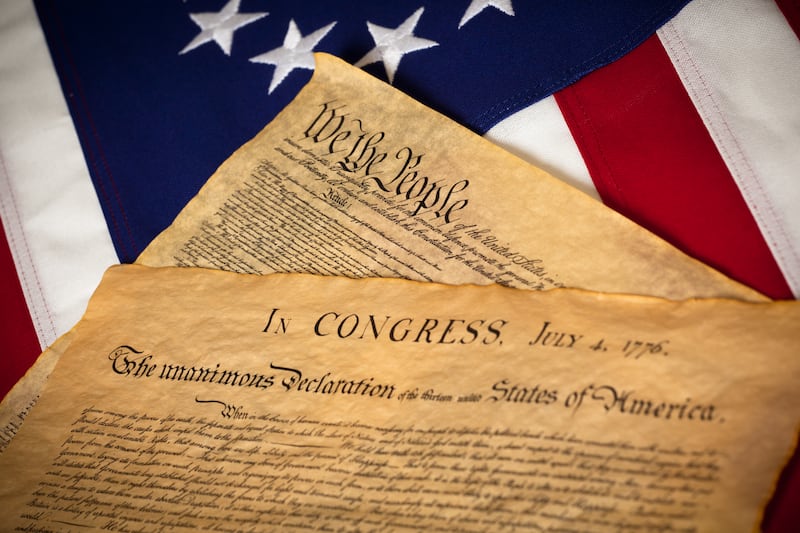
Constitution Day, on Sept. 17, marks 239 years since the Constitutional Convention of 1787 concluded in Philadelphia. In Utah, Gov. Spencer Cox has designated September as “American Founders and Constitution Month.”
This year as you read and celebrate the Constitution, take a moment to consider that what is not in the document may be just as important as what is there.
The word federalism, for example, appears nowhere in our Constitution. Yet it permeates every article of the Constitution.
From the elections of our national officials to the framework distributing governing power and responsibility between the national government and states, federalism structures our constitutional system of government.
Federalism emerges from the Constitution wherever the national government’s powers are defined or limited, where states are mentioned, and their integrity is protected or powers limited. This is why the United States has what is called a federal system of government.
Without naming it, the 10th Amendment reaffirms that federal system by proclaiming that the powers not delegated to the national government or denied to the states belong to the states or the people.
But which of those powers reside with the states, and which are retained by the people? The answer to that question is also not found in the Constitution. Rather, it is answered by the citizens of each state in their state constitutions.
It follows that the U.S. Constitution alone offers but an incomplete description of the American constitutional order. “We the People” is part of a larger system that also includes the 50 state constitutions.
This grants the people in their states considerable liberty to order and organize their governments and to establish laws and policies that fit their values, interests, and culture. The resulting diversity among states is part of the constitutional design. It allows substantial space for self-government within the states. It permits individuals to vote with their feet and move to the state whose policies best represent their own values.
Variety among states fosters novelty and competition that often results in a race to the top. Mississippi’s notable gains in elementary education provide one recent example of innovative state policy now being considered by other states.
Federalism does not guarantee good government, however. Besides protecting liberty and nurturing innovation, state authority has also been used to exclude, oppress or deny fundamental rights. The 14th Amendment, adopted after the Civil War, and other national laws protect citizenship and individual rights within all states. Federalism recognizes a role for both national-policy direction and state-policy formulation. Neither’s power is unlimited.
Insisting that national unity requires uniform laws across the country would impose one set of values on the entire citizenry and stifle a nation as large, complex, and diverse as the United States.
Yet over the last century we have watched governing authority accumulate in Washington, DC, a result of wars and economic crises, industrialization, and public demands for national action. Such reforms were justified by expansive interpretations of narrow clauses in the Constitution, such as the commerce, necessary and proper, tax and spend, general welfare, and supremacy clauses.
While this consolidation has produced important domestic achievements, they have come with a cost — an overloaded and gridlocked national government, which is expected to resolve an extraordinary range of disputes for more than 330 million people. Our public discourse is polarized, driven by a fear that losing a national election means having the opposing party impose its values on the entire nation. And national administrative agencies struggle to manage policies across radically different local conditions.
While America’s founders hoped that it would stretch from sea to shining sea, they did not form a central government intended to manage the complexity, diversity and scale of this grand nation, much less the 13 states of their era.
The way forward must include recognizing that what is contained in the Constitution must be understood in the context of what is not there — federalism, state-reserved powers and self-determination, as established in state constitutions.
The American constitutional system does not administer one people in one way. It is a union in which power is divided, rights are secured and the people govern themselves through multiple constitutional communities. This radical idea in 1787 still holds the best potential to build unity and protect liberty, while promoting innovation and protecting rights in the large, complex and diverse nation that we are.