



- Court-ordered map includes +14 Democratic seat and +40 Republican seats.
- Gov. Spencer Cox said this will make Utah primary elections more polarizing in 2026.
- Phil Lyman to challenge Rep. Celeste Maloy in new 3rd Congressional District.
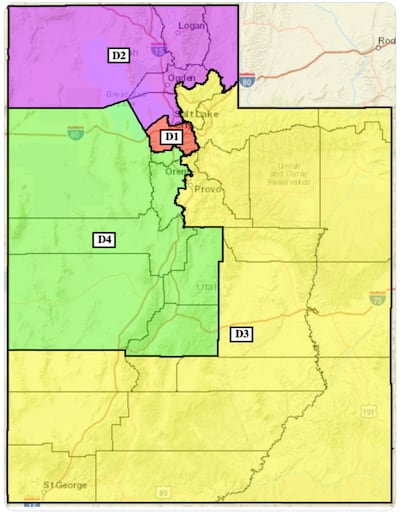
A new court-ordered congressional district map has already transformed the landscape of Utah primary elections, pushing out one Republican incumbent and potentially making the other three more vulnerable to conservative challengers.
The congressional map, which still stands despite lawsuits from the state Legislature and federal delegation, includes a Democratic seat with a 14 percentage-point margin, and three Republican seats with margins of 38-42 points, an Inside Elections analysis found.
The redistricting reshuffle has given Utah Democrats a rare opportunity to engage in a competitive primary. Former U.S. Rep. Ben McAdams filed to run in the Salt Lake County district on Monday, along with several other declared Democratic candidates in the race.
But Utah Gov. Spencer Cox believes the “unbelievably safe” districts drawn by judicial fiat could do the opposite of what was intended by anti-gerrymandering activists when they sponsored Proposition 4 in 2018 and then sued the state in 2022 for amending the law.
“It certainly doesn’t depolarize our politics. Instead, I think it’s the exact opposite. I think it polarizes them even more,” Cox told the Deseret News on Friday. “Politics is going to be really interesting in the state of Utah during 2026.”

Backlash to a judge using Prop 4 to select a map drawn by special interest groups prompted legal complaints and a promised constitutional amendment. For now, Utahns are left with new congressional districts that could upend party primaries for the GOP incumbents.
Moore, Maloy tout conservative records and Trump endorsements
Last week, Rep. Burgess Owens announced he would not seek reelection after it became clear that court decisions upholding the boundaries could not be appealed in time to avoid an incumbent-on-incumbent clash in one of the new GOP-leaning districts.
Reps. Blake Moore and Celeste Maloy filed their declarations of candidacy on Monday, telling the Deseret News that their track records and endorsements from President Donald Trump would convince constituents, new and old, of their conservative credentials.
“Establishing tax policy to be permanent, I’m going to run on that, we’re reducing deficits,” Moore said. “I don’t know how you get more conservative than a strong Trump endorsement and the record that I have.”

Moore has received criticism from some GOP players for being one of the original chairs of Better Boundaries, which ran the Prop 4 ballot initiative, approved by voters in 2018 to establish a redistricting commission and guardrails on legislative map drawing.
Moore is working closely with state leadership to craft language for a constitutional amendment affirming the Legislature’s authority to change ballot initiatives like Prop 4. He said his “entire focus” is being a “credible voice” in support of the amendment.
Rep. Celeste Maloy, who barely won her Republican primary election in 2024 after a recount, said she is excited to work with communities on the east side of the state on the issues she has already championed in the south, like water management and public land access.
“I want smaller, more accountable government. I want less federal interference in our day-to-day lives, and I think that’s what the people in Utah want,” Maloy said. “We’re all after representation that takes Utah’s values and tries to apply them at the federal level.”
Rep. Mike Kennedy, who entered office last year, announced last week he intends to run in the 4th District, which includes portions of Utah County, southern Salt Lake County and western Utah. He has yet to receive a high-profile primary challenge.
Who is challenging GOP incumbents?
But both Moore, who is the fifth-ranked Republican in the U.S. House, and Maloy, who sits on the powerful appropriations committee, are already on track to face tough GOP primary opponents.
Former state lawmaker Karianne Lisonbee announced on Tuesday her congressional bid to challenge Moore in northern Utah. Lisonbee has built a reputation among state GOP delegates by sponsoring Utah’s abortion trigger law, and bills on election security and gun rights.
In an interview with the Deseret News, Lisonbee emphasized Moore’s role in passing Prop 4 which could influence the congressional majority in 2026. Moore’s home now sits within the new Democratic 1st District “he helped create,” said Lisonbee, who lives in Syracuse.
“I don’t want Utahns to forget that that’s an important part of this,” Lisonbee said. “An activist judge, has drawn new maps, and they are changing Utah, and will continue to do so for many years.”
Former gubernatorial candidate Phil Lyman filed on Monday to challenge Maloy. Lyman, who formerly represented Blanding in the state House, has campaigned in much of the 3rd Congressional District which covers 17 counties across eastern and southern Utah.

Lyman won in 11 of these counties during his 2024 primary campaign against Cox. Outside of his home county of San Juan, Lyman performed strongest in the population center of Washington County, where he won by nearly 20 percentage points and where Maloy lost by nearly 20 points.
“When the maps first came out from the courts, I looked at that district and I thought, ‘That’s a sweet district,’” Lyman told the Deseret News. “When the dust settled, and those were the districts, I felt compelled.”
Similar to his gubernatorial race, Lyman said he plans to highlight conservative policies on energy, immigration and lands. He acknowledged he is not known for “trying to fix the system” and said he will continue to try to “show the glaring deficiencies in the system.”
Lyman never conceded his primary loss to Cox. He said he felt the need to verify the election results through an independent, third-party audit first. And over the next 18 months, Lyman repeatedly accused officials of mishandling the election.
During his subsequent write-in campaign, Lyman called Cox an “illegitimate” candidate because he qualified for the primary through what Lyman said were “fraudulent” signatures instead of a delegate nomination. He still alleges “coordinated collusion” tainted the 2024 race.
But Lyman said he will gather signatures to get on the primary ballot this year. He said he believes it makes more sense to leave his options open, and said his campaign will try to meet the 7,000-signature threshold using only volunteer signature gatherers.
Where’d the maps come from?
The 2026 midterm election is shaped by the eight-year redistricting saga that preceded it.

In 2018, voters narrowly approved Prop 4, creating a redistricting commission to make map recommendations every 10 years, establishing guidelines that barred partisan gerrymandering and opening the Legislature up to lawsuits if they did not comply.
In 2020, lawmakers amended Prop 4 to ensure it followed the Utah and U.S. constitutions which give legislators map-drawing power. But when they chose a map splitting up Salt Lake County Democrats a year later, supporters of the initiative turned to the courts.
Following a landmark Utah Supreme Court ruling in 2024 that made ballot initiatives immune to most legislative changes, a district judge rejected Utah’s 2021 map and replaced it with one submitted by advocacy groups, creating a new heavily Democratic district.
A blue district in traditionally reliably red Utah could have implications for congressional majorities. But the biggest change to Utah politics may be in the three districts that have become redder, according to Taylor Morgan of Morgan May Public Affairs.
“It means that these three maps, because they are so Republican and so rural, they really do disproportionately favor a Republican candidate who is more extreme and more radical in their politics,” Morgan said.
Partisan political pressures could push toward the extremes in the urban Democratic district, too.

McAdams’ moderate reputation has quickly become the target of attacks by other candidates, like progressive former state lawmakers Nate Blouin, Kathleen Riebe and Derek Kitchen, as well as activists like Eva Lopez Chavez and Liban Mohamed.
But McAdams said on Monday he is confident Utah voters prefer consensus-building candidates who want to bring the country together. While he stood up on LGBTQ issues and Trump impeachment in Congress, McAdams said his strength is in assembling coalitions.
“I’ve never been polarizing. I try to be unifying,” McAdams told the Deseret News. “I think we’ll let the voters decide. What do they want? Do they want polarizing figures, or do they want unifying figures? So we’ll see.”