

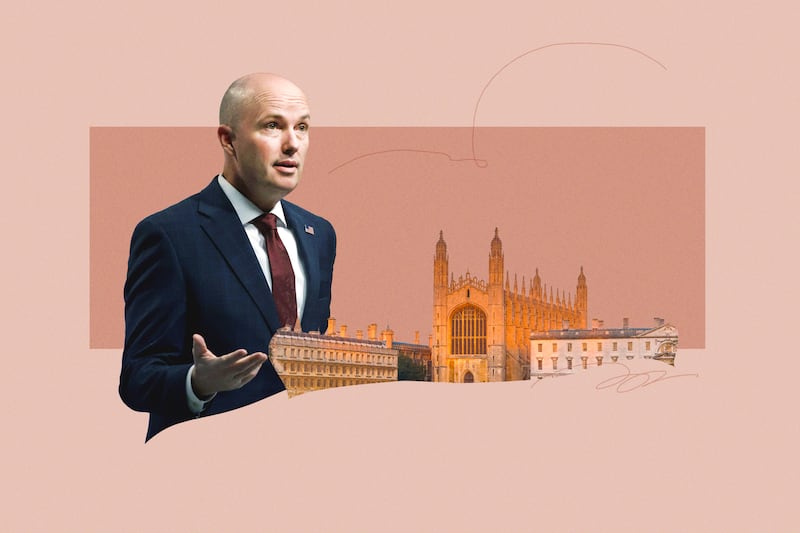

- Gov. Spencer Cox said Utah is treating social media giants like tobacco companies.
- Cox cautioned a European audience about government trying to label disinformation.
- Cox said some of reaction to Charlie Kirk's assassination was driven by foreign bots.
Utah Gov. Spencer Cox defended free speech against government overreach during the Cambridge Disinformation Summit in England on Wednesday.
The Republican pushed back against European and American participants who called for increased internet censorship to protect users from harmful content.
But the anti-Big Tech crusader also declared war on what he said is the source of online threats: social media algorithms.
Cox made a virtual appearance at the annual event which brings together experts from around the world to discuss interventions to mitigate “the harms of disinformation.”
Despite the conspiratorial chaos surrounding the assassination of conservative activist Charlie Kirk in Utah, Cox insisted governments should not dictate speech.
Instead, governments should take aim at the way platforms exploit human psychology by elevating ever more engaging, outraging and ensnaring posts, according to Cox.
“It’s one thing to say that you should be able to say what you want to say online,” Cox said. “It’s another thing to say ... ‘I’m going to employ a device ... to feed you information ... because I know I can get you addicted.’”
Recent rulings provide legal foundations for Cox’s treatment of algorithms as a dangerous drug. But some warn this could bring the erosion of free speech seen in Europe to the U.S.
Tech as tobacco?
Since Kirk’s murder at Utah Valley University in September 2025, Cox’s message that “social media is cancer” — for mental health and political rhetoric — has gone viral.
Under the national spotlight, the second-term governor has received plaudits from celebrity psychologist Jonathan Haidt and presidential nudges from top politicos.
Cox has turned the momentum into a series of campaign-ready videos highlighting his eagerness to take on the industry giants who he says are intentionally targeting children.
On Wednesday, Cox declared that now is the time to initiate a public policy revolution against Big Tech.
“We’re treating this the way we treated the tobacco companies in the 1950s and 1960s in the United States. The way we’ve looked at the opioid companies in the ’90s and the early 2010s,” Cox told his audience.
This year Utah became the second state to create a tax for the biggest online advertising companies and continued its lawsuits against social media giants Meta and TikTok.
In addition to making companies liable for the outcomes of their algorithms, Cox touted Utah legislation that gives people control of how their online data can be used.
Another area where government can get involved, Cox said, is in ensuring that social media traffic is not dominated by automated accounts run from different countries.
“I truly believe that people should be able to say whatever they want to say on social media, but we don’t have to allow bots of foreign adversaries to be able to proliferate at will,” Cox said.
The “vast majority” of dialogue in reaction to Kirk’s killing was actually coming from computer “bots” employed by adversaries “to help divide us,” according to Cox.
Immediately after the assassination on Sept. 10, media watchdogs identified thousands of inaccurate posts coming from accounts linked to China, Russia and Iran.
Is speech in the U.K. OK?
Questions directed at Cox during the event reflected a desire by media researchers, policy analysts and journalists for the government to define and remove online “disinformation.”
Cox told his audience that on this point they did not see eye to eye.
Over the past decade, the United Kingdom has seen an uptick in law enforcement actions related to social media posts deemed inappropriate by public officials.
This has created a chilling effect among publishers and users since parliament passed the Online Safety Act in 2023, requiring age verification for some internet access.
It also gives online platforms the responsibility to police what users say, leading companies to remove content out of fear that posts may come close to violating the law.
Cox warned against government efforts to classify disinformation, citing Biden administration policies that pressured companies to censor true claims about COVID-19.
“I think sometimes the reaction can be as bad, or at least add to the harms that we’re talking about,” Cox said. “If government gets too heavy handed, the conspiracy theories actually become more real.”
Cox faced questions from well-known champions of government efforts to classify and counter disinformation.
Nina Jankowicz, who headed President Joe Biden’s Disinformation Governance Board, said her goal was sharing “good information,” not “deciding what was true or false.”
But Cox repeatedly stated it was not the government’s role to be the arbiter of truth online.
It should be the opposite: to encourage a competitive social media market where points of view are debated without the discussion being determined by addictive algorithms, he said.
Are algorithms free speech, too?
This framing of social media companies as toxic and addictive has been boosted by recent judicial orders.
In March, courts in New Mexico and California ruled that Meta and YouTube designed their platforms to be addictive to adolescents in a way that harmed mental health.
This has been billed as a “watershed” moment, potentially forcing a massive overhaul of online business models, similar to the changes cigarette makers made.
But the industries under fire, and their libertarian-minded allies, argue a crackdown on algorithms is no different than Europe’s approach, and will lead to the same outcomes.
“(Cox) is seemingly trying to suggest this is different than what Europe is doing, and the direct speech regulation,“ Cato Institute fellow David Inserra said. “But algorithms, and the use of algorithms to create speech, is speech.”
U.S. Supreme Court precedent has granted the online “curation” of speech the same First Amendment protections as news articles or book stores, according to Inserra.
Inserra, who previously worked on Meta’s content policy team, called the comparison between Big Tech and Big Tobacco “deeply, deeply flawed” and “absurd.”
Social media does not have the same physical effects as nicotine, Inserra said, and it has many positive applications, like community creation and knowledge development.
The right response to the negative impacts of social media is not to regulate algorithms into submission, Inserra said. It is to educate individuals and families about healthy uses.
While Cox believes Americans need a shift in public policy, he largely agrees it comes down to the individual.
Cox told Wednesday’s audience he did not trust government to “combat disinformation.” He said he believes regular citizens can overcome the incentives of social media.
His best attempt to do so came after the online vitriol in the wake of Kirk’s assassination convinced him he was a “Twitter addict” and it “wasn’t healthy,” he said.
“I had a really hard time and it was leading to dark places for me personally,” Cox said. “And finally, in December of last year, again, I deleted that platform from my phone. I can tell you I’ve been much healthier.”