

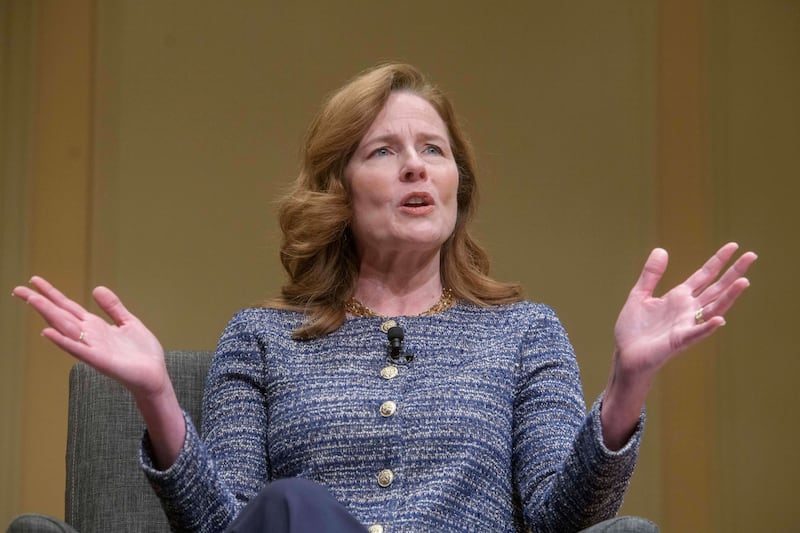

Supreme Court Justice Amy Coney Barrett joined former Sen. Ben Sasse and journalist Chris Stirewalt on their podcast “Not Dead Yet,” where she discussed her busy work and home life and what she wishes more people knew about the high court.
Sasse asked Barrett about how her 40s are different from previous decades and how she juggles her role on the nation’s highest court and as a mother to seven children, in a podcast that aired in late March.
“I don’t know how productive I always feel, right? I mean, I think one of the things that working parents always say is, ‘You’re doing a lot of things and none of them completely well,’” she said.
Barrett noted that 10 years ago, she wouldn’t have been able to be a Supreme Court justice, but now that her children are older, she’s able to be less hands-on at home. She said that parenting requires a lot of teamwork, and her husband, Jesse, has taken on the work of cooking, grocery shopping and the kid’s appointments.
“I do think one thing that Jesse, my husband, and I have always tried to do is put our family life first. It was always more important to me to have children and raise children than to have a career,” Barrett said. “And my posture was always that I was willing to walk away if my kids needed and Jesse would say the same thing.”
Stirewalt noted that Barrett appears to have lived her life “like you were in a hurry,” pointing to what she has accomplished before she turned 55.
Barrett was nominated to the Supreme Court by President Donald Trump in 2020 shortly after Justice Ruth Bader Ginsburg’s death. Before assuming office in the high court, she clerked for Justice Antonin Scalia after graduating from Notre Dame Law School. She went on to teach at the university’s law school and served as a U.S. circuit judge for the U.S. Court of Appeals for the 7th Circuit.
Once confirmed, she became the fifth woman to join the Supreme Court in its history.
Her confirmation process was controversial because Trump nominated her shortly before the 2020 presidential election and congressional Republicans refused to hold hearings for Merrick Garland when former President Barack Obama nominated him during the 2016 election year.
There were sharp criticisms of Barrett from some Senate Democrats, who questioned whether her devout Roman Catholic beliefs would affect her decision-making on the court. She said during her confirmation that she was a “faithful Catholic” but her religious beliefs would not “bear in the discharge of my duties as a judge.”
On the podcast, Barrett detailed how the public scrutiny of her religion was “really, really hard.”
She pointed to the late Sen. Dianne Feinstein’s comments about the “dogma living loudly” in Barrett and having concerns she would not uphold Roe v. Wade given her Catholic beliefs.
“There were a lot of articles,” Barrett said. “I mean, law professors are not written about in The New York Times and suddenly my faith is the subject of a New York Times article, you know, I’m being mocked and all these … people are talking about it.
“What you’re supposed to say as a Christian, right, is, well, that humility is good and you should be willing to do that,” she continued. “It certainly wasn’t my natural reaction. It was really kind of hard to get through. But, I mean, I wouldn’t have done anything different in my life.”
She noted that she regarded the scrutiny as a way to grow in humility. Responses from some law students have made her think it was worth it.
Even if she didn’t agree with some of the criticism, Barrett has had to get used to disagreeing with people. She’s even come under some criticism from the president and his base for not consistently sticking with the Supreme Court’s more conservative justices on certain rulings. Barrett supports textualism and has maintained judicial independence, including in striking down the president’s sweeping international tariff agenda.
Stirewalt asked Barrett how the Supreme Court would operate differently if all of the justices worked and voted remotely.
“I imagine that it would be a lot sharper. I mean, I think that’s what’s happened with social media, and, you know, our personal relations generally, because it’s a lot easier to say sharp things to someone that you don’t have to look in the eye,” she said.
Barrett noted that disagreements happen, but knowing that her fellow justices also all have lifelong appointments, they’re going to have to work together for some time.
“If I say something that ruptures a relationship or destroys a relationship, it’s in your face, you know, you see it. You see it in the hallways, you see if around the conference table,” she said.
“And so I think building … interpersonal communication, face-to-face communication, working on relationships, all of those things make disagreements easier, because then you’re disagreeing with someone for whom you have affection, someone that you know what their kids are up to, you know what they’re reading or watching on TV and they’re a real person and they’re not just someone who has really frustrated me because they’re casting a vote that I really disagree with,” Barrett continued.
Barrett highlighted what she wished more people knew about the Supreme Court, which is that oftentimes, the rulings are unanimous. The flashy, divisive cases that are — as of late — often decided 5-4 or 6-3 and along ideological lines are the ones that grab media and national attention. But in reality, a lot of the cases decided at the Supreme Court are unanimous, including many in the court’s most recent term.
She wishes that people would be “a little bit more critical about what you’re reading, because really, the court’s work, if you look at the court’s work and if you look at the statistics, it does not paint a very partisan story.”