


This article was first published in the On the Hill newsletter. Sign up to receive the newsletter in your inbox on Friday mornings here.
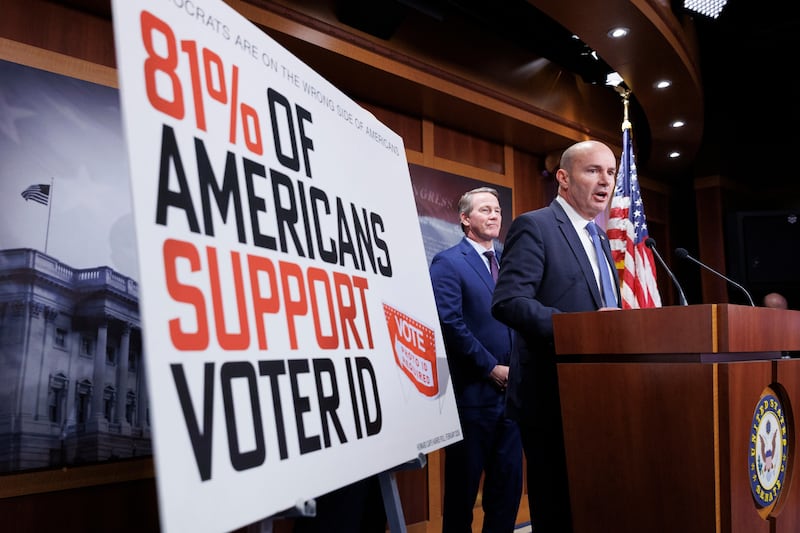
Just two months ago, President Donald Trump said the SAVE America Act should be Republicans’ top priority in Congress.
Now? It’s collecting dust in the Senate.
Despite a floor takeover attempt in mid-March, the marathon debate session ended without a vote on the bill itself. Other priorities such as ending the Department of Homeland Security shutdown and extending key government surveillance powers took precedence.
Utah Sen. Mike Lee, who is spearheading the bill, understood that some pieces of legislation were more timely — but he repeatedly told me that they would come back to his proof-of-citizenship and voter ID legislation.
But they haven’t. And it doesn’t look like they will any time soon.
“We don’t have the votes to get rid of the filibuster,” Senate Majority Leader John Thune, R-S.D., told reporters this week. “We had a very spirited debate. I made more speeches on the floor in support of the SAVE Act than any other senator.”
The filibuster, it seems, is still the main obstacle in the way. Because of Senate rules, bills need at least 60 votes to end debate and advance to a final vote. With the current margins, that would mean at least seven Democrats would need to support Lee’s bill.
Spoiler alert: Those Democrats are nowhere to be found.
That prompted Lee to call for changes to the filibuster requirements. First, he wanted a talking filibuster, which is what led to the marathon debate session. Basically, his argument was: If you want to block the bill, you have to be on the floor actively talking to do so.
But that fizzled out. And we haven’t come back to the marathon debate session since.
If you ask Lee, the SAVE America Act is not dead yet. In fact, this is what he told me:
“The SAVE America Act lives on in the Senate as long as President Trump and the vast majority of Americans keep demanding its passage. I will not stop fighting for election security and neither should any elected Republican.”
Lee has since called for getting rid of the filibuster altogether — which, as Thune mentioned in that earlier quote, is not an option. There just isn’t enough support to nuke the filibuster, even among Republicans.
It may not be the end, though. Aside from Lee vowing to push on, there are other Republicans who want to see some sort of action on it.
Some House Republicans like Rep. Anna Paulina Luna, R-Fla., have repeatedly threatened to tank other pieces of legislation if SAVE isn’t passed in the Senate, although those threats haven’t really resulted in anything yet.
And some Republicans are eyeing ways to tuck some of SAVE’s provisions into a third partisan spending bill later this summer. But that’s not a done deal — mainly because they aren’t sure if voting legislation is eligible for the budget reconciliation process, and some aren’t even sure if they can get a third package through at all.
More on that later.
Stories Driving the Week
- Free-range parenting: Utah Rep. Blake Moore introduced a bill this week that would clarify the definition of neglect under federal law to ensure parents aren’t at risk of being punished for allowing their children to engage in “independent play.”
- Get schooled: Utah Rep. Burgess Owens is spearheading an effort to restrict federal funds from going toward certain topics in schools, specifically surrounding gender and racial ideologies, according to bill text I scooped this week.
- Not so fast: Sen. John Curtis is brushing off a report that he is actively weighing a bid for the Utah governor’s race in 2028, telling the Deseret News on Tuesday those conversations would be a “long time away” and that he is focused on his current job as senator.
Republicans eye a third spending bill — before they are done with their second
Republicans are already planning to push through a third budget reconciliation bill before their August recess — and they aren’t even finished with their second one yet.
House Republicans met earlier this week to start mapping out some priorities for what could be included in the spending bill, which would allow them to approve some of their party’s priorities without needing Democratic approval. That’s because the budget reconciliation process doesn’t require the 60-vote filibuster so long as it follows the rules adhering strictly to budgetary policies.
“We think this is something we have a lot of momentum on,” Rep. August Pfluger, R-Texas, the chairman of the Republican Study Committee, said on Wednesday.
But is it possible? Looking at the calendar, the answer is … maybe.
Republicans are currently working on their Reconciliation 2.0 right now to fund federal immigration enforcement for the remainder of President Donald Trump’s term. They are hoping to get that through the Senate and then the House before the end of next week so lawmakers can go on their Memorial Day recess but still meet Trump’s June 1 deadline.
If they can do that, passing a third one before August is possible. But some Republicans in the Senate aren’t yet convinced it will happen.
“If they’re telling you that’s what their schedule is,” Senate Majority Leader John Thune, R-S.D., said this week. “But we’re still working on reconciliation 2.0.”
Others were a little more candid.
“I wouldn’t bet my house on it, and if it were your house I were betting on, I’d say, ‘Maybe,’” Sen. John Kennedy, R-La., told reporters this week. “I hope that they’re right.”
Quick Hits
From the Hill: Senators agree to pause their own pay during future shutdowns. … Sen. Curtis wants more answers on $1 billion price tag for White House ballroom security. … Utah Rep. Blake Moore keeps fiscal priorities in closely watched primary.
From the White House: Utah is a major recipient in the Interior’s 2027 budget. … Challenges await the newly confirmed Fed chair. … Trump, business leaders leave for China with Iran war backdrop.
From the courts: Clarence Thomas becomes second-longest serving justice in the history of the Supreme Court. … What Justice Neil Gorsuch says about America ahead of its 250th.