

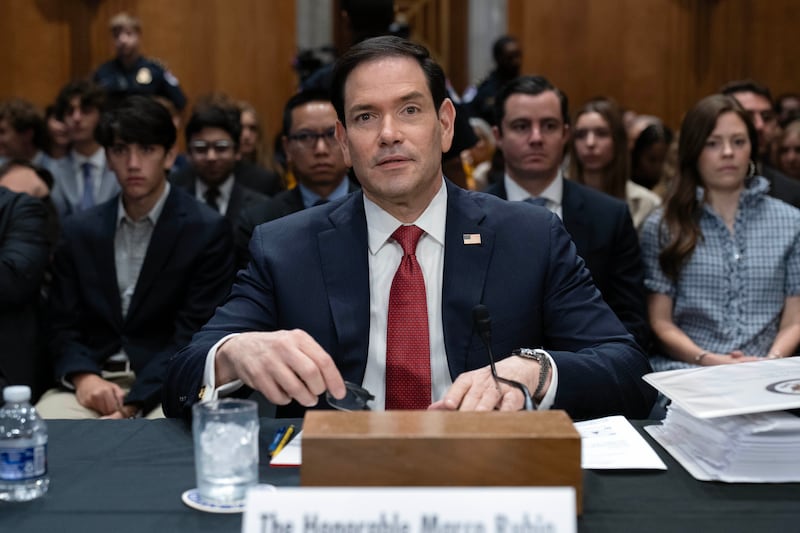

Secretary of State Marco Rubio took questions from senators on the Senate Foreign Relations Committee on Tuesday, the first time the top administration official has publicly testified before Congress since the war in Iran began.
Both Utah Sens. Mike Lee and John Curtis, who are on the committee, asked questions of the secretary related to the war as well as other foreign affairs topics under Rubio’s jurisdiction.
Rubio also traded barbs with a number of Democrats on the committee, after they pressed the secretary for updates on negotiations with Iran and whether the Trump administration was acting within its bounds for engaging in military operations without congressional approval.
“Could you use your influence to get the administration to share the Iran war legal opinion with Congress?” asked Democratic Sen. Tim Kaine, D-Va., who has led efforts attempting to rein in President Donald Trump’s war powers.
“The Department of State does not develop the legal opinion,” Rubio replied.
“But you’re the chief national security adviser,” Kaine shot back.
Rubio then said he would ask the Office of Legal Counsel why it hasn’t been provided.
Lee and Curtis focused their questions on how negotiations are proceeding between the Trump administration and Iranian officials. They refrained from any direct criticism.
Sen. Mike Lee: Has the fractured regime in Iran complicated negotiations?
Lee opened his line of questioning by asking Rubio if the Iranian regime’s current fractured state has led to the prolonged negotiations — and if that’s why a deal has not yet been made.
“One of the things I’ve wondered, for example, are whether the diplomatic Iranian channels are at odds with or working hand in glove with the (Islamic Revolutionary Guard Corps), which is itself causing a lot of these ceasefire violations,” Lee said, “or is it all sort of coordinated chaos to try to undermine and tip the scales in favor of Iran in the negotiations?”
Rubio acknowledged a shift in Iranian leadership after the death of Ayatollah Ali Khamenei, who was killed on Feb. 28 in a joint U.S.-Israel strike in Tehran. He was replaced by his son, Mojtaba Khamenei, whom Rubio said is believed to be alive and “increasingly engaging at some level.”
That transition was slow, Rubio said, as Mojtaba Khamenei was injured in the same strike. It took him a month to make contact with the U.S., and since then, he has not been seen or heard from publicly. Communications have only been in writing or through intermediaries.
Rubio also pointed to a disjointed communication hierarchy within the Iranian regime, which he said has led to the delay in negotiations.
“There is evidence that there are communications issues within the regime as well,” Rubio said. “What’s complicated (negotiations) is you ultimately are negotiating with people who then have to negotiate within their own system to see what they’re allowed to give and where they’re allowed to agree to.”
“This is why you see reporting about ‘There might be a deal in the next few days,’ because internally it takes time to get responses from them, sometimes upward to five or six days,” he added.
Sen. John Curtis: What was Trump’s conversation with Hezbollah leaders?
Meanwhile, Curtis pressed for clarification from the secretary on a recent social media post from Trump that said he had spoken with Hezbollah about recent strikes against Israel.
Curtis was referring to a post from Trump on Monday, indicating he had spoken both to the leaders of Hezbollah as well as Israeli Prime Minister Benjamin Netanyahu to coordinate a ceasefire. In his post, Trump said Netanyahu agreed “not to go into a major raid of Beirut, Lebanon,” and Hezbollah leaders agreed to “stop shooting at them.”
“The president had a tweet about speaking with Hezbollah yesterday,” Curtis said. “Do you want to clarify for people what happened?”
Rubio explained that Trump had received communications “via the Lebanese government and the speaker over there on behalf of Hezbollah” beginning on Sunday that they would “restrain from attacking Israeli territory if Israel did not take new strikes in Beirut.”
“It came from Hezbollah, but through Lebanese authorities,” Rubio said.
“I think that clarification is important, thank you,” Curtis said.
Rubio says deal could come soon
During his remarks on Tuesday, Rubio told senators that a deal with Iran could be imminent, but he stopped short of giving a definitive timeline of when the war could come to an end.
Rubio said an agreement “could happen today, could happen tomorrow, could happen next week,” as he remained vague on the status of talks. However, the top Trump administration official offered optimism that they have made progress in the last year on ensuring Iran does not develop a nuclear weapon.
“For the first time, certainly in my memory, they have agreed to negotiate aspects of their nuclear program that just a month ago, just a year ago, they were refusing to even mention,” Rubio said.
The secretary of state did not share what aspects of the nuclear program are under negotiation.
However, “if it doesn’t work out, then we still have a problem with respect to their nuclear ambitions.” But, he added, Iran “won’t have a conventional shield” to protect its nuclear program.