

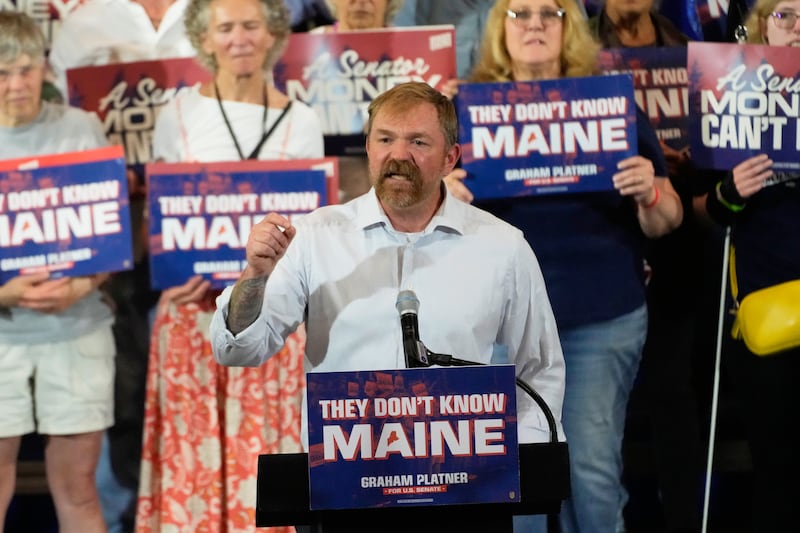

- Graham Platner won the Democratic nomination for the Maine Senate seat and will face incumbent Sen. Susan Collins in November, despite months of controversies that drew national attention to the race.
- Platner’s campaign was rocked by his past Reddit posts, a Nazi-related tattoo and allegations of abusive behavior from former romantic partners.
- The activists who recruited and vetted Platner acknowledged that their background check uncovered some concerns.
Oyster farmer, firearms instructor and veteran, Graham Platner, was declared the winner of Maine’s Democratic Senate primary by The Associated Press shortly after polls closed on Tuesday night.
He was ahead of former Maine Gov. Janet Mills, who stopped campaigning in April, 72%-20%, as of late Tuesday night.
He will face incumbent Republican Sen. Susan Collins in November’s general election.
Platner ran a campaign in support of progressive policies, including universal healthcare, a focus on climate change and increased taxes on the wealthy.
Speaking from Blue Hill, Maine, Platner said, “If you believe as I do that we can change our politics and change our country, then you must also believe that people can change.”
“The reason I believe that is because I have lived it. And the reason that I have lived it is because of my wife,” Platner said. The crowd started chanting, “Amy,” the name of Platner’s wife, and the Democratic candidate joined in.
Amy Platner stood by her husband in recent weeks after news broke of his sexting multiple women during their marriage.
Platner has reiterated the promise of change during his campaign over the last ten months, as various news stories and former romantic partners have brought forward controversial aspects of his past.
These controversies have been magnified by the weight this Senate seat holds for Democrats. Incumbent Sen. Collins’ seat is largely viewed as key to the party’s effort to flip the Senate blue in November.
Controversies have dotted Platner’s campaign
Several months after Platner launched his campaign last August, the first controversy arose.
In mid-October, Politico and CNN published a series of the candidate’s Reddit posts, which showed his political ideology and his comments about women and other members of the military.
Five years ago, the now-41-year-old had described himself as “a vegetable growing, psychedelics taking socialist.“ In 2018, he wrote, if people “expect to fight fascism without a good semi-automatic rifle, they ought to do some reading of history,”
Other posts from 2020 and 2019 said respectively, “All cops are b-----ds,” and “An armed working class is a requirement for economic justice.”
He also said sexual assault victims should “just take some responsibility for themselves,” and said people who live in Maine “are actually” racist and stupid.
When news of Platner’s posts broke, his political director Genevieve McDonald resigned.
Then Platner addressed a tattoo on his chest, a Nazi-related “Totenkopf,” which he later covered up.
He denied knowing what it was, saying he got the tattoo while drinking at a bar in Croatia with fellow Marines; he chose the skull and crossbones off a wall at the tattoo parlor.
“It was not until I started hearing from reporters and DC insiders that I realized this tattoo resembled a Nazi symbol,” Platner said.
However, a former girlfriend told The New York Times that Platner did know it was a Nazi symbol and he joked about it. He denied her allegations.
In May, reports emerged that Platner had a history of sending sexually explicit images to women besides his wife, Amy Gertner.
Accusations of sexual misconduct expanded in early June when The New York Times reported on the experiences of three women Platner had been romantically involved with.
Lyndsey Fifield, 40, and Jenny Racicot, 41, told the Times that Platner’s Reddit posts reinforced their beliefs that he did not respect women. Fifield described moments when Platner was rough with her.
Platner told Fifield that rape was power, she told the Times. “He said this a lot: ‘If anybody ever broke in here, I would rape them,’” she said. She added that Platner would say it would not be in “a sexual way, not in a gay way ... He was like, ‘I would rape them to show them that I’m dominant.’”
The New York Times reviewed Fifield’s journal. In one entry from June 2016, she described Platner as “the most toxic literally abusive man on earth who destroyed my life.”
Platner’s campaign released a statement: “Let’s be very clear: This is a lifelong G.O.P. operative who’s dedicated her career to electing Republicans.”
Pre-campaign vetting turned up ‘some’ of the controversy
The Wall Street Journal published the first extensive interview on Sunday with the two out-of-state activists who “found Graham Platner.”
Daniel Moraff, a Yale Law School graduate, and his fiancée, Leanne Fan, said they went through “thousands and thousands of prospects” in search of a Democrat to run for Maine’s Senate seat.
They told the Journal they were looking for someone with a “healthy contempt for existing Democratic party infrastructure” and someone who “reflects the culture of the district they come from.”
“Leanne pulled up a video of someone with an oyster farm,” Moraff said. Then they pulled up his Federal Election Commission (FEC) history.
They “saw the money he had given to Bernie Sanders and some other people, and that was enough information to know that we had the best prospect that we had ever seen,” Moraff said.
When asked how the pair vetted Platner, Moraff said, “We paid a nice firm a whole chunk of money, then we got some stuff back. Some of what you’ve seen on the news we got back and other stuff we didn’t.”
Their vetting process did not turn up Platner’s chest tattoo and only showed some of the Reddit posts that have now been published.
Upon seeing the posts, Moraff said, “None of this will or should stop him from becoming a U.S. senator. I think if what the voters wanted were people who were grown in vats and had never done or said anything that they might regret their entire lives, we’d have a very different country.”
“Part of our thesis here is that people do not want their candidates grown in vats, they want people who are real human beings,” Moraff said.