


A version of this article was first published in the Right to the Point newsletter. Sign up to receive the newsletter in your inbox every Wednesday morning and to vote in subscriber-only polls.
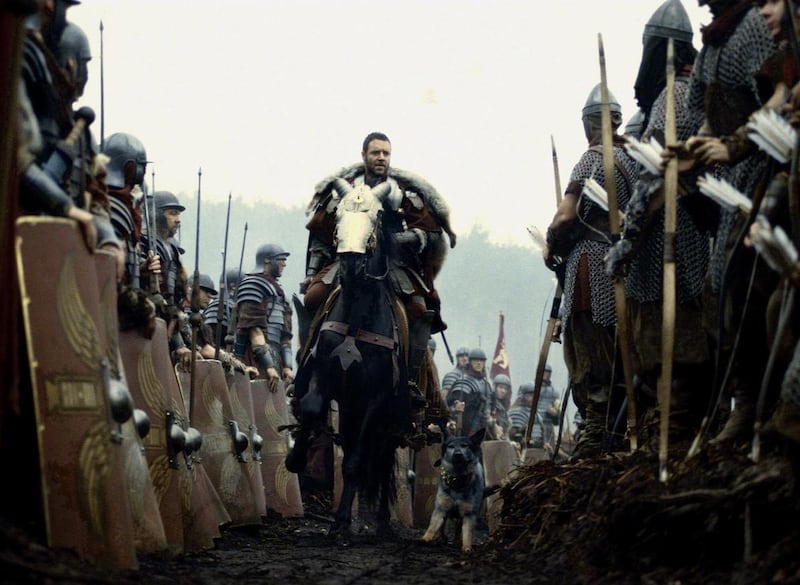
Actor Russell Crowe recently made headlines at an Italian film festival for what he said about “Gladiator,” the 2000 movie that won the Oscar for best picture.
Unlike its sequel, “Gladiator” was successful “because it had a moral core,” Crowe said, going on to add, “In a way, we all want to be that guy who can stay that strong, if you’re a man. And if you’re a woman, we all want a man to love us in that way.”
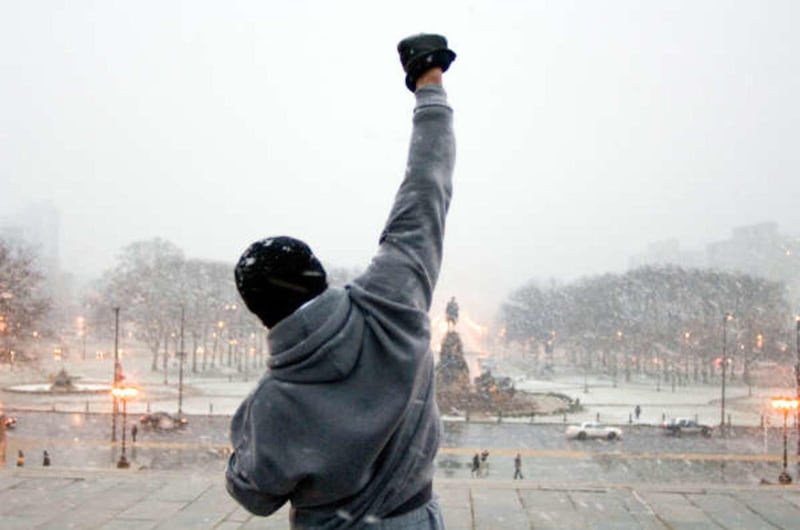
Those are fightin’ words in this culture, but that was also true of “Rocky,” the Sylvester Stallone movie that turns 50 this year.
Writing about “Rocky” in her column for The Wall Street Journal, Peggy Noonan noted that it was cultural event. “Everyone went,” she wrote. (Some of us, more than once.)
Stallone’s film, Noonan wrote, “summed up, without even trying, what a spectacularly new thing in history America was, because the meaning of the movie was the American promise: Anyone can come from anywhere and become anything. The mook from the mean streets can become a champ. That’s all. It’s the oldest story in America.”
You’d think Hollywood would be throwing out stories like that like so much confetti on the occasion of America’s 250th anniversary this summer.
But so far, we’ve gotten — checks notes — a Super Mario movie, a biopic about Michael Jackson, horror movies made by YouTubers, and aliens, so many aliens.
The Daily Wire’s Matt Walsh recently took the industry to task, noting how many stories about America could be told to great effect.
“One of the big reasons for the current lack of patriotism and pride in our nation’s history is that about 40 years ago our most prominent storytellers in Hollywood just basically stopped telling stories about American history altogether, unless it has something to do with WW2, civil rights, or slavery,” Walsh wrote on X.
He suggested that Daniel Boone alone could be the source for multiple movies, and argued that they should be rated R because “‘conservative’ attempts at American history films and TV shows are invariably hokey and kid friendly, the kind of thing you can watch with your grandmother and your 5 year old, and you’ll all be equally informed and bored by the experience.”
He’s wrong on that point. The success of both the “Rocky” franchise and this year’s “Project Hail Mary” show that great stories don’t need R ratings.

To the larger point, however, Walsh was spot on. Only Angel Studios and Wonder Project took on the American Revolution in “Young Washington,” which debuts in theaters July 3.
Other than that, all we have is a video series Hillsdale College produced in partnership with the White House, called “The Story of America.” The videos are well made, but are more college lecture than blockbuster movie. Hillsdale’s feature-length film “Revolutionary America” has already come and gone from theaters.
Last year on YouTube, Greg Wagman of Little Wars TV took up the question of why, in the past half-century, there’s only been one major movie about the American Revolution: “The Patriot,” starring Mel Gibson and the late Heath Ledger. It’s a question that’s been nagging at him since he saw the film in theaters.
“It’s a time of legendary heroes, larger-than-life personalities, epic battles, stunning betrayals and miraculous turns of fate. And yet, despite all of these dramatic story telling opportunities, Hollywood has given us one movie in 50 years? How is that even possible?” Wagman asks.
It’s a good question worth pondering as we head to the theater for “Toy Story 5.”
Freddy Fever
If you’re not a denizen of X, you may be unaware of Freddy, the German tourist who came to the U.S. for the World Cup and immediately went viral by posting photos and commentary about his six-week road trip through multiple states.
Freddy is enthusiastic about America in a way that too many of us aren’t. It’s been refreshing to see his bullish take on Buc-ee’s, Bass Pro Shop and Waffle House, as well as the American landscape.
Equally important, it’s also been refreshing to encounter an internet superstar who seems to have zero interest in being an internet superstar.

Despite copious attention on social media and in the press, Freddy has not given his last name, nor identified his traveling companions, even covering up their faces in photographs. He is, by any standard, certifiably famous now — he’s gotten the attention of celebrities, including JJ Watt, who provided a lavish hotel stay for Freddy and his companions. But he seems to not care at all about being famous. He’s just interested in all things America, and also, of course, the World Cup.
Transportation Secretary Sean Duffy and his family are promoting the Great American Road Trip as part of the America 250 celebration, and NewsNation’s Brian Entin is about to do something similar with a “Spirit of America” cross-country trip.
But it may well be that the road tripper of the year is a German: Freddy, the Alexis de Tocqueville of social media. My prediction: He’ll have a book deal by the end of the year, if not the end of the month.
Recommended Reading
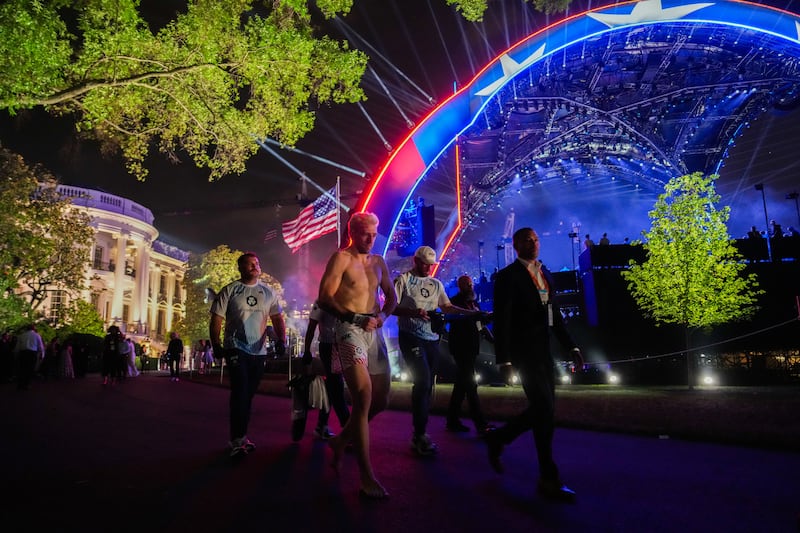
My colleagues Aaron Shill and Jesse Hyde traveled to Washington, D.C., to make sense of the UFC fights on the White House lawn and put the controversy over them in perspective.
Read their take before the event here:
There’s a UFC fight card at the White House. Is it profane — or pure American?
And then their take after the fact:
What went right — and wrong — at the White House fights
An excerpt from Hyde: “I’m not a fan of the president’s aesthetics. All the gold leaf stuff, the gold toilets. So to me, the White House backdrop and the use of the military was a turn-off. But a lot of people like the president’s style, and so I’m sure for them the backdrop and all the militaristic touches looked awesome, even patriotic.”
An excerpt from Shill: “I wouldn’t object to a basketball game or a boxing match on the South Lawn. And while I understand and respect the pointed opinions to the contrary, I admire what the UFC tried to do with Freedom 250. And I found the sneering of some of the media and critics on social media more distasteful than the event itself.”
And in non-UFC discourse, Susan Madsen penned an excellent essay about moral clarity and why we should pay attention if we start trying to justify something we want to do.
“Justification is rarely neutral; it’s often the first warning light that an ethical boundary is being bent.”
End Notes
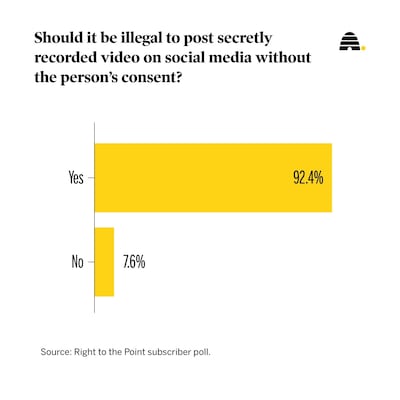
Last week, we talked about the proliferation of secret cameras that enable people to film others in public without their knowledge. Although it’s commonly said that there is no presumption of privacy when you’re in a public space, some are arguing that there should be guardrails to protect ordinary citizens.
And most Right to the Point subscribers who participated in our poll agreed.
Finally, like Freddy, I love Walmart, but I did get a laugh out of people pointing out that some of their merchandise celebrating America’s 250th anniversary looks a bit like something you’d put on a tombstone.
“Funeral plates” is how Jon Stewart’s team described them.
It’s a good reminder that, even when you think something is ready to ship, it’s always good to run it past another pair of eyes.