

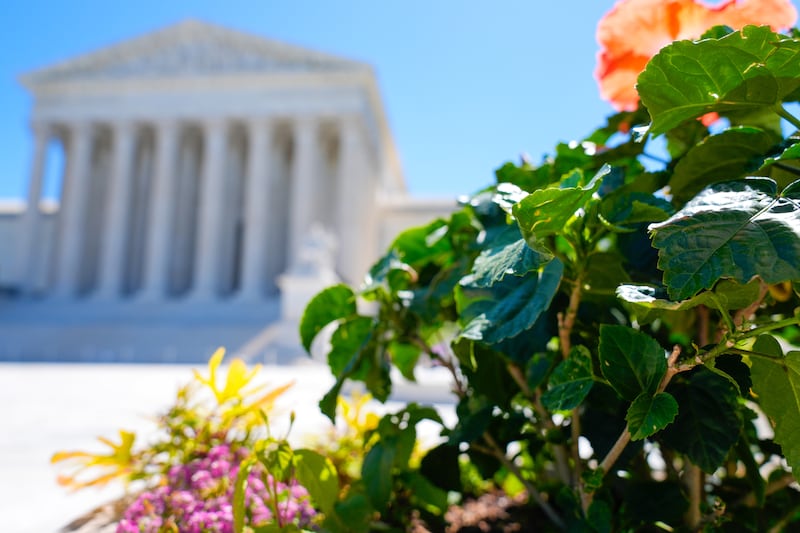

The Supreme Court said in an opinion issued Tuesday that children born in the United States are citizens under the 14th Amendment.
On the first day of his second term, President Donald Trump signed an executive order challenging the long-established interpretation of the U.S. Constitution by eliminating citizenship for children born to parents who are in the U.S. temporarily or without legal status.
But, in a 5-4 decision, a majority of the justices said a child born in the United States, regardless of their immigration status, is a citizen.
“Children born in the United States to parents unlawfully or temporarily present are ‘subject to the jurisdiction’ of the United States and are citizens at birth under the Fourteenth Amendment’s Citizenship Clause,” the opinion in Trump v. Barbara, written by Chief Justice John Roberts, said.
Roberts was joined by Justices Sonia Sotomayor, Elena Kagan, Amy Coney Barrett, and Ketanji Brown Jackson. Justice Brett Kavanaugh concurred in part and dissented in part.
Justices Clarence Thomas, Neil Gorsuch and Samuel Alito filed dissenting opinions.
Roberts wrote that the problem with Trump’s order was that there’s “scant evidence for this dramatically revisionist view.”
Kavanaugh agreed with keeping citizenship in place for those born in the United States, but disagreed with Roberts’ reasoning, saying current federal law allows for birthright citizenship, but it was not a constitutional right. He said Congress could pass a law restricting citizenship.
“Congress could — consistent with the Fourteenth Amendment — amend or otherwise enact new legislation establishing exceptions to birthright citizenship for children born to foreign citizens unlawfully or temporarily in the country. But Congress has not yet done so," he wrote.
Thomas, in his dissent, which was joined by Gorsuch, expressed skepticism that the ruling will “stand the test of time,” arguing the Constitution does not guarantee citizenship to children born to parents in the country illegally or temporarily.
“Some took advantage of the Executive Branch’s recent policy of granting citizenship to anyone born on American soil. The policy encouraged ‘birth tourism’ — the practice of traveling here with temporary authorization solely to give birth and obtain citizenship for one’s children, then returning to raise them in another country," Thomas wrote.
In a separate dissent, Alito said it was one of the most important decisions in the history of the Supreme Court and in his opinion, the justices made a “serious mistake.”
Trump posted online that it was “too bad” but he would “easily” make up for it by having Congress pass legislation. It’s a major blow for the president, who has seen the court decide against him on other key issues like tariffs.
“Congress should start TODAY to work on ending expensive and unfair to our Country, Birthright Citizenship. They will have my Complete and Total Support!” he said.
In another post, Trump highlighted his win Monday in Trump v. Slaughter, and said it was the term’s “biggest and most consequential” decision.
Outside of the court, a small group of advocates were huddled around a phone awaiting the decision to drop. They cheered and were relieved when the ruling was in their favor.
Paulina Vargas with the League of United Latin American Civil Rights organization said she was pleased with the outcome.
“As an organization we do value the Constitution and upholding it so that was so that was definitely a win in that regard,” she said in an interview with Deseret News outside the court. “On a personal level, I am really grateful that that was the decision they made today.”
Case background
Trump, through his executive order, was seeking to reinterpret the constitutional language that gives citizenship to almost every child who is born in the United States.
His order, titled “Protecting the Meaning and Value of American Citizenship,” sparked concern among expecting mothers, immigration advocates and constitutionalists, but was supported by those who believe the constitutional right has been applied too broadly. The order also made it unclear what it could mean for those who had already been granted citizenship under the right.
The case was partially presented to the Supreme Court during last year’s term, but the justices ultimately ruled on the matter of nationwide injunctions and declined to take up the birthright issue.
The Supreme Court heard oral arguments in the case earlier this year. Trump made a historic move as the first sitting U.S. president to attend an oral argument session, proving how important the issue is to him.
The Constitution states, “All persons born or naturalized in the United States, and subject to the jurisdiction thereof, are citizens of the United States and of the State wherein they reside.”
U.S. Solicitor General D. John Sauer said in his argument before the justices that the federal government’s interpretation of the “subject to the jurisdiction thereof” means lawful, permanent allegiance to the U.S., which means children born to temporary visitors or immigrants living in the country illegally would not automatically qualify for citizenship since their parents are not domiciled residents, not permanent residents and don’t hold allegiance to the laws of the U.S.
Sauer also leaned on the fact that the U.S. is among a small handful of countries that allows birthright citizenship. “We’re in a new world now,” Suaer said, noting that the framers of the 14th Amendment couldn’t have imagined living in a world with 8 billion people who are “one plane ride away from having a child who is a U.S. citizen.”
The government’s argument was pushed back upon by both the court’s liberal justices and some of its more conservative justices. “It’s a new world,” Chief Justice Roberts said to Sauer, “It’s the same Constitution.”
The American Civil Liberties Union argued against the government and national legal director Cecillia Wang leaned on the 127-year-old precedent in the U.S. v. Wong Kim Ark.
Wong Kim Ark, born in San Francisco in 1873 to Chinese parents who were ineligible to become U.S. citizens due to immigration law at the time, visited China and was denied reentry to the U.S.
The Supreme Court decided in a 6-2 decision that birth on U.S. soil automatically conferred citizenship, regardless of the person’s parents.
Questions from the justices showed skepticism of the government’s argument, particularly since Sauer said they were not attempting to overturn the Wong ruling, but instead reinterpret it or narrow it down.
Wang, on behalf of the ALCU, capitalized on the fact that the government doesn’t want to overturn the precedent, calling it a “fatal concession.” She also highlighted the humanitarian argument of keeping the long-standing right, saying that it’s contributed to the “growth and thriving” of the country.