

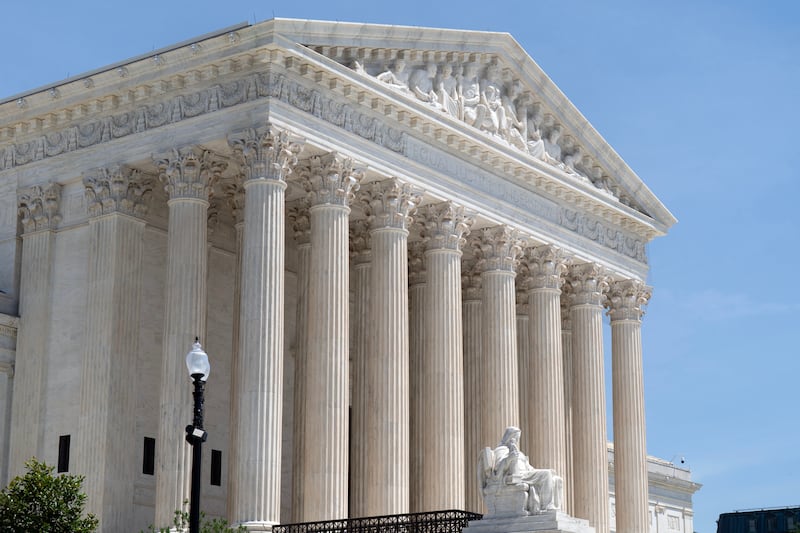

The Supreme Court will hear arguments next term in a case stemming from a Colorado law that excludes Christian preschools from the state’s universal preschool program.
U.S. Solicitor General D. John Sauer was joined by members of Congress, 21 states and faith groups including the United States Conference of Catholic Bishops, the Union of Orthodox Jewish Congregations of America, and the Church of Jesus Christ of Latter-day Saints, in writing friend-of-the-court briefs for the justices to consider during the 2026 term, which starts in October, according to the Becket Fund for Religious Liberty.
In April, the Supreme Court agreed to hear arguments in the case, which was brought by two Catholic parishes challenging the state’s decision to ban them from the universal preschool program, which includes 15 hours of free instruction a week.
The state says Catholic preschools can’t take part in the program because of a nondiscrimination clause that mandates participating schools cannot ban children of same-sex couples or children based on their gender identity or sexual orientation.
Becket released a statement Monday detailing the joint effort to overturn the lower court ruling.
“Colorado has united a diverse array of Americans around a simple point: It’s wrong to promise preschool support to every family in the state and then yank it away from Catholic families,” Eric Rassbach, senior counsel at Becket that represents the families, said in a statement. “This broad coalition shows just how egregious and unlawful Colorado’s religious discrimination has become.”
In the case, St. Mary Catholic Parish v. Roy, the Archdiocese of Denver, which oversees 34 preschools, said it was excluded from the statewide program and the funding that comes along with it because it wouldn’t comply with the nondiscrimination clause.
The justices in an order agreeing to take up the case said they would not consider overturning Employment Division v. Smiths, a 1991 decision that said exemptions for religious organizations are not required when a state law is applied neutrally and in a broad way.
Still, the way the justices decision in the case could narrow that 1990 decision, particularly since some of the court’s more conservative justices have spoken out about wanting to revisit it.
In a statement provided by Becket, the families represented in the case said they were grateful so many people from across the country were rallying behind their case.
“Colorado promised preschool for all, but then showed Catholic families the door. That’s unfair to parents, unfair to children, and contrary to the spirit of the Constitution’s promise of religious freedom,” Dan and Lisa Sheley said in a statement.
The Sutherland Institute, a Utah-based think tank, also filed a brief to the court, arguing most private schools in Colorado are religious and align their curriculum with their faith.
Gov. Jared Polis released a statement Monday after Sauer and other states filed briefs to the court.
“I am passionate about building a Colorado for all, where every student gets a strong start and families can thrive. We are proud to have the participation of so many religious schools and welcome the participation of all religious preschools in universal preschool,” Polis said. “Faith-based preschools have always been welcome to participate in Colorado’s Universal Preschool and many already do. I hope more to join so we can expand access, help more families save money, and give more kids a strong start.”
Polis did not mention the nondiscrimination clause, but his statement noted in the 2023-24 school year, at least 68 faith-based schools participated in the state-wide program.
The public won’t know how the justices will rule in the case until they release their decision, but in recent years faith-based cases have gone in religious groups’ favor and justices have said they don’t need to abandon their beliefs to participate in publicly-funded programs.
Case background
In 2020, Colorado voters approved the preschool program in a statewide referendum. The program allocates taxpayer dollars for parents to use to send their kids to their preferred preschool.
However, in 2023, the archdiocese told its educational institutions not to enroll in the state preschool program so they didn’t have to participate in the nondiscrimination requirement.
They later asked the state if they could be exempt from the nondiscrimination part of the law and still receive the state money and participate in the universal preschool program. The state said it would not grant the exception and the requirements were final and set in law.
The lawsuits were filed and the U.S. District Court for the District of Colorado found the nondiscrimination requirements were constitutional.
The plaintiffs appealed to the U.S. Court of Appeals for the 10th Circuit, which upheld the district court ruling, setting the stage for them to bring their arguments to the Supreme Court.