



Tribal leaders representing the Bears Ears and Grand Staircase-Escalante monuments say they were not consulted before the Trump administration signed a pair of executive orders drastically reducing the size of the national monuments.
President Donald Trump signed the orders on Monday, removing nearly 3 million acres of the public land designation for the two monuments combined. But members of the tribal coalitions say there was “no consultation initiated with tribes” ahead of that decision as they raised concerns that key voices are being left out of a decadeslong debate.
Autumn Gillard, the coordinator for the Grand Staircase-Escalante Inter-Tribal Coalition, and Davina Smith Idjesa, co-chair of the Bears Ears Inter-Tribal Coalition, both told the Deseret News on Tuesday that neither were part of the conversations leading to the monuments’ reductions.
“If Utah (legislators) and leadership felt that their constituents were not being able to access this national monument in the way that they thought was applicable, then a conversation of mitigation should have been held with tribal nations so that we could have worked together to help mediate this issue,” Gillard said in a press call on Tuesday.
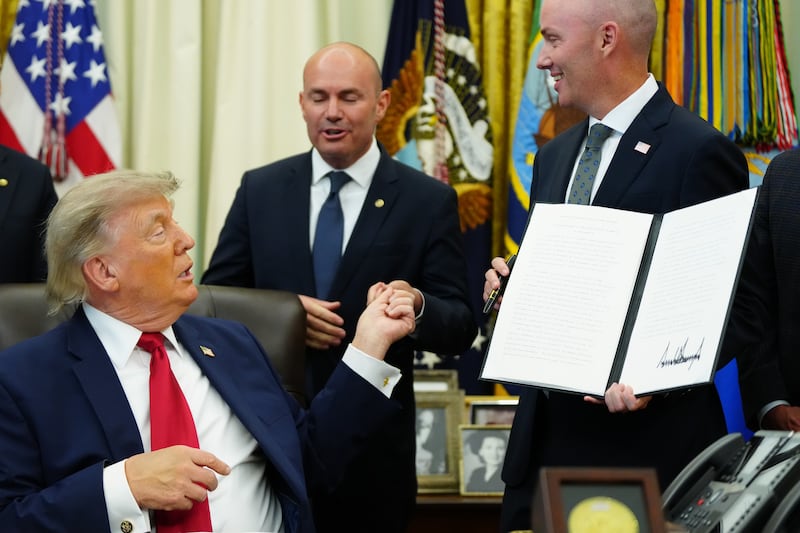
The Deseret News contacted the White House for comment. The Interior Department referred questions to the White House when reached for comment.
The effort to downsize Bears Ears and Grand Staircase-Escalante was spearheaded by members of Utah’s congressional delegation, particularly Rep. Celeste Maloy and Sen. Mike Lee.
Lee told the Deseret News on Monday they had engaged in conversations with local stakeholders and elected officials over the last year and a half regarding this issue.
Maloy, who has worked on this issue for roughly 25 years, said she has spoken with residents of rural Utah who often lamented their perspectives were not being heard on the issue.
“Sen. Lee and I both have been working on every tool we have at our disposal to make sure that the people in rural Utah know that we hear them when they say that they are tired of having decisions about our resources in Utah being made 2,500 miles away by people who don’t know and love the resources the way we do,” Maloy told the Deseret News in an interview.
Tribal leaders pushed back on that assessment, arguing that the efforts to ensure stakeholders’ opinions were taken into account resulted in the absence of local tribes weighing in.
“I think one of the most hurtful and offensive things to the coalition was that we kept hearing this narrative that local stakeholders were not heard. But what about our tribal voices?” Gillard said. “We have constituents and members who are citizens of the state of Utah. Are their voices not equal to those of other citizens that live in the state?”
Idjesa echoed those sentiments, calling the argument from the Utah congressional delegation “biased” against local tribal nations.
The Deseret News contacted both Lee’s and Maloy’s office for comment on whether tribal nations were notified of the executive orders.
Democrats in Congress accuse Trump administration of opening lands to mining
Several Democrats in Congress criticized the Trump administration’s decision to shrink the two national monuments, warning it would open up the land to mining and extraction of natural resources.
New Mexico Sen. Martin Heinrich, the top Senate Democrat on the Energy and Natural Resources Committee, told reporters on Tuesday that the possibility of mining in an area that was previously protected was “absolutely” a motivating factor.
“I think those are the interests that this president has consistently elevated,” Heinrich said. “This is about a giveaway of our public lands to international corporations that want to mine for uranium and other minerals on our lands.”
Arizona Rep. Adelita Grijalva cited similar concerns, accusing the administration of putting “extractive industries ahead of people, wildlife, and cultural resources.”
“This administration is handing over public lands to private interests while ignoring the voices of tribal nations and the overwhelming majority of Americans who support these places,” Grijalva said. “These lands belong to all of us, not just this administration, and certainly not to the highest bidder.”
Maloy acknowledged the tense debate that has occurred over the size of Bears Ears and Grand Staircase over the past three decades — but told the Deseret News those fears are often rooted in misinformation.
“I’ve talked to a lot of people who think if the monuments go away, it’ll be private land, or if the monuments are there, the resources can be managed more intensively. And those things just aren’t true,” Maloy said. “A lot of the big feelings people have about it are based on misunderstandings of how federal land management works.”