

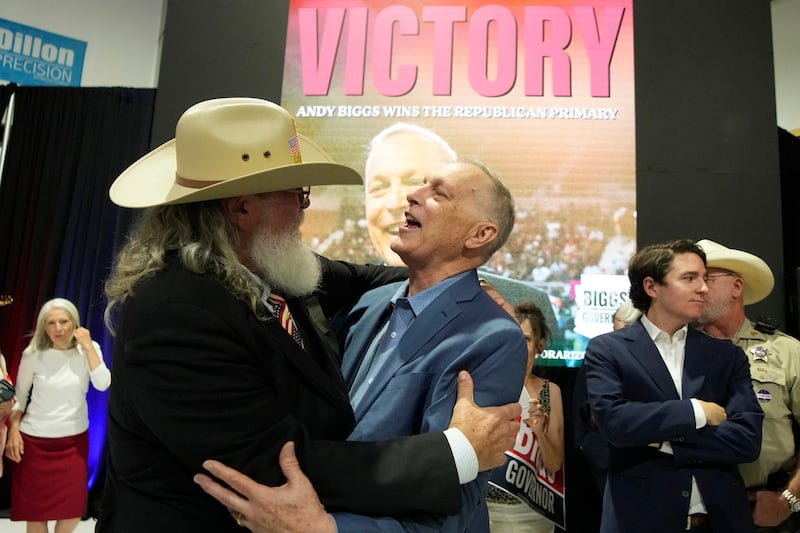

Arizona Republicans chose Andy Biggs, a congressman and Brigham Young University graduate, to run as their candidate in the governor’s race this November. He will face Democratic incumbent Gov. Katie Hobbs.
While the gubernatorial race is one of the most closely watched in the country, results of Tuesday’s primaries for congressional races could also be instrumental in determining which political party will hold a majority after the November midterm elections.
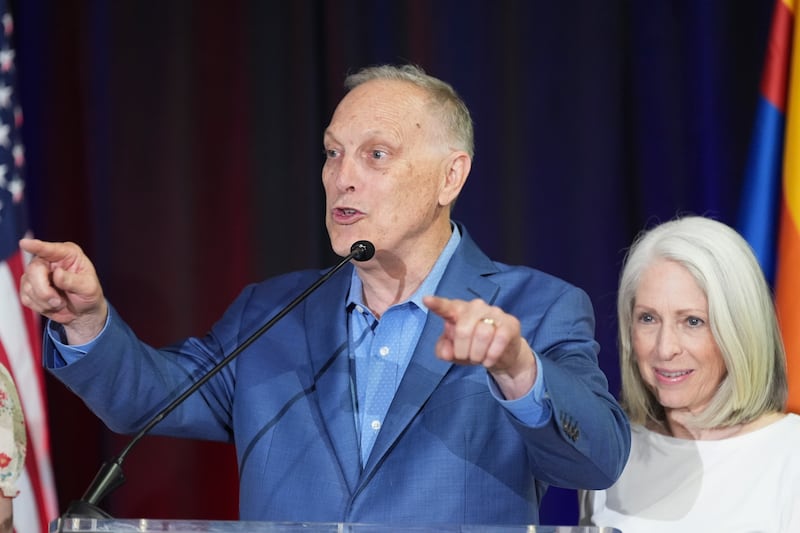
President Donald Trump continued his winning streak with his endorsements on Tuesday, in the purple state he lost in 2020 but won in 2024.
Biggs wins gubernatorial bid after comfortable lead in pre-primary polls
Biggs watched polls open Tuesday with a comfortable lead in public polls and an endorsement from Trump, and it wasn’t long after polls closed that The Associated Press called the gubernatorial race in his favor.
Biggs earned 73.4% of the vote, according to AP, defeating Rep. David Schweikert and businessmen Scott Neely and Ken Miceli.
After his win, Biggs, who was also a state lawmaker for years, turned his attention to his race against Hobbs.
“As we advance to the General Election, I want to make sure every Arizonan knows this: no matter what your political party is or your background, you deserve a better leader than Katie Hobbs,” Biggs said in a statement following the election results.
Hobbs, who was unopposed in her Democratic primary, is also primed for November.
“Andy Biggs has spent his career selling out Arizona families for billionaires, special interest, and even convicted sex offenders,” Hobbs said in a post on X shortly after results were announced. “The more Arizonans learn about Biggs, the more they’ll realize he’s one big problem they can’t afford.”
Hobbs has an advantage as an incumbent, but only narrowly defeated her Republican challenger, Kari Lake, in 2022. The Cook Political Report said Hobbs is “the most endangered Democratic incumbent” but also noted that Biggs may be “potentially polarizing” after refusing to certify the results of the 2020 presidential election. The report recently shifted its evaluation of the race from a “toss-up” to “lean Democratic.”
Lamb claims victory despite sexual misconduct allegations
In securing his name on the November gubernatorial ballot, Biggs leaves an empty House seat behind him, another race where Trump’s endorsement proved successful.
Former Pinal County Sheriff Mark Lamb claimed the Republican nomination, overcoming allegations made by The Arizona Republic claiming he engaged in sexual misconduct.
While some believed the accusations would signal doom for Lamb’s campaign against Daniel Keenan, a home developer, that didn’t prove to be the case. AP called the race for Lamb just minutes after the polls closed on Tuesday.
On the general election, Lamb faces nurse Elizabeth Lee, who won the Democratic primary with 65.2% of the vote.
Feely vows to ‘keep this a Republican seat’
Former Arizona Cardinals placekicker Jay Feely was the only candidate in Arizona’s 1st Congressional District Republican primary with an endorsement from Trump, which proved an advantage in Tuesday’s race.
Feely won 49.7% of the vote, defeating state Rep. Joseph Chaplik and telecommunications executive John Troboug.
When some Republican leaders, including Majority Whip Tom Emmer, R-Minn., and Speaker of the House Mike Johnson, R-La., offered their congratulations, Feely responded by saying he would “keep this a Republican seat.”
“It is time for Republicans to unite, we have a lot of work to do between now and November to ensure we keep this crucial seat RED!” Feely said on social media after thanking voters for their support.
While Feely celebrates his win, Democratic candidates for the district await the results of their race, which was too close to call as of Wednesday morning.
Amish Shah, led with 40.5% of the vote as of midday Wednesday ahead of Marlene Galán-Woods, a former Republican who was backed by the DCCC, who has 33.6%.
The Cook Political Report referred to Arizona’s 1st District as “one of the most competitive districts in the country,” noting that voter loyalty has narrowly switched between Republican and Democratic candidates in recent presidential elections.
If Shah gains the Democratic nomination and moves to the November election, it won’t be the first time his professional path has crossed with Feely’s. Shah, now an ER doctor, once worked as a physician for the New York Jets, a role he filled at the same time Feely was a member of the team himself.
The two could now go head-to-head in November’s high-stakes race, and whoever claims victory in November will replace Schweikert after his unsuccessful run for governor.