

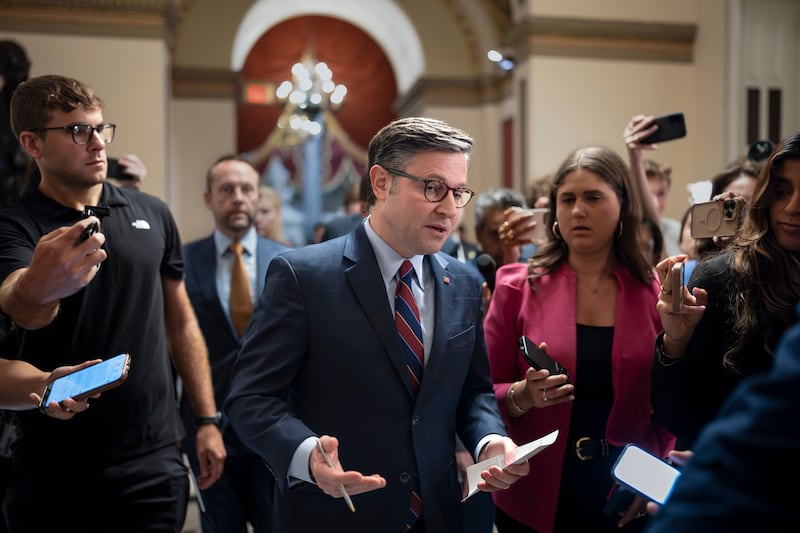

The House narrowly passed a multibillion-dollar budget framework advancing a number of Republicans’ top priorities after a last-minute scramble from GOP leaders to get all corners of the party on board.
The budget resolution was adopted in a 216-214 vote that was approved along party lines. Two Republicans and one GOP-aligned independent joined Democrats to oppose the measure, giving GOP leaders a razor-thin margin to advance the framework before leaving town for the August recess.
Because of Republicans’ slim majority, GOP leaders could only afford to lose two party members on any given vote. Shortly before the vote started, a handful of lawmakers threatened to oppose the measure — sending top Republicans into a frenzy to flip their votes in the days leading up to the vote.
Republican leaders unveiled the budget blueprint just last week, proposing $95 billion to provide supplemental funding to the military as well as enacting portions of President Donald Trump’s desired proof-of-citizenship and voter ID megabill.
The 47-page resolution gives instructions to four different committees to draft the bill over the coming weeks. Those instructions lay out spending ceilings including $60 billion for House Armed Services; $10 billion for House Administration; $12 billion for House Agriculture; and $13 billion for House Intelligence.
Exact details of how that spending will be used are not yet determined. The instructions approved on Wednesday only offer spending maximums for each committee. Lawmakers will draft the actual spending legislation in the coming weeks once the Senate approves its own framework.
Republicans stage revolt over lack of spending cuts
Republican leaders are planning to push the blueprint through Congress through the reconciliation process, which allows the Senate to bypass the 60-vote filibuster and approve the legislation mostly along party lines.
As a result, the framework includes only Republican priorities — leaving the party, with its historically slim majority, to rely only on GOP lawmakers to pass the House. All Democrats voted against the resolution.
Although the resolution is not yet finalized, it’s not expected to include major spending cuts to offset the costs — prompting fiscal hawks in the Republican Party to raise their eyebrows at the multi-billion dollar price tag.
Rep. Warren Davidson threatened to vote against the framework, telling reporters throughout the week he wouldn’t back a blueprint without offsets. Davidson ultimately voted against the bill.
Rep. Thomas Massie, R-Ky., also voted against the resolution, criticizing it as an effort to create a “slush fund” for the war in Iran and a “payoff” to communities suffering from the costs of the conflict. Massie specifically pointed to the agriculture component of the framework to help ease costs for farmers.

“So the solution of this is not to give more money to the war in Iran and more money to the farmers, and then later, more money to Iran and more money to some other industry that’s crumbling because of this war,” Massie said. “The solution is stop the war.”
Rep. Kevin Kiley, a former Republican turned independent, also voted against the bill.
Republicans look to advance SAVE Act in budget bill
Republican leaders managed to head off a larger revolt on the floor by including portions of the SAVE America Act, an election reform bill that has stalled in the Senate for months due to Democratic opposition.
Although the election portion of the framework has not yet been written, it’s expected to include grants or other financial incentives for states to establish the proof-of-citizenship and voter ID requirements. Budget resolutions must pertain to tax or spending in order to be eligible for the filibuster-skirting reconciliation procedure.
But several lawmakers had questions about how those election reform policies would be enforced, prompting White House officials to come to Capitol Hill this week to sell them on the idea.
There are still questions on whether the SAVE America Act adheres to the strict rules of the budget reconciliation process. However, House Republicans hope the budgetary instructions to the House Administration Committee, under which the election bill will be included, will be eligible.
Utah Sen. Mike Lee, the main sponsor of the SAVE America Act in the Senate, told the Deseret News it’s possible some things could be included — but it would depend on how it’s drafted.
“There may be some things they can do to replicate some of the principal benefits of America through reconciliation,” Lee said. “The SAVE America act itself could itself never fly through reconciliation because it is policy and non-budgetary. But there are some things that you could fund through reconciliation geared toward facilitating election security, citizenship verification, and possibly voter ID.”
Here comes the hard part: Getting the Senate on board
It was a grueling process to get House Republicans on board with the resolution. But the hard part is just beginning.
It’s not yet clear how quickly the Senate will move. The framework released on Wednesday does not include instructions for the upper chamber, which will need to be separately drafted.
The pair of instructions will then need to be negotiated and combined until it is one identical resolution. That could take a few weeks, and Senate Majority Leader John Thune, R-S.D., has indicated he wants to prioritize government funding ahead of the October 1 deadline.
Even then, there hasn’t been much appetite among Senate Republicans to pursue a third reconciliation bill.
Timing is not on Republicans’ side. Both chambers are preparing to leave Washington for the August recess, returning in early September. That leaves just three full weeks of legislative business to draft the actual spending resolution and pass both chambers before adjourning for the midterm elections.