

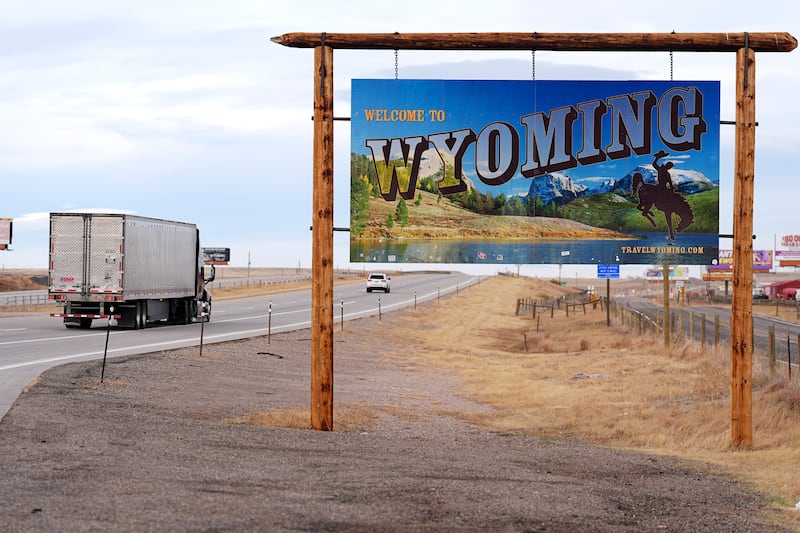

Wyoming’s sole seat in the House of Representatives is almost sure to be won by a Republican, which is why the nine-person GOP primary for the open seat is a feisty one.
The candidates are vying to replace current U.S. Rep. Harriet Hageman, who announced a bid to succeed Wyoming Sen. Cynthia Lummis, who is not seeking reelection.
The candidates who spoke to the Deseret News addressed infighting over money, lawsuits, and crowded candidate forums, as the Republicans battle to earn the hearts of voters in the Cowboy State ahead of the Aug. 18 primary.
Here’s a look at what voters need to know about the race so far.
Candidates on the issues
At a July 23 candidate forum hosted by the League of Women Voters and Wyoming Public Media, eight of the nine candidates tried to differentiate themselves from one another over issues like public lands, Social Security reform and supporting Wyoming’s energy industry.
The candidates include Secretary of State Chuck Gray, businessman Reid Rasner, state Senate President Bo Biteman, businessman and conservative donor Steve Friess, former Wyoming then Virginia State Superintendent of Public Education Jillian Balow, Army veteran Kevin Christensen, congressional staffer and Army veteran David Giralt, homeless advocate Richard Dodson, and former Democratic state senator Keith Goodenough, who is running as a Republican and did not attend the forum.
When the candidates were asked what their first priority would be if elected, Biteman said he wanted to be the state’s “hype man in Congress,” particularly when it comes to the all-important energy sector.
Friess, whose father was conservative megadonor Foster Friess, echoed Biteman’s focus on energy, while Giralt said his first priority would be to reduce the debt.
When asked whether they would support turning control of federal lands over to the state, Gray, who has received the support of the state party, said “public lands must remain in public hands,” but said they must be open for multiple use.
Balow agreed, saying, “the wholesale transfer or sale of our public lands is a generational mistake.”
Most of the candidates rejected the idea of using government shutdowns as a bargaining tactic in budget negotiations. “I am not in favor of shutting down the government,” Rasner said. “And I think we see what a disaster the Democrats have caused for the shutdowns and they’re talking about another one.”
On Social Security, Gray called the program a “promise,” while Balow and Biteman said there were opportunities to curb fraud and abuse. Biteman also called for eliminating the income cap on the Social Security tax. Christensen called Social Security a “contract, not an entitlement.”
How do candidates differentiate themselves?
In an interview with the Deseret News, Balow said there’s definitely overlap on policy issues, given that most of the candidates are fairly conservative. They all support strengthening borders, ensuring elections are secure and honest, and they all want to work for Wyomingites in Congress, if elected, she said.
But what makes any of these candidates stand out?
Giralt told the Deseret News that with so many candidates in the race “I think one of the frustrations has been from the electorate … this has been a very hard race to poll for a lot of different reasons. The only consistent thing I think that has been demonstrated through polling, is that there’s still an incredible amount of undecideds.”
Giralt and Balow both said they have been knocking doors and participating in events across the state.
“I’m in communities every single day. I am talking to local leaders. I’m visiting local businesses,” Balow said. “I’m spending my campaign listening and traveling to those communities, not sending out mailers and kind of popping into a community to show my face.”
Gray, who benefits from the name recognition that comes from serving in statewide office since 2023, pointed to his record.
“I’ve got a real record — fighting for voter ID, pro-life protections, and securing our elections as Secretary of State,” he said in a statement. “I deliver results, not rhetoric.”
As for Rasner, he touted his business experience.
“What separates me in this crowded field is simple: I’ve built things, taken risks and delivered results in the real world,” Rasner said. “I’m not running because I need a title. I’m running because Wyoming deserves a fighter who can actually get things done.”
Campaign finance records tell another side of the story
While crowded, the race has been divided among “self-funders” and others who are pursuing grassroots fundraising efforts.
Second-quarter campaign finance reports filed with the Federal Election Commission show that three of the nine candidates in the primary have lent their campaigns more than $1 million of their own money. It’s something the other candidates, who must raise funds for their races, are hoping to point out to voters in the state.
Giralt said it’s the self-funders against “the rest of us.” At 35, he’s the youngest candidate in the race and running his first campaign. He said he feels “completely outside” because “I can’t touch those guys, and we knew that from the beginning.” Still, with more than $150,000 cash on hand, Giralt said he feels happy about how they have fundraised “on the ground.”
“None of these guys have emerged as a clear frontrunner that has scared off all the other competition, and that even includes me,” Giralt said. “I mean, they’re staying in (the race) … and those guys are all still pretty confident, so I think it’s just going to come down to who appeals to the most people.”
Friess, who joined the race months after several of the top candidates, has raised the most, with FEC disclosures showing $2.17 million in total receipts, including a $2 million loan from the candidate. After spending almost $1.5 million of that, Friess still has the most cash on hand of any candidate in the race.
Rasner told the Deseret News in January after launching his campaign that he put in $1 million of his own money and he “probably” would put more in. Since then, disclosures show Rasner has loaned his campaign an additional $708,500 out of a total $2 million raised.
Disclosures also show Rasner has spent the most out of any of the other nine candidates, almost $500,000 more than Friess. Now, with weeks to go, Rasner has less than $100,000 cash on hand.
This is something Gray is looking to capitalize on. He argues that his more than $445,000 lead in cash on hand may be helpful in the lead-up to the primary.
“We’ve got the money we need to win. We’re raising what’s necessary and staying laser-focused on our message,” Gray said in an emailed statement to the Deseret News. “The resources are there to finish strong and deliver our closing argument to every Republican voter.”
Gray’s disclosures show he’s loaned his campaign $1.14 million of a total $1.3 million raised.
Balow said in an interview with the Deseret News that she’s “the candidate in this race that doesn’t have a lot of money.” But after running two statewide campaigns in Wyoming, she said she believes that voters care about showing up.
“I’ve been a voter in this state since I was 18. I’ve worked on different local campaigns since I was really young, like fifth grade. And if there’s one thing I know, it’s that Wyoming voters can’t be bought,” she said.
Rasner’s defamation suits
In the midst of his campaign, Rasner has filed five defamation lawsuits against members of his own party.
He said it isn’t how he wanted to spend the final weeks of his race, but said he felt like he had no choice but to defend himself against people who are “calling me the most terrible thing you can think of.”
Rasner — who is openly gay, and a staunch supporter of President Donald Trump — said the defamation suits stem from allegations that he’s a pedophile.
Among the five suits filed, one is against a former Republican state senator, who Rasner alleges has been running a “whisper campaign” against him accusing him of sexual assault. He recently earned a win in court when a judge denied a bid to dismiss the case.
Rasner also recently settled another case with an Iowa man who Rasner said defamed him online.
Rasner, in an interview with the Deseret News, said the legal battles have left him feeling unwelcome at state Republican events, including a recent barbecue in Laramie, a claim the organizer denies.
“It’s just making it harder for us to campaign around the state. We’re having to do things a little differently,” Rasner said.
Nathan Winters, the president of the Wyoming Family Alliance, said his organization “held off” from inviting Rasner to one of their events because they believe there are allegations against him that are “very serious and should be treated with dignity and seriousness.”
Winters pointed to a video Rasner shared online kicking in bathroom stall doors talking about transgender individuals using women’s restrooms. At Wyoming Family Alliance and other conservative organizations, Winters noted there are people who have been “working hard in this space” to ensure girls have private restrooms.
“It just became clear that he was operating in a way that the rest of the candidates were not, and it did not reflect the kind of values that we believe rather deeply,” he said.
There were 10 candidates
In late July, attorney Frank Chapman, who had loaned his campaign hundreds of thousands of dollars, dropped out of the race, dropping the number of candidates from 10 to nine.
He told Wyoming radio station KHOL the race was too crowded, and he believes Trump hasn’t endorsed any candidates because the race is too close.
“The forums weren’t productive because you’ve got too many people. It just creates a lot of clutter for the voter,” he said, worrying that “normal” candidates could end up splitting the votes.
Contributing: Suzanne Bates