

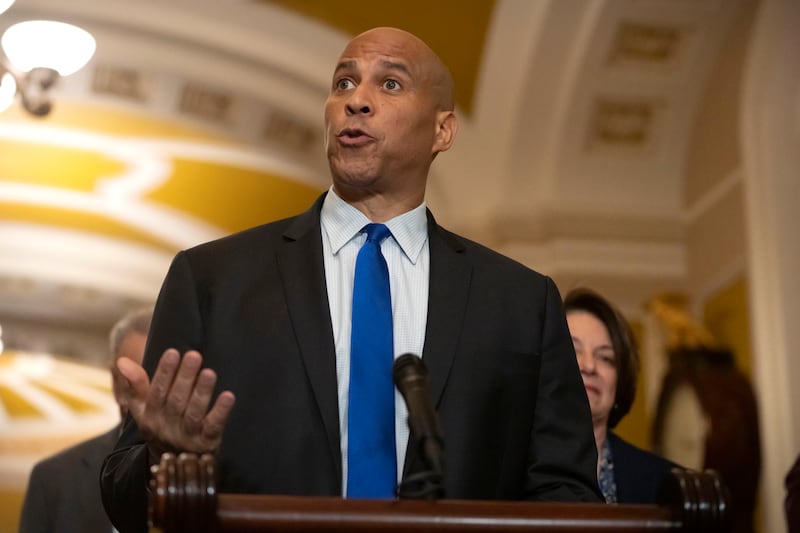

- New Jersey Sen. Cory Booker is scheduled to hold a fundraiser in Park City.
- Booker has raised more money than nearly any other U.S. Senate candidate.
- He is using a committee made to carry funds from his 2020 presidential bid.
Officially, the 2028 Democratic presidential primary has not begun. But the money tells another story.
Congress members in deep-blue districts are raking in millions despite likely victory in November.
U.S. Sen. Cory Booker has $23 million in cash on hand for his solidly Democratic seat in New Jersey.
Reps. Ro Khanna, D-Calif., and Alexandria Ocasio-Cortez, D-N.Y., have around $16 million for theirs.
On Wednesday, Booker is scheduled to make a fundraising pitch to Utah donors in Park City.
The invitation, obtained by the Deseret News, features a smiling Booker soliciting support for the “Booker Victory Fund.”
The joint committee helps fund his Senate campaign, the New Jersey Democratic Party and the Senate Democrat campaign arm.
Booker registered the entity the same day he suspended his 2020 presidential run, giving donors a place to support a future bid.
For new or returning donors, Wednesday’s event is billed as an exclusive one-on-one, costing anywhere from $250 for a guest, to $5,000 for a co-chair.
Utah Democratic Party Chair Brian King will question Booker on “the issues shaping our communities and our country,” the party said in a statement.
The candidate’s trip out West sends a not-so-quiet signal to a crowded field, according to Larry Sabato, the director of the University of Virginia Center for Politics.
“That tells me he’s serious about it,” Sabato told the Deseret News. “And he should be; you know, when you get to your second and last try, you want to pull out all the stops.”
Sabato’s Crystal Ball newsletter counts 38 Democrats already making moves to indicate interest in entering the race. And he wouldn’t be surprised if half of them do end up running.
The upcoming presidential election is gearing up to be a pivotal moment in how the Democratic Party chooses to define itself without their favorite foil of President Donald Trump.
If democratic socialist-leaning candidates win statewide in midterm battlegrounds like Michigan and Wisconsin, then the party’s future may look like a lurch to the left, Sabato said.
Booker, as a mainstream Democrat with some more progressive views, could be angling to take advantage of that energy, he added, but the main pitch will still be blocking a Trump-picked successor.
Who’s leading in the polls?
Polls show many Democrats want a familiar face. More than a dozen recent surveys show that 20-40% of Democratic voters want a repeat of Kamala Harris’ 2024 nomination for president.
Following Harris are California Gov. Gavin Newsom and Ocasio-Cortez. But if you remove Harris, Ocasio-Cortez and former Transportation Secretary Pete Buttigieg rise to become the top contenders.
A Granite State poll found Booker with 2% in a hypothetical primary. Likely Democratic voters had the most favorable views of Buttigieg, Ocasio-Cortez and Vermont Sen. Bernie Sanders.
But the 2028 Democratic primary will feature far more names than those on the typical short list, said Steven Pierce, director of Winning Jobs Narrative, a Democratic-aligned nonprofit.
“You’d be shocked by the number of people who are thinking about running for president,” Pierce told the Deseret News. “People would be surprised at the breadth of folks that are taking a look at being part of that field.”
This category includes figures ranging from Pennsylvania Gov. Josh Shapiro, to members of Congress to just about every federal or statewide elected official, Pierce said.
As 2028 draws nearer, what Booker is doing will become the norm, Pierce said: Democratic officials helping the party campaign to build their own networks before they announce their candidacy.
Such an electoral free-for-all is not a bad thing, according to Pierce. Packed primaries give voters a chance to test candidates, spot weaknesses and determine the future of the Democratic Party.
This contrasts with the Republican Primary which some are treating as almost a foregone conclusion, with Vice President JD Vance and Secretary of State Marco Rubio as presumptive frontrunners.
What’s the winning message?
A perception that Trump maintains a hold on the GOP could create an opportunity for Democrats to really tap into economic populist energy, said Ben Haynes, a senior partner at Elevate Strategies.
“The message that is clearly resonating with folks is that the wealthy continue to get more and more powerful while the middle class continues to shrink,” Haynes told the Deseret News.
Reports of the Democratic Party establishment being torn over the success of candidates who are aligned with the Democratic Socialists of America are “overblown,” according to Haynes.
The party needs red-state Democratic candidates like Gov. Andy Beshear and Sen. Jon Ossoff, Haynes said, who incorporate working class solidarity into campaigns that appeal beyond urban strongholds.
As one of the activists trying to turn ruby-red Utah into a swing state, Haynes is encouraged by Booker visiting Utah long before most candidates would make the obligatory campaign pit stop in Park City.
“A message that can only win in a certain place is not a helpful message,” Haynes said, later adding, “In order to be the next Democratic nominee, in order for Democrats to make change, they have to go fight places where the battle is the hardest.”