



This article was first published in the Ute Insiders newsletter. Sign up to receive the newsletter in your inbox each Wednesday night.
In a season where Utah’s offensive production was lacking, the Utes’ defense kept them in games.
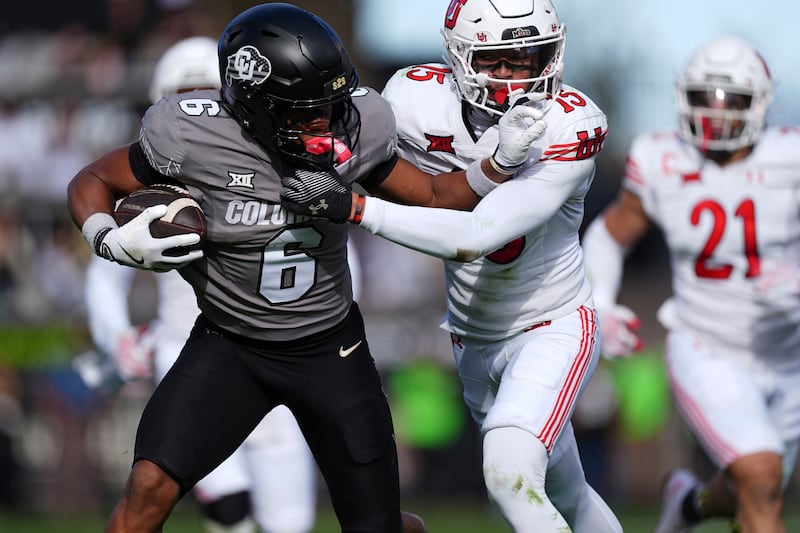
Despite only averaging 23.6 points per game on offense this season, Utah was only blown out once — 49-24 at Colorado — and even in that game, the Utes were in it in the fourth quarter.
Utah’s defense was not perfect this season — there were too many missed tackles, especially early on, the pass rush never hit the elite level expected out of Utah and coverage was lacking at times.
And there were times where the defense could have sealed the deal with a game-ending stop and didn’t (vs. BYU and Iowa State), but overall, without much offensive support, the defensive unit should be commended for its play this season.
Utah allowed 20.7 points per game (No. 28 in the nation) and 329.7 yards per game (No. 30) in another good defensive season.
Here’s a position-by-position look at how Utah’s defense performed in 2024.
Defensive line

This group faced injuries all season long, with the starting front four — Connor O’Toole, Junior Tafuna, Keanu Tanuvasa and Van Fillinger — only playing together a few times during the season.
Partly due to the injuries, it was a bit of an up-and-down season for the defensive line, which didn’t produce as many sacks this season as Utah fans have become accustomed to — 24 this year, which ranks No. 65 in the country.
While the unit as a whole didn’t have the year some thought it would when the season started, one player in particular was consistently good: Tafuna.
Tafuna made the most of his senior year, playing in 10 of Utah’s 12 games and finishing with 31 tackles (three for loss), an interception and a forced fumble while being a leader and someone the team could count on.
Tanuvasa, O’Toole and Fillinger all had good moments, but the time missed between them proved to be too much.
Fillinger led the team with six sacks and was especially impactful early on in the season, while O’Toole had 2.5. Logan Fano, who returned from an ACL tear, contributed 35 tackles and 2.5 sacks.
The group was touted as the strength of the defense ahead of the season, but it never all fully came together in 2024.
Linebackers

Ahead of spring ball, this position group was looking set, returning all of their top three linebackers — Karene Reid, Lander Barton and Levani Damuni.
Like the defensive line, injuries threw a wrench into this position group, starting with Damuni, who suffered a season-ending injury during spring camp. Reid also suffered an injury that saw him miss four games, but when he did play, he was back to his usual self — the leader of Utah’s defense.
Barton, who had an ascendant season in 2023, got off to a slow start this year, and it took him a while to get into the swing of things after a season-ending injury. It didn’t help that Reid was injured, forcing Barton to take on more responsibility.
It wasn’t the season that many were expecting Barton to have, but in the last month of the season, he looked back to his old self, extending Utah’s pick-six streak with an 87-yard interception return for a touchdown in the penultimate game of the season against Iowa State.
His best game of the season came in the finale, as he forced a fumble and had two tackles for loss in Utah’s win over UCF.
Johnathan Hall gained valuable experience, moving from safety to linebacker, and could be in the mix for a starting job next season.
Cornerbacks

Georgia Tech transfer and starting cornerback Kenan Johnson suffered a season-ending injury on one of the first series of the season for the Utes. Down a starter as soon as the season started, Utah used a tandem of Elijah Davis and Cameron Calhoun to fill in.
In Calhoun, a redshirt freshman transfer from Michigan, the Utes may have found their cornerback of the future. He filled in admirably and finished the season as one of the highest-graded players on Utah’s defense. Receivers had a 48.8% completion rate against Calhoun — one of the lowest on the team.
Smith Snowden blossomed in his first year in the starting nickelback role. He had 48 tackles, two interceptions (including a pick-six), and eight pass breakups while holding receivers he faced in coverage to a team-low 41% completion rate.
Meanwhile, Zemaiah Vaughn didn’t have the season he was expecting to in his senior year, finishing with a PFF grade of 62.5, though he did end his season on a high note with a pick-six vs. UCF.
Safeties
Perhaps the most-hyped player on the defensive side of the ball this offseason was Tao Johnson, who made the move from nickelback to starting free safety.
For the most part, Johnson lived up to that hype all season long, becoming the type of rangy free safety that defensive coordinator Morgan Scalley loves to have in his defense.
Johnson finished the season with a team-high 85.3 PFF grade while playing in all 12 games for the Utes. He had a team-leading 70 tackles, plus an interception, five pass breakups and a forced fumble. He also returned a blocked field goal for a touchdown.
Alaka’i Gilman and Nate Ritchie both started at strong safety at points this season to mixed results, but Rabbit Evans emerged at the end of the year, starting the final three games and turning in good performances in each of them.
Johnson and Evans will likely be Utah’s starting safety tandem next season.
In case you missed it
Utah inked its 2025 recruiting class during Wednesday’s early signing day, signing over 20 high school players. Here’s a look at each player, with film for most of the signees.
From the archives
Extra points
- How Utah women’s basketball upset No. 3 Notre Dame (Deseret News)
- Micah Bernard takes his final bow (Deseret News)
- ‘We deserve the seed’: What draw did Utah volleyball get in the NCAA tournament? (Deseret News)
