Brayden McNabb is one of the lucky ones. As lucky as you can be after taking a puck to the face, that is.
It happened in Game 2 of the Stanley Cup Final on Thursday. While manning his post in front of the net, the Vegas Golden Knights defenseman inadvertently got in the way of Nikolaj Ehlers’ shot — and his nose took the entire impact.
Medical staff took him straight to the hospital, where he got too many stitches to count (he said the number was in the 20s or 30s).
In true hockey player fashion, McNabb returned to action 48 hours later, playing nearly 36 minutes and recording a pair of assists in a double-overtime Golden Knights win.
But not everyone’s ending is quite so happy.
In a March 2011 game against the Colorado Avalanche, then-Vancouver Canucks forward and current Canucks head coach Manny Malhotra took a deflected puck to the face. The puck rose a couple inches higher than the one that hit McNabb, causing permanent damage to his left eye.
After multiple surgeries, Malhotra would return to action in the Stanley Cup Final that summer — but the road to recovery was still far from over. Three abbreviated seasons later, he’d hang up the skates for good.
A key difference between McNabb’s and Malhotra’s respective injuries is the level of protective equipment each was wearing. McNabb wears a plexiglass visor, whereas Malhotra played with no face protection at all.
It’s been speculated that without the visor, McNabb’s injury could have been much worse.
The list of guys who play without a visor is dwindling because in 2013, the NHL instituted a mandatory visor policy. Anyone who had played in the league prior to that point was grandfathered in under the old rule — and a few still remain — but newcomers must wear them.
It might be time for an additional rule change.
From youth hockey all the way to college, visors are not deemed sufficient in protecting players’ faces. In those leagues, it’s mandatory to wear a full face shield. In the NHL, on the other hand, full face shields are categorized as “dangerous equipment” under rule 9.8 and may only be worn by players who have facial injuries.
Had McNabb or Malhotra been wearing one of these, the puck would have bounced off the metal cage or plexiglass shield, leaving the player with nothing but a sigh of relief.
Whether the league should make full face protection mandatory can be debated, but giving players that option should be a no-brainer.
How to implement a rule change in the NHL
NHL players generally detest change. That’s evidenced by the fact that most guys wear the same shoulder pads, elbow pads and shin pads until the equipment managers can no longer repair them — despite the fact that they don’t have to pay for any of it.
If the NHL ever had intentions of making face shields mandatory, you could imagine how hard it would be to get players to place an extra barrier between their eyes and the playing surface.
But what those players refuse to acknowledge is that, as mentioned, they all grew up playing with full face protection. The only change happened when they switched to visors at the major-junior or pro levels.
A rule change would have to be grandfathered in, just like it was when visors became mandatory, and when helmets became required before that. As became the case with those previous rule changes, the coming generation of NHLers wouldn’t think twice about it because of how common it would be.
Remember, the first 57 years of the NHL’s existence featured goalies playing without masks. Nowadays, the very idea is preposterous.
Another prudent proposition
Along the same lines, there’s a good case to make neck guards mandatory in the NHL.
As is the case with face shields, players are required to wear neck guards until they get to the NHL, but once they get there, almost all of them choose to go without them.
This discussion really took off in 2023 when former Pittsburgh Penguins forward Adam Johnson, who was playing pro hockey in England at the time, died from a laceration to his neck during a game.
After Johnson’s death, a number of pro hockey leagues — including the NHL’s top minor-league affiliate, the American Hockey League — immediately mandated the use of neck guards. Several NHL players began wearing neck guards voluntarily, but it has yet to become commonplace in the top league in the world.
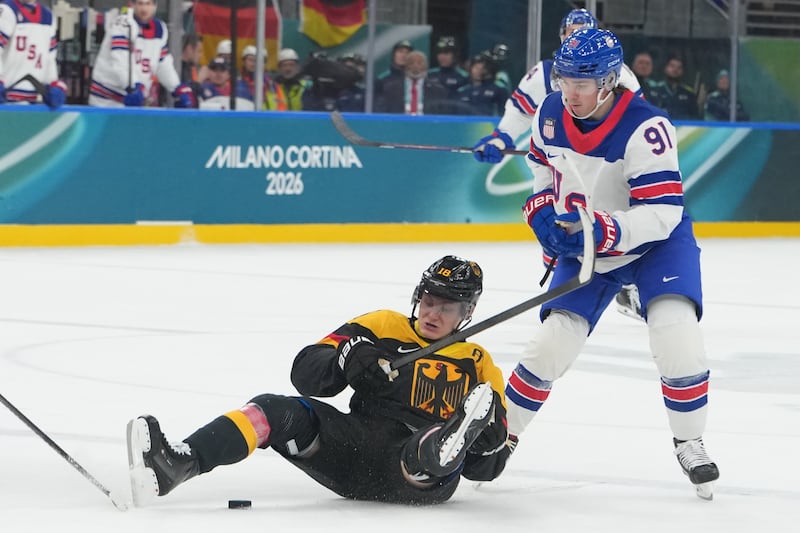
Where the best players in the world did have to wear neck guards was at the 2026 Winter Olympics in Italy.
“At the start, it was kind of annoying,” Utah Mammoth forward JJ Peterka, who played for Team Germany, told the Deseret News after the Olympics. “But I think if you get used to it, it (will be) different. But definitely, it (takes) some time to get used to it.”
Clayton Keller, who won gold with Team USA, said he didn’t really notice a difference, but he’s aware that every player is different and not everyone would want to make that change.