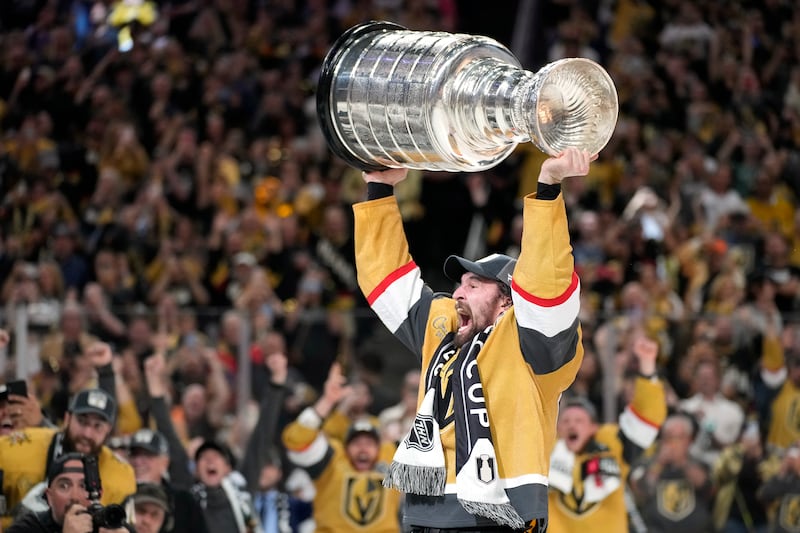

Most NHL general managers love the phrase “building through the draft.” One who doesn’t is Kelly McCrimmon, the mastermind of the Vegas Golden Knights, who currently sit two wins shy of their second Stanley Cup championship.
Ever since the Golden Knights entered the league in 2017 (at which point McCrimmon was an assistant GM), they’ve done things differently.
They weaponized the expansion draft, for example, acquiring assets in exchange for the assurance that they would take specific players, rather than others. Those trades landed them Marc-André Fleury and William Karlsson, among others, who would become integral parts of the squad’s run to the Stanley Cup Final that spring.
In a league where virtually every expansion team of the last 30 years had started from the bottom, the Golden Knights were competitive from Day 1.
To stay competitive, the team has been ruthless with its trades.
If a player gets paid too much, they have no problem trading him — no matter how beloved he is to the fans.
Of the 13 first-round draft picks the franchise has owned (including this year’s), only one of those players is still with the organization and none of them have played a full season in a Golden Knights jersey. Every promising prospect is dealt for win-now pieces.
In fact, the only Vegas-drafted players to have suited up for the Golden Knights in these playoffs are Pavel Dorofeyev and Kaedan Korczak.
This aggressive management style has led the Golden Knights to sustained success. In their nine seasons, they have made the Stanley Cup Final three times and the Conference Final five times.
The Carolina Hurricanes, the Golden Knights’ opponent in the current Stanley Cup Final, are built in a somewhat similar way. They haven’t outright neglected the draft, but a number of their key players came through free agency and trades.
The NHL is famously a copycat league, so it’s inevitable that teams will try to replicate, at least in some way, the success of this year’s finalists. But what does it take to actually pull it off?
Factors of building a winning NHL team in 2026
Climate
Seven consecutive Stanley Cup Finals have featured at least one team from a warm-weather city. That’s far from the only factor that makes players want to play for a given team, but it’s growing increasingly clearer that players want to be in destination markets.
Who wouldn’t want to drive their golf cart to the rink in their shorts and flip-flops in February?
Facilities
When Rick Tocchet’s coaching contract with the Vancouver Canucks expired, he declined to sign an extension. It was widely speculated that the Canucks being the only team in the league without a practice facility was part of his decision — and he hinted at it on the Donnie and Dhali radio show.
It may seem minor to outsiders, but coaches and players alike want the best of the best when it comes to facilities, travel and every other area where the team can choose to spend extra money.

Taxes
NHL commissioner Gary Bettman will deny it until his last breath, but taxes weigh into players’ decisions on where to play. But the players themselves are starting to acknowledge that it does, in fact, matter.
For example, per PuckPedia’s tax calculator, someone earning the 2024-25 league-average salary of $3,817,293 would pay a hair less than $2 million in taxes in Toronto, keeping less than half of his money. But if that player were to sign in Dallas for the same cap hit, he’d pay a little less than $1.37 million.
When it comes to the big-name players, who make a lot more money than that, the difference is even more stark.
The NHL currently has six teams in no-tax states, and at least one of those teams has played in the Stanley Cup Final in seven consecutive seasons.
Attention
Gone seem to be the days of NHL players wanting the spotlight.
In an era where every fan has a platform to make a viral observation, players are becoming more cautious in what they say and do — especially in markets where hockey is the biggest show in town.
And when given the chance, many of them are leaving for quieter markets.
Golden Knights forward Mitch Marner is a prime example of that. He spent nine years as the scapegoat of the Toronto Maple Leafs, the most media-crazed club in the sport. When he finally got the autonomy to choose his destination, he opted for a city where he isn’t even among the top 50 most famous people.
Quinn Hughes and Matthew Tkachuk have done the same, and with the recent reports that Dylan Larkin wants out of Detroit, a trend seems to be forming.
Competitiveness
All the other factors weigh into players’ decisions on where to sign, but they’re all moot if the team isn’t competitive.
That’s why a high-tax, cold-weather, high-attention place like Edmonton can retain some of the best players in the world, while a low-tax, warm-weather, low-attention place like Nashville struggles to make the playoffs year after year.
Team management has little to no control over most of the factors, but it has all the control over this one. If you want to attract high-end hockey players, build a winning environment.