


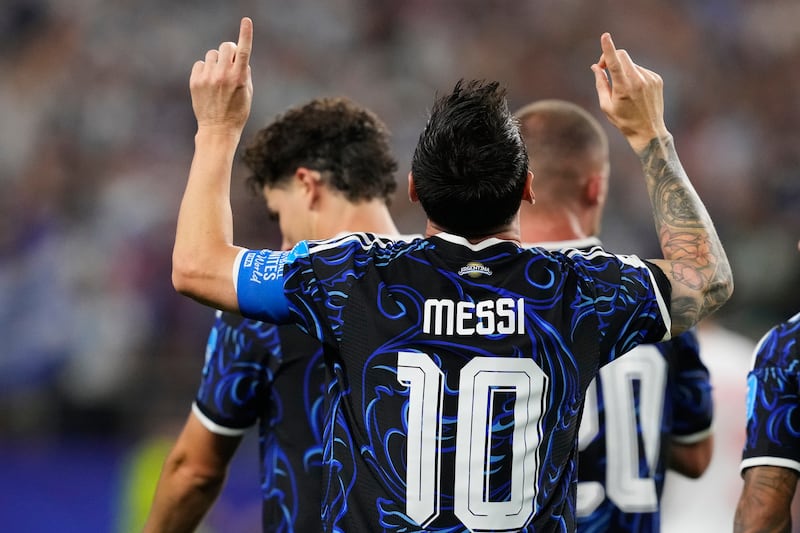
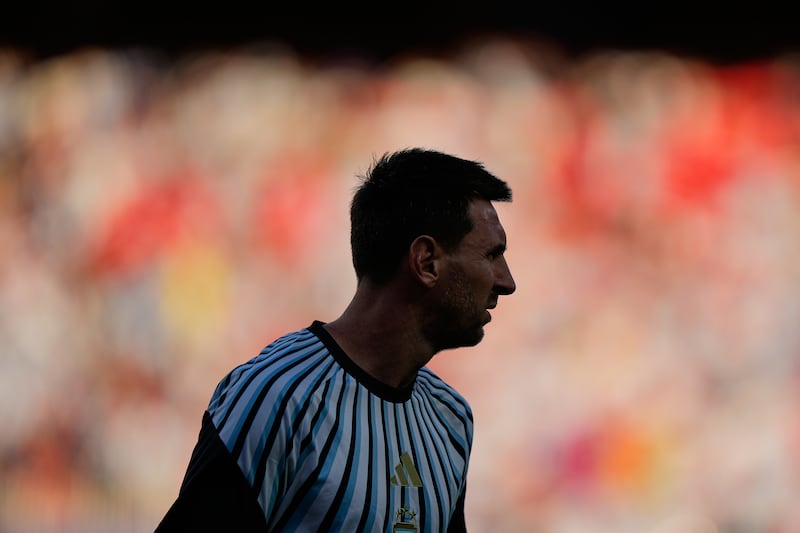
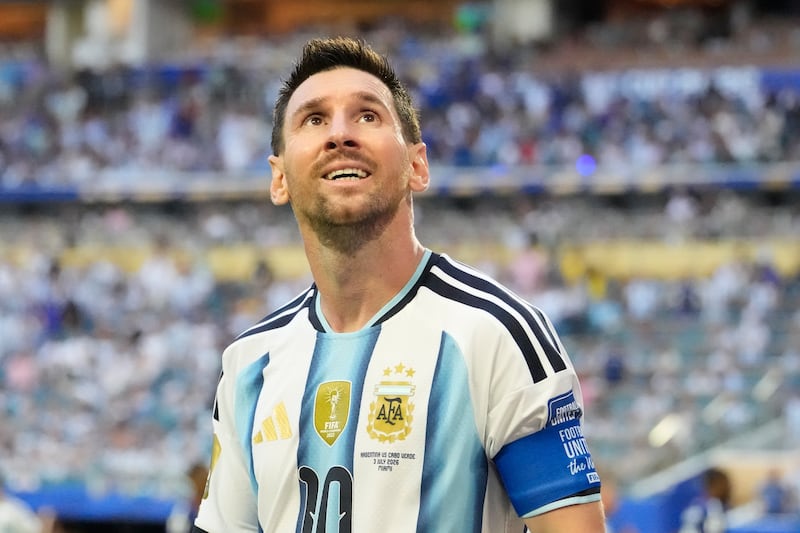
After Lionel Messi, the near-undisputed greatest soccer player who has ever lived, secured his first-ever World Cup hat trick against Algeria back in June, he blessed himself with the sign of the cross.
That’s common for Catholic athletes like Messi. Less common are his religious tattoos — one depicting Christ wearing a crown of thorns on Messi’s right shoulder; another, sprouting like a spider web around his right elbow, showcasing a stained-glass rose window, likely inspired by a church in Barcelona, where Messi spent most of his career.
Even less common, though, was what he said after that game. “I can’t ask for anything more,” Messi told reporters. “God gave me too much.”
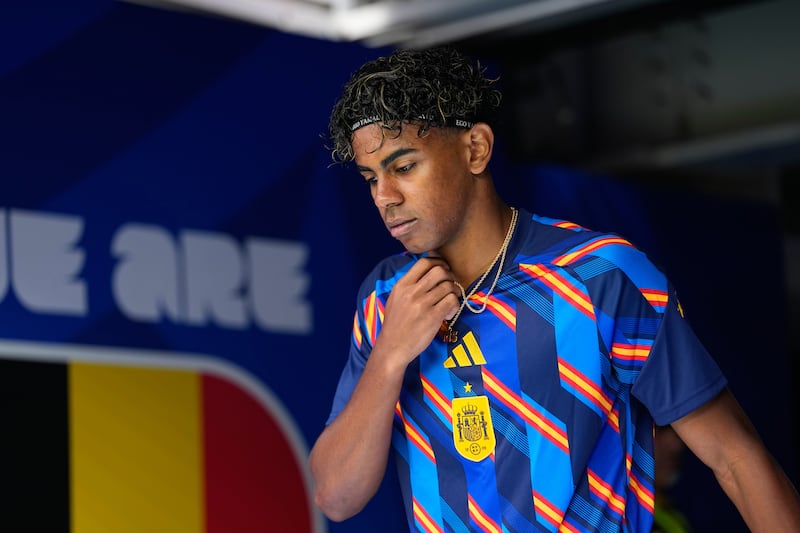
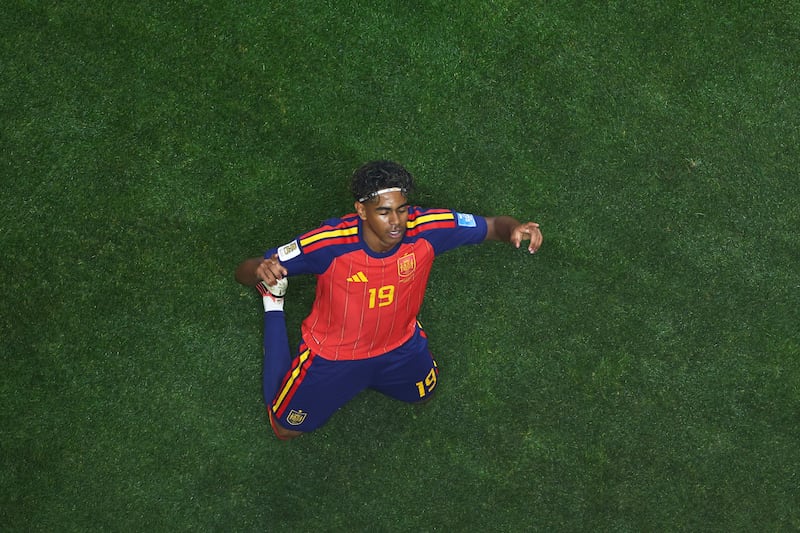
Apparently not, because on Sunday, Messi’s defending champion Argentina will play once again in the World Cup final. This time against Spain, whose best player is, in some ways, Messi’s heir at Barcelona. He is Lamine Yamal, a 19-year-old who even inherited Messi’s No. 10 jersey at Camp Nou.
He’s an up-and-coming superstar who represents a historically Catholic nation that, nowadays, is largely secular — while he himself is Muslim. Like Messi, he celebrated a goal in his first start of the tournament. Rather than a sign of the cross, though, he prostrated himself and pressed his head to the turf, a Muslim prayer ritual called sujood.
“Let’s go Spain!!” Yamal wrote in Spanish on his Instagram page after winning that game. “Thank you all for the support, always with God.”
Both men, in their respective moments of triumph, turned instinctively to God — just in different directions.
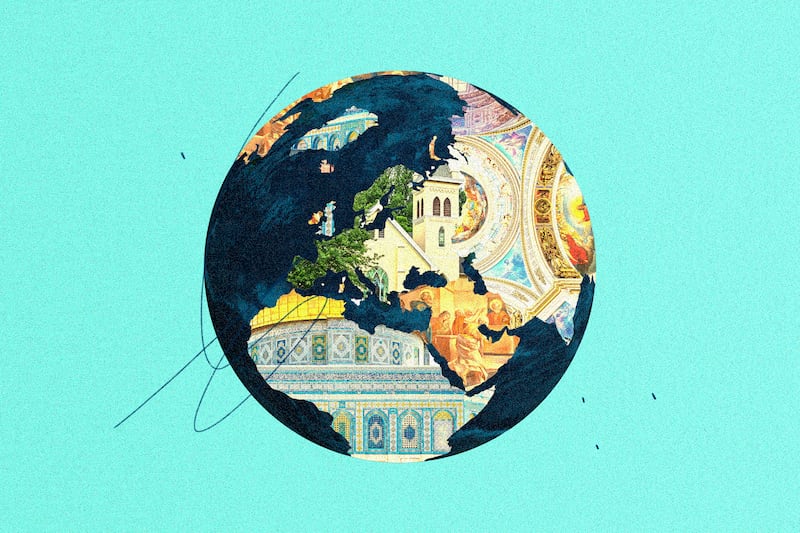
Their shared instinct has become a defining feature of the world’s biggest sporting event. As Interfaith America observed earlier this month, “Religion is all over the 2026 World Cup,” offering a blueprint for what religious tolerance and cooperation can look like at their best.
And while it starts with Messi and Yamal, the phenomenon spans the globe:
- On June 10, a day before the World Cup’s opening match, Pope Leo XIV declared, “Soccer helps us remember something very important: life is not a race to live in isolation; it is a team sport, and we have to learn to work together.“ Later, on July 6, he confirmed he was rooting for the United States, his home country, in the tournament. The Pope’s June prayer intentions also nodded to the World Cup: “Let us pray that sport may be an instrument of peace, encounter and dialogue between cultures and peoples, and may promote values such as respect, solidarity and personal growth.”
- German midfielder Felix Nmecha, after scoring a goal in his country’s opening game against Curaçao, performed a celebration where he knelt, mimed the removal of a crown from his head, placed it at his feet and pointed to the sky. “All the glory I give to God,” he said after the match, “because He is the one who has given me this talent and the opportunity to be here living this dream.”
- After that same game, a group of German and Curaçaoan players gathered to pray together, despite Germany’s crushing 7-1 victory. “We simply said a little prayer together because we are all still feeling very grateful for everything that has happened,” Nmecha said. “Overall, we all believe that Jesus is glorified through the game, and that is why we came together.”
- Before their opening match against England, a pair of Croatian players explained the depth of their Catholicism. “We are a country in which we are Catholics and in which faith means the path in our lives,” one of them, Kristijan Jakić, told EWTN News. “I think faith represents the entire national team. Faith simply means everything in our lives.”
- When Spain beat France in the semifinal to advance to Sunday’s game in New York, Salvadoran referee Iván Barton officiated the contest with a silver crucifix dangling from his whistle.
- The American team was particularly expressive about their faith. Christian Pulisic, the team’s star player, is proudly Christian and even leads Bible study groups with teammates called “Bible Time.” More visibly during the World Cup, defender Mark McKenzie led postgame prayers during the team’s five-match run.
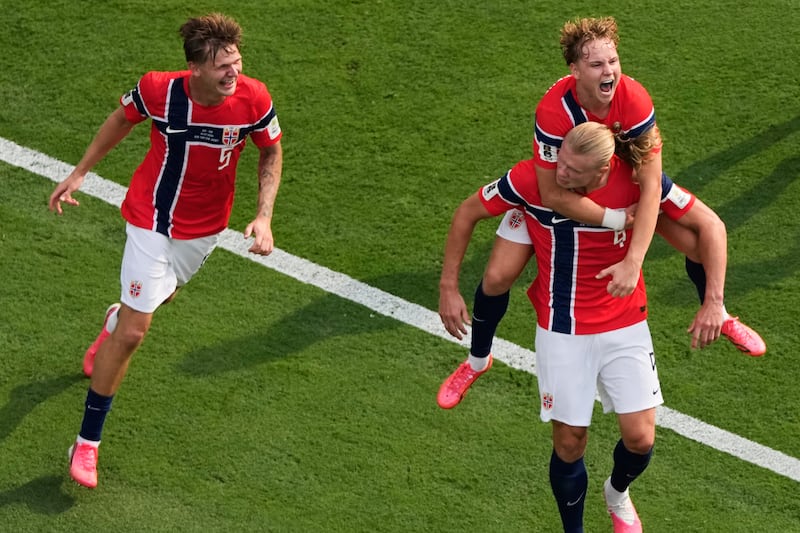
- Though the tournament’s breakout star, Norwegian striker Erling Haaland, is not outspokenly religious, his team’s uniforms were inspired by the country’s Urnes Stave Church. Carvings found in the church, built in the 12th century, were embedded in the fabric of the blue crosses on the team’s “home” jersey.
- Egypt’s entire team practiced sujood after scoring goals, as did Morocco and Swedish midfielder Yasin Ayari.
- FIFA has accommodated Muslim players who have won “Player of the Match” awards, which are normally sponsored by American beer brand Michelob Ultra. The Muslim players, whose religion views alcohol as forbidden, or “haraam,” have instead received an alcohol branding-free trophy. The accommodation is technically open to anyone at the tournament who wishes to use it, including players like Yamal who, religion aside, is also under 21.
All of which helps explain why Brad Kenney, team chaplain for Major League Soccer’s Colorado Rapids, doesn’t believe in slogans like “religion has no place in the locker room.”
He’s heard it many times, and he understands the temptation; professional soccer teams typically combine people of very diverse faiths, backgrounds and geographies.
“But it’s sort of short-sighted. Because when an athlete or coach or staff member comes into work, they bring all of themselves,” Kenney says. “And I think what we’re seeing, especially in this World Cup, is we’re seeing the expressions of people of faith in the midst of the highs and the lows of the beautiful game.”
For Kenney, it all feels somewhat familiar. He’s Christian, but he’s worked with many players who aren’t — including a Muslim player who once confided in Kenney that he planned to fast for Ramadan. “Have you spoken to anyone about your desire to observe the fast?” Kenney asked. No, the player told him; he was afraid it might cost him his role on the team because of fears about poor performance. “If you trust me,” Kenney told the player, “I’d like to try and see if we can support you.”
The player’s fears turned out to be well-founded. Team support staff and coaches balked at the possibility of him playing at anything less than ideal nutrition and hydration levels. But eventually, Kenney helped broker a nutrition/hydration plan and got the coaches on board. The player fasted and played throughout Ramadan. Afterward, the player and Kenney got together to eat and celebrate the end of the fast.
“Why did you do this?” the player asked him then. “Why did you advocate for me?”
“Because,” Kenney told him, “I care for you.”
From there, the two launched into a dialogue about some of the differences and similarities between their faiths. Kenney has seen that happen again and again thanks to soccer.
Another Rapids team featured a devout Christian and a staunch atheist who teased each other relentlessly in the locker room. Kenney remembers one time when the Christian player came to him and said, “We need to get you in the locker room so you can defeat this guy and his arguments.” Kenney explained he was not there to win arguments, even though the player himself was welcome to argue away. However, Kenney also offered a suggestion. “Even though he’s an adversary,” Kenney told him, “you need to really see him as a friend.”
It didn’t happen immediately, but over time, their friendship did deepen. They saw each other more fully and began to trust each other. Until eventually, rather than tease the Christian player about his beliefs, the atheist player started asking genuine questions about them. Trying to understand them.
“You saw a depth of relationship starting to form,” Kenney says. “So those things give me hope.”
In each case, soccer was the common ground — the shared activity that made the relationship possible. Now that same hope is visible for millions around the world thanks to the World Cup. Religious expressions are not exactly new to soccer, but their visibility at this year’s tournament does feel unprecedented.
“We’ve never seen this before,” says Jesse Bradley, team chaplain for the MLS’ Seattle Sounders. “If you start with our national team praying together after every match — the entire team, whether they win or lose — that’s new.”
And it’s not limited to the United States.
Bradley suspects, rather, that the trend is generational — and that it will accelerate.
“What I’ve seen in this younger generation is that they don’t want a hidden life,” he says. “Who they are in private is who they want to be in public. If faith is really significant for them, they don’t want to be silent or pretend like it isn’t.”
Yet the most remarkable thing about faith at the World Cup is how, even when lived loudly, it can still exist largely in the background of the game itself. The game is a vessel that allows diverse identities to flourish within it, whatever their differences off the pitch.
“When I play pickup soccer, literally on my team, there’s someone from Russia and there’s someone from Ukraine,” Bradley says. “And we have a great, great time together. We’re all just teammates.”
That’s not coincidental. Soccer can help cross divides because it embodies what Eboo Patel, founding president of Interfaith America, sees as the fundamental requirement of pluralism, religious or otherwise: a shared activity.
Other things we can share — like virtues or a common purpose — tend to be more abstract. But shared activities form the fabric of true nations. We are what we do together.
“Nobody disagrees with soccer,” Patel says. “Nobody disagrees with backgammon. Nobody disagrees with community theater.”
Pluralism begins, Patel says, with identity; with an acknowledgment that we are all different, and that’s OK. Those differences in faith, culture, language or heritage make us who we are.
“I think one of the main questions of our era is, can diverse people respect, relate, and cooperate together?” Patel says. “Can we welcome a variety of identities and still have a strong community?”
If the answer is going to be yes, Patel says we need to start with respecting identities — then move toward building and maintaining relationships across those identities. Only then can we support a more enduring community like a nation.
“That’s pluralism,” he adds. “And that’s what we’ve seen in the World Cup.”
He’s also fascinated by Yamal, the Spanish star who represents a country that, in 1492, put an end to 700 years of Islamic rule. Within 10 years, the reigning Catholic monarchs decided all remaining Muslims had to convert to Christianity or face expulsion.
“Imagine what (King) Ferdinand and (Queen) Isabella would be thinking right now,” Patel says. “Imagine what they would be thinking watching (Lamine Yamal) represent the country.”
Look, then, at how far we’ve come.
“We need people from a range of backgrounds to contribute the best of their abilities, which is often inspired by an identity, in order for us to be the best kind of community that we can be. And it is on full display right now in athletics. It’s on full display in the World Cup,” Patel says. “Is there anybody in Spain who doesn’t want Lamine Yamal on the team?”
Come Sunday’s final, Yamal and Messi will be playing on opposing teams, representing different countries and expressing different faiths. If Messi scores, he’ll bless himself with the sign of the cross, the way he always has. If Yamal scores, he’ll press his forehead to the turf, the way he probably always will.
Different prayers on the same field. Different faiths in pursuit of a common goal.