

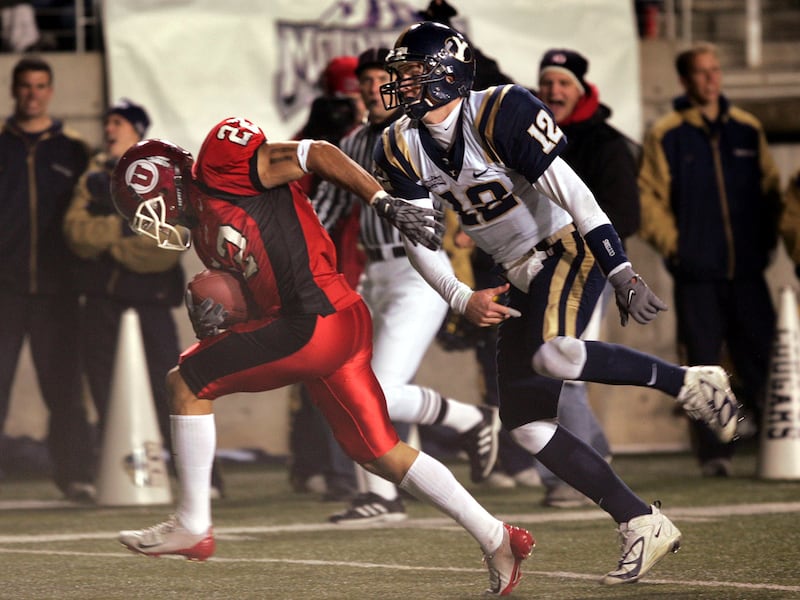

Bo Nagahi reached some of the highest highs available in college football during his senior season at Utah.
A captain for Utah’s 2004 team, Nagahi started at cornerback and was a punt returner for the Utes, who went 12-0 and became the first team from a nonautomatic qualifying conference to crash the BCS party.
Nagahi, a “Mr. Football” award winner at Skyline High, had a storybook ending to his football career, scoring a fumble return touchdown in Utah’s 52-21 win over BYU and contributing three tackles in Utah’s 35-7 win over Pittsburgh in the Fiesta Bowl to cap off a perfect season.
“There’s not a better guy to be in this position. I’ve always been impressed by Morgan Scalley. I’ve always looked up to him as a friend, as a teammate. As I see him in this role, I’m not surprised by how well he’s prepared and how well he’s doing.”
— Bo Nagahi on Morgan Scalley
In the blink of an eye, Nagahi went from playing in front of tens of thousands of fans and being around his teammates every day to wondering what he was going to do with his life.
“I know how I felt when I was done playing football here. I had a wonderful career. It was great. I didn’t go on to the next level and I had a degree in my hand and I just didn’t know what to do,” Nagahi told the Deseret News this week. “I know how I felt. I know how scary it was. And in talking to some of the alums, teammates and other guys, I found that I wasn’t the only one.”
Nagahi was able to translate the leadership skills learned in football to the corporate world, finding his footing in the medical sales world, where he eventually worked his way up to roles like director of enterprise sales and area business manager.
In his new role as Utah football’s director of alumni relations, part of Nagahi’s job is to help players like his former self as they say goodbye to football and join the workforce.
Fewer than 2% of eligible college football players are drafted in the seven-round NFL draft annually. While some undrafted players will further their football career by signing undrafted free agent deals, for the vast majority of college football players, their playing days come to an abrupt end.
Since high school, and even earlier, football is a way of life for the players that end up at the college level. High school football and spring and summer recruiting camps give way to college football, where a player is immersed in the sport and the school for three to five seasons.
Sure, this isn’t Nagahi’s era anymore. Players are being paid to play football, with some earning a lot more than others. But even for those that make a good living in college, they will still eventually have to get a job post-football.
Excellent college football players have to grapple with the fact that an important chapter of their lives has come to an end. Utah works hard to make sure that its players graduate with a degree, scoring over 90% in the NCAA’s Graduation Success Rate in each of the last eight years, and sets players up with career guidance counselors.
In his role, Nagahi can complement that by helping each alum with a plan for the future.
“I want to be able to initiate or create a plan for those guys who, if their career ends after college, that they have a plan moving forward,” Nagahi said.
Nagahi isn’t just focused on career guidance, either — he wants to craft a holistic approach to help former players in every aspect of their post-football lives.
“Some of the pillars that I have in mind are career leads, mentorship, degree completion, mental health, substance abuse, to name a few,” Nagahi said. “That’s kind of what I mean by creating something meaningful. It’s not just about events or game tickets or golf tournaments. It’s more of ‘How can we help our brothers succeed in life after football?’”
Another valuable tool in the toolbox — one Nagahi leaned on a lot in the corporate world — is the Utah football network.
“Spending a lot of time in corporate America and understanding how it works, I think one of the most important things for me that helped my success was relationships, was networking,” Nagahi said.
“To be able to be a part of Utah football, generation after generation, once you leave here, you have an entire network established already. The goal is to connect that network because there are guys who played here a while back who want to help the program.”
Scalley places importance on connecting with alumni
Morgan Scalley has been involved in the Utah football program for over two decades, starting with his sensational playing career, which led to his coaching career. He rose up the coaching ladder, becoming the safeties coach, then the defensive coordinator and finally the head man in charge of University of Utah football.
“There’s not a better guy to be in this position,” Nagahi said. “I’ve always been impressed by Morgan Scalley. I’ve always looked up to him as a friend, as a teammate. As I see him in this role, I’m not surprised by how well he’s prepared and how well he’s doing.
“I’m not surprised about what he focuses on. I’m not surprised about the culture that he’s implementing. Like I said, he is Utah football and he’s been Utah football since a young kid.”
From the time he took over as Utah’s coach, Scalley made it a priority to involve former players in his program.
“They bled and sweat and they love this program and they want to know that there’s a legacy there,” Scalley said. “I mean, shoot, our current players didn’t build this building. Our current players are building their own legacy. So there’s a lot of guys with a lot of passion for this program. The way it’s been run, the family atmosphere, they need to know that that continues.”
Shortly after becoming head coach, Scalley reached out to Nagahi to have him head up the new role.
“He said, with your perspective of having been a player here and understanding what it felt like afterwards or what was missing or what was good or what was bad, he thought that I could be a part of this and help him build it,” Nagahi said.
In the new role, Nagahi says that he feels like he hit the lottery as he works with his former teammate and strengthens relationships between the program and its alumni.
“It starts with him, right? For him to say, ‘Listen, this is something that we want to initiate. This is a program that we want to build.’ Opening the doors, again, the connection, the access, the engagement, it’s all important to coach Scalley,” Nagahi said.
‘It’s the fact that you can tell that they care about it’
Kicker Golden Whetman was welcomed into Utah football’s brotherhood while playing for the Utes from 1999-2000 (his 55-yard field goal vs. Wyoming in 2000 is still tied for third-longest in program history).
“You think about how the game is played and it’s typically a team is only as good as its weakest player,” Whetman said. “So when you look at it from that perspective, it’s very important and critical from a team perspective to include everybody.”
During his time at Utah, Whetman built a strong bond with his teammates, one that has lasted well past his playing days.
“I think of those who I still stay in contact with. I’m still good friends with Mike Anderson, still good friends with Steve Smith,” Whetman said. “These are guys who played significantly more years elsewhere than they did in college … yet they hold a lot of stock in what happened in their college experience.”
“Ultimately that brotherhood that you get from playing college football is really unrivaled, I would say, outside of the military.”

Since Scalley took over, Whetman has seen a difference in how former players have been welcomed back to the program. During fall camp, Utah has hosted former players to watch practices and scrimmages, but their involvement in the program goes much deeper than that.
Scalley invited a group of former players, including former NFL offensive lineman Tony Bergstrom and former NFL linebacker Stevenson Sylvester, to participate in a recruiting weekend at the football facility this summer.
“We were in a room and all of these players and their families walked through and they got to see people who’ve bled for the program cheering them on, making sure that they understood that they were not only supported from a program and a fan experience, but also from an alumni perspective,” Whetman said.
Whetman’s experience with Utah’s program since Scalley has taken over has been different than during the Kyle Whittingham era.
“First and foremost, it’s the fact that you can tell that they care about it. That was not the case in the previous administration,” Whetman said.
“I wouldn’t say that it was malicious in how Kyle looked at it. This is my personal opinion — he is the ultimate competitor and if he doesn’t see value in the time and effort put into something like that, he’s not going to invest in it.
“Morgan, from my perspective, sees it differently. He understands that there is so much more to building a program than just with the players itself. You can tell that he is fully invested in the fan experience as well as the former player experience.”
While Scalley’s main goal with the program is making sure former players feel welcome and connected to the program, football alumni can also play a role in helping the program.
“Oftentimes people that are successful in sports are also typically successful in business. So I think that Morgan understands that aspect, and I don’t necessarily think he’s doing it from a monetary perspective, but I think he sees that there is a lot of ancillary value, not only with NIL, but you think about recruiting,” Whetman said.
“How many of these former players are coaches in high school? And how many of them would love to, if they could, push a player in the direction of their alma mater?”
Scalley, Whetman says, looks at incorporating Utah’s former players into the program through a different lens.
“I, for one, value that because as close as I was with Whittingham, and I have nothing but great things to say, I never truly felt welcome up at the facility, a place where we spent a lot of time in our college years,” Whetman said.
‘This is a family and you want to be able to take care of your family’
Since beginning his role last winter, Nagahi has been hard at work reaching out to as many former players as he can. There’s no “Rolodex” to draw from, so Nagahi has been building the contact book from scratch with the help of alumni.
“I’m just gathering information at this point to make sure that I approach this properly, that I can do it the right way, that I can build something, that we can build something meaningful that the entire alumni can be proud of.”
— former player Bo Nagahi on his new role with the Utah football program
“Initially, I think the most important thing that I can do is connect with former players, and that’s everybody who’s played before (Ron McBride) was around and while Mac was coaching and everyone in between to guys that just graduated last year,” Nagahi said. “Just to make a connection, just to inform the alum that we are trying to build a program and then trying to understand what would be meaningful for everyone.”
What would be meaningful will differ across the board, but Nagahi’s job right now is to listen.
“I’m just gathering information at this point to make sure that I approach this properly, that I can do it the right way, that I can build something, that we can build something meaningful that the entire alumni can be proud of,” Nagahi said.
Perhaps the simplest description of what Nagahi wants to do is to take care of the Utah football family.
“This is a brotherhood. This is a family and you want to be able to take care of your family,” Nagahi said.
On the first play of Utah’s 63-28 rout of UNLV in 2004, Nagahi fielded the opening kickoff, ran it out to the 10 yard line, then flipped it to Scalley, who had a wide-open right side of the field. Scalley took it 90 yards for a touchdown.
Some 22 years later, Nagahi will try to assist Scalley — and Utah’s football alumni — once more.