


Immigration is perhaps the hottest and thorniest issue in America, and now it has come to the sports arena, where international student-athletes are taking more and more spots on college rosters. This not only robs young U.S. athletes of scholarships and opportunities to develop their talent, but also hurts the U.S. effort to develop national teams for international competition (the Olympics).
Now a pair of Republican congressmen wants to do something about it. Jon Husted, a senator from Ohio, and Tim Walberg, a long-time Michigan representative, are introducing legislation that would limit international athletes to no more than 20% of a team’s roster at schools that receive federal aid. If approved — and that’s a big if — it would take effect in time for the 2029-30 academic year.
There is precedence for placing limits on international athletes. The Canadian Football League and most of the European professional basketball leagues limit the number of Americans a team can have.
“I’m all about developing American athletes to their full potential,” says BYU track and cross-country coach Ed Eyestone when asked about the proposed law. “Part of that development is having talented international athletes to compete against. To me, this legislation would allow for more American opportunities while still providing talented international competition.”
Eyestone, who leads one of the premier programs in the country, raised the issue last fall in a Deseret News story.
The presence (and dominance) of international student-athletes was a big issue in the 1970s and 1980s — UTEP became a powerhouse with foreign distance runners — but eventually faded away. Now it has returned in a big way. The number of international athletes receiving scholarships has nearly tripled since 2001, from about 8,945 to roughly 25,000. They are coming in increasing numbers, lured by the rise of NIL in U.S. college sports and the opportunity to dash for cash.
“All the (college) races look like the world cross-country championships,” noted Eyestone.
College competitions are now more difficult than the U.S. championships or even the U.S. Olympic trials because of the presence of so many international athletes.
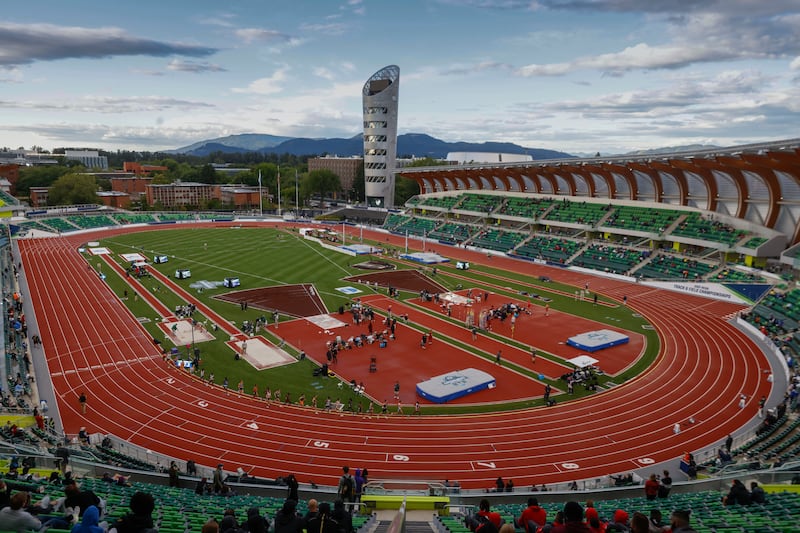
The 2026 NCAA Outdoor Track and Field Championships was an international event and typical of recent previous championships. The competition consists of a combined total of 38 individual men’s and women’s events, with the top eight in each event scoring points. International athletes claimed 76 of the 152 scoring places — or half — in the women’s competition; international athletes claimed 73 of the 152 scoring places — or 48% — in the men’s competition. They won 25 of the 38 individual events.
It was much the same in the 2025 NCAA Cross Country Championships, where international athletes claimed 25 of the top 30 places in the men’s race and 21 of the top 30 places in the women’s race.
Other international sports are feeling the same trend in the U.S. collegiate ranks. According to Basket Under Review, international players make up about 20% of Division I basketball rosters — one out of every five players.
Sportico reported that international players made up 40.9% of the roster spots in the 48-team NCAA Division I men’s soccer national championship tournament, which might answer all the questions about the continuing struggles of the U.S. in the World Cup.
According to Forbes, international athletes make up about 60%-65% of all players on NCAA Division I tennis rosters. For top 30 programs, it’s 70% to 90%, according to the NCAA Scholarship Guide.
Men’s and women’s Division I golf rosters are comprised of 33%-35% international athletes, according Mikkelgolf.
As noted in the Deseret News story last fall, with the new NCAA limits on roster sizes already cutting opportunities for aspiring high school athletes, the flood of international athletes exacerbates the situation. The collegiate ranks are the minor leagues for U.S. national teams and are realistically the only path for young runners to develop. As things stand now, U.S. colleges are serving as a farm system for international athletes.
“American colleges and universities should first and foremost provide opportunities for American students,” says Walberg. “ … This bill restores balance by protecting roster spots for American student-athletes. America has built the strongest collegiate athletic system in the world, and we should make sure it continues to develop the next generation of American students and American Olympians.”
Eyestone has been one of the few coaches who has dared speak out on the issue, and he did so last fall with some trepidation, fearing that he might be misunderstood. There was some pushback at the NCAA cross-country championships press conference from coaches who make a living with international athletes, but he also received private support from coaches who don’t dare go public with it.
“I don’t want this (issue) to define me,” says Eyestone. “I’m not against international athletes. They made me better (he was a four-time NCAA champion in the 1980s). I’m really advocating for the development of American athletes. This proposed bill allows for both (Americans and international athletes).”
Some cross country programs — Oklahoma State, Iowa State and New Mexico — are made up almost entirely of international athletes. They’re the easy way out for schools that are tough to recruit to and for coaches who prefer ready-made talent they don’t have to take time to develop.
In many cases, the international athletes are more experienced and older; some have even competed abroad professionally. The NCAA’s new rule, which limits eligibility to five years and starts the eligibility clock at the age of 19, should remedy the age disparity.
“American colleges and universities are increasingly giving scholarships and limited roster spots to foreign athletes, and the growth of NIL money only creates more incentive for foreign athletes to cash in on the American system,” says Husted. “If the U.S. Congress is being asked to ‘save college sports,’ we should save it for American student-athletes.”
One thing is certain: Coaches and athletes will be closely following the bill that has been introduced by Husted and Walberg — HR10351, Training and Education for American Members in University Sports and Athletics (Team USA) Act.
