

The National Hockey League departed Arizona more than two years ago, but the idea of professional hockey returning to the Grand Canyon State has hardly vanished.
For nearly three decades, the NHL tried to make hockey work in the Phoenix area. There were different owners. Different arenas. Different plans for a permanent home.
Eventually, the NHL’s experiment in the desert ended when the Arizona Coyotes’ hockey ops were transferred to Salt Lake City in 2024 by the hands of Utah Jazz owner Ryan Smith, creating the Utah Mammoth.
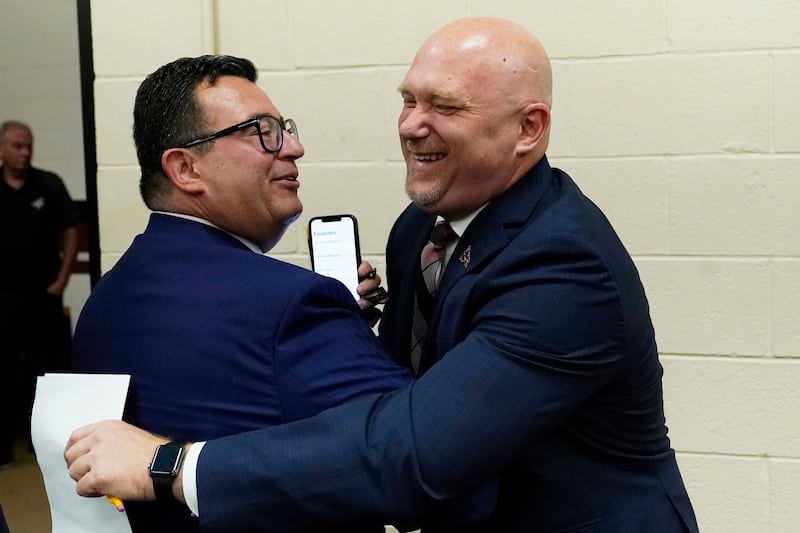
But former Coyotes President and CEO Xavier Gutierrez, who led the organization from 2020 until its departure, doesn’t believe the league’s relationship with Phoenix is over.
Gutierrez, while appearing on Sportico’s “Sporticast” podcast Tuesday, laid out his case for why the Phoenix market remains viable for the NHL and why he believes the league can eventually return as it slowly approaches expansion.
“Arizona is a hockey market without a doubt,” Gutierrez said. “I can tell you for a fact that there are NHL players who would love to play in Arizona, and who would love to have a hockey team there as long as it was in a right location.”
Gutierrez added, “But do I feel that the NHL wants to be there? Yes. Do I feel the NHL could be successful there? Yes.”
His comments come at a time when the NHL is considering adding two new franchises to expand beyond its current 32 teams. At the league’s biannual Board of Governors meeting on Tuesday in New York, the topic was discussed, though no formal vote was taken.
According to a report from ESPN on Tuesday, NHL Commissioner Gary Bettman stated that while the NHL continues to get pitched by potential owners, the league is not currently conducting a formal expansion process.
“Expansion is a multibillion-dollar transaction, which has an impact on all the other clubs in the league,” Bettman said. “If there’s going to be expansion, three-quarters of the governors are going to have to be comfortable that this makes sense to them. And that’s not something you do overnight.”
The NHL has already been evaluating a potential second Texas franchise in Houston or Austin to join the Dallas Stars. Other markets such as Atlanta, Indianapolis and New Orleans have also crept up in expansion conversations. Not to mention Arizona.
The league expects to have more clarity on expansion by its December Board of Governors meeting, though Deputy Commissioner Bill Daly also cautioned that a formal vote may not necessarily happen then.
While Bettman and Daly have pumped the brakes on seeing the 32-team league expand to 34, Gutierrez, now chair of strategic advisory firm ImpactX Sports Group, pointed to several factors that he believes make the Phoenix market viable despite the Coyotes’ long history of ownership, arena and financial challenges.
Phoenix has something the NHL still wants

The Valley of the Sun remains one of the largest U.S. cities without a current NHL team.
The league has already acknowledged that potential ownership groups in Phoenix are interested, with Bettman confirming Tuesday that “a couple of different groups” from the desert have reached out.
That doesn’t mean Arizona is leading the running for a team. That remains Houston or Austin after the NHL agreed to a term sheet with Houston-based billionaire Dan Friedkin that grants him exclusive rights to bring an expansion franchise to either city.
The Sporting News also reported that Houston Mayor John Whitmire indicated his office is currently in active discussions with key stakeholders involved in the NHL’s expansion initiatives.
Nevertheless, the Phoenix market is being considered by the NHL, and rightfully so.
On the podcast, Gutierrez highlighted Arizona as the “second largest Canadian snowbird market” outside South Florida. Given that the Coyotes called the area home from 1996 until their sale and move to Utah, established hockey infrastructure is already in place.
“It’s also a major market where hockey players go retire,” said Gutierrez.
The core issue isn’t whether Phoenix can sustain a professional hockey team, but whether the ideal conditions can finally be met for the NHL to return there.
“There are plenty of reasons the NHL would want to return to Phoenix,” according to Alex M. Silverman of Sports Business Journal. “It is the nation’s 12th-largest media market and one of the fastest-growing metropolitan areas in terms of both population and economic activity.”
Gutierrez said, “I can tell you three cities for a fact that aren’t part of the NHL that should be, which is Atlanta, Houston and Phoenix. And I think they know that.”
The arena problem remains the biggest hurdle
In reflecting on his tenure, Gutierrez pointed out that arena challenges persistently plagued the Coyotes throughout their time in Phoenix.
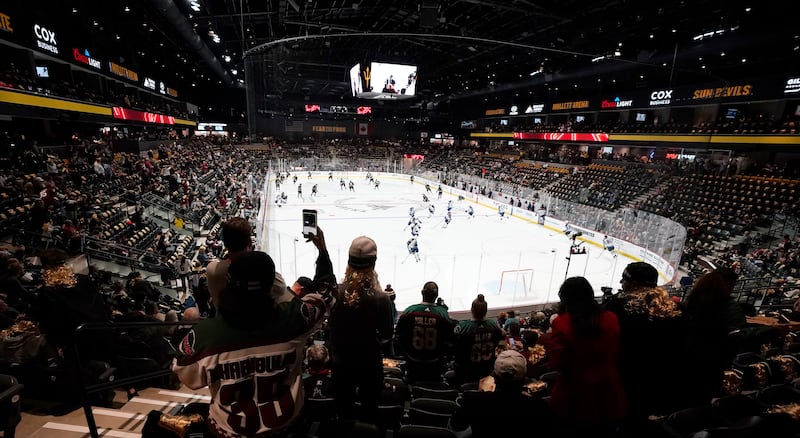
The former CEO knows better than most what went wrong. The defunct team played in multiple arenas during its history, eventually ending up at the 5,000-seat Mullet Arena, home of the Arizona State hockey club, for its final two seasons.
“The fundamental challenge for the Coyotes has always been the facility, had always been the location,” said Gutierrez. “Even when the Burkes were awarded the franchise in 1995 and they started in 1996, they played where the (Phoenix) Suns played … in obstructed views, in a small arena that wasn’t really built for hockey.”
“And then obviously they moved out to Glendale, which was a fantastic facility, but it just really wasn’t the right location. It wasn’t where the center of the population growth and center of the corporate growth was. And so it was really difficult to get people out there.”
The Coyotes tried to pursue a new arena in Tempe with a planned $2.1 billion entertainment district but that was rejected by city voters in May 2023.
The former NHL franchise also sought to acquire a 95-acre tract of state trust land located in northeast Phoenix. The team envisioned building a new 17,000-seat arena on the property, alongside a comprehensive entertainment hub featuring dining, retail, housing, a theater, potential hotel developments and an adjoining practice facility.
However, those plans fell through after the land auction was canceled by the Arizona State Land Department.
Former Coyotes owner Alex Meruelo walked away from it all.
“Unfortunately, there were forces that really just didn’t want another arena competing with the arena that was owned by the city of Phoenix in downtown,” said Gutierrez.
Silverman said, “The Coyotes’ challenges were always ownership instability and the lack of a suitable arena in the right location, not weak market fundamentals. While there may be investors interested in bringing a team back, Bettman said Tuesday that it ‘doesn’t make sense to even talk about’ expansion there until a viable arena plan is in place. Houston, Austin and Atlanta appear to be further along on that front.”
Any future Arizona bid needs a credible long-term arena solution.
Money, money, money
Things will always come back to the financial aspect of the equation.
The NHL told prospective expansion groups last year that the expansion fee was around $2 billion. That amount is just one piece of the financial commitment.
The ongoing evaluation of markets like Houston and Austin offers a clear window into the massive financial scope required for a modern franchise expansion. Back in June, Bettman noted that establishing another club in the Lone Star State would demand roughly $3.5 billion in capital, covering both the entry price and building a venue.
For an ownership group in Phoenix, that means putting together capital to cover both the steep franchise fee and the construction of a modern venue that ensures the club’s long-term sustainability.
While bringing professional hockey back to the desert comes with its share of hurdles, the idea remains far from dead. Gutierrez sees the path that some don’t.