

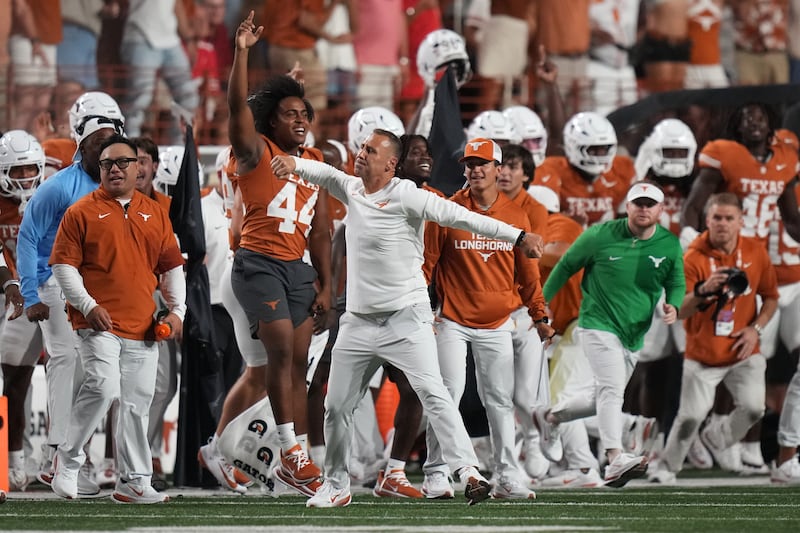

The Holly Rowe-Steve Sarkisian Drama — in which the Texas coach bailed out of one of those pointless sideline interviews (this time with Rowe) followed by overreaction by a media always eager for a topic to jump on — has finally blown over, and not a minute too soon. The fake AI depiction of physical contact between Rowe and Sarkisian only added to the show.
Too bad everyone missed the broader point.
We don’t need sideline reporters, period.
This is not personally directed at Rowe, whose long career speaks for itself and who is more than a sideline reporter, but sideline reporters are extraneous — their reporting is fluff.
You know the drill. They check in with the audience occasionally to state something obvious and then do futile interviews with coaches as they come off the field at halftime and the end of the game.
Complaining about sideline reporters and their cringy questions has become an American pastime.
How do you feel?
What does this win mean to you?
What do you have to do to win?
Has anyone anywhere ever seen an on-field interview with a coach and wished it had been longer?
The coaches, contractually obligated to cooperate, say nothing of interest and why should they? They’re not in the entertainment industry and they’re not going to give away strategy or inside information. They offer the most innocuous, vapid comments possible.
Have they ever said anything even remotely interesting? They’re in a hurry to get to the locker room; we’re in a hurry to get to the refrigerator. They’re drive-through interviews, the equivalent of journalistic fast food.
It all started with Jim Lampley in the mid-1970s — he is considered to be the first regular sideline reporter. And it’s been all downhill ever since.
Charissa Thompson, who took a degree in law and society and originally applied at Fox Sports for a position in HR, blew the lid off the whole industry during a 2023 podcast. In a weak moment of candor, she confessed that during her career as an NFL sideline reporter, she invented quotes if a coach did not cooperate.
She reasoned that this was OK because she used the standard, cliched quotes that coaches use anyway, apparently believing that this met the ethics of accuracy and integrity. Who needed the real thing?
“The coach wouldn’t come out at halftime, or it was too late and I didn’t want to screw up the report, so I was like, I’m just going to make this up,” she explained.
“First off, no coach is going to get mad if I say, ‘Hey, we need to stop hurting ourselves, we need to be better on third down, we need to stop turning the ball over and do a better job of getting off the field.’ Like, they’re not going to correct me on that. I’m like it’s fine, I’ll just make up the report.”
In other words, the coaches’ interviews are so predictable and so uninteresting that they can simply be manufactured.
After this created an angry backlash from her peers, Thompson apologized and made an attempt to walk back some of her statements, but the damage was done and the curtain had been pulled back on the industry.
(Not only did Thompson not get fired, she has risen up in the biz — she is “host” of the Thursday night NFL broadcast.)
Back to the Rowe-Sarkisian drama. Just seconds after Sarkisian’s team had pulled off a dramatic win over Ohio State, Rowe tried to interview him as he ran off the field. Eager to meet with his players (understandably), he said “Let’s go! Texas Fight! Hook ‘em,” and ran away. There was some outrage — mostly from other journalists — and Sark went through the motions of an apology as if he had committed some great offense.
It was much ado about nothing. And it was unfair. At halftime, Sarkisian, down 20-3, had to wait several minutes for another on-field interview while ESPN tried to sort out technical difficulties.
He should get points for that.