

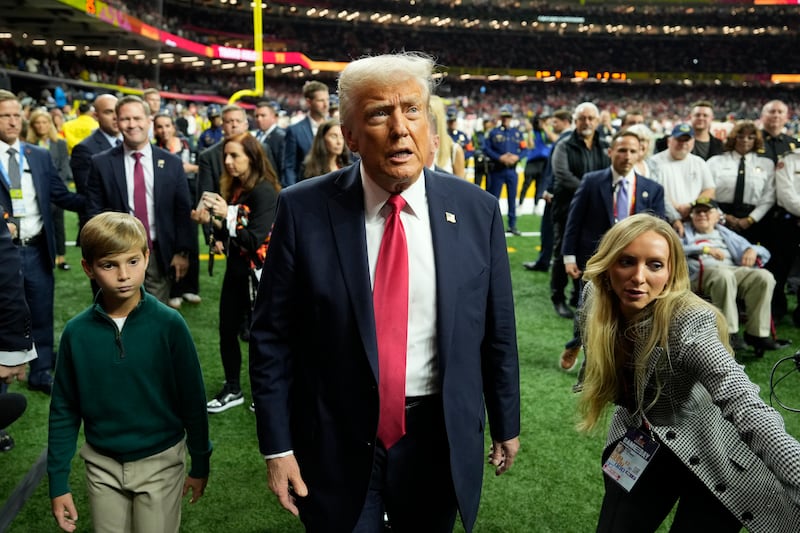
President Donald Trump’s planned appearance in Knoxville at Saturday’s Battle of UT game will put one of college football’s marquee games in the bigger national spotlight at a time when the business and governance of college sports are potentially facing major changes.
OutKick’s Clay Travis reported Wednesday that Trump is expected to attend the No. 1 Longhorns’ SEC opener against No. 14 Tennessee. The White House press confirmed the president’s plans this week.
The president’s scheduled appearance adds to a game that already features two undefeated SEC teams, a national audience and ESPN’s “College GameDay.” Sports Business Journal reported Thursday that Trump is not expected to attend the latter.
The timing of Trump’s appearance comes after Texas Sen. Ted Cruz appeared on ESPN’s flagship college football pregame show two weeks ago in Austin, Texas, where he was loudly booed while promoting the Protect College Sports Act, a sweeping proposal that would establish federal rules governing several of the issues that have reshaped the economics of college athletics since the NCAA’s name, image and likeness era began in July 2021. Cruz was a co-author of the bill.
STATUS’ Natalie Korach reported the pregame show’s hosts interviewing Cruz “sparked questions inside and outside Bristol” about the segment’s “political nature — and more blurring of the line between its premier hosts and political advocacy.”
What’s the bill’s current standing?
The PCSA cleared what appears to be its last procedural obstacle on Thursday, securing 74 votes to clear the way for a decisive vote expected Monday, unless lawmakers reach an agreement beforehand. It easily passed an earlier procedural vote by a 77-23 margin, marking its fifth procedural victory with at least 70 votes in favor. Approval on the upcoming final vote will require 60 votes.
The bill has become one of the most consequential pieces of federal legislation for the college sports industry in years.
For universities and conferences, the legislation is an attempt to provide a more uniform set of rules for an industry that increasingly operates like a national commercial enterprise but is governed by a patchwork of state laws, NCAA rules and court decisions.
A notable guest
That business backdrop makes Saturday’s game notable beyond the matchup itself.
The game was already positioned as one of the biggest matchups of the early college football season. Texas quarterback Arch Manning will be making his first appearance at Neyland Stadium — the home stadium where his uncle, NFL legend Peyton Manning, became a Tennessee star.
Texas is also one of the most valuable athletic departments in college sports and entered the SEC after decades in the Big 12. Tennessee is one of the SEC’s most recognizable programs and plays in one of the largest venues in college football.
Both programs operate within a conference that is at the center of the modern college sports economy, with massive media-rights deals, expanded revenue-sharing obligations and increasingly aggressive investment in sports. The PCSA is designed, in part, to establish federal guardrails around that rapidly changing marketplace.
Trump’s visit will bring additional security measures and logistical considerations to the stadium and surrounding area.
The Knoxville Police Department has already advised fans attending the game to plan for increased security and allow additional time to get to Neyland Stadium. “If you’re attending the game, plan accordingly and allow extra travel time,” police said.
Trump’s visit to Knoxville is the latest in a series of major sporting events he has attended during his second term. He attended January’s College Football Playoff national championship game between Indiana and Miami and was present for Game 3 of the NBA Finals this summer. He also attended the FIFA World Cup final in July, where he presented the championship trophy to Spain following its victory over Argentina. Not to mention his UFC Freedom 250 event he staged alongside UFC President and CEO Dana White, one of his most vocal supporters.
The bigger matchup not on the field
Trump has publicly backed the PCSA, while Cruz has been among its most prominent advocates. ESPN, in response to the backlash the network received from the Texas senator’s appearance on “GameDay,” scheduled NAACP President and CEO Derrick Johnson to appear on its 6 p.m. EDT edition of “SportsCenter,” where he outlined the arguments against the bill.
Johnson said during the taping the bill “creates an opportunity for the sports leagues to commit what would now be illegal acts because they will have exemption from antitrust legislation.” He added, “Who says there’s instability? You have coaches that have been doing this for decades now, and unfortunately the players did not have the same rights. Now that players have rights, they’re saying it’s unstable.”
For the schools playing in Knoxville, the immediate business stakes will be familiar: television exposure, sponsorship opportunities, ticket demand and the value that comes with being part of one of college football’s marquee games.
But the larger industry is waiting to see whether Congress will establish a national framework for how those businesses interact with their athletes.
Saturday’s Texas-Tennessee game therefore arrives at an unusual intersection of college football and Washington — with the president having a front-row seat in the stadium.