



- Utah's senators put forward a bill to transfer 124 acres of public land to Price, Utah, last fall without any transfer, payment or protective clauses.
- It stalled in committee until last week when, with bipartisan support, that reversionary language was added.
- This is the second time in the last year that Utah senators have proposed land transfers to the state without such language.
Last October, Utah Sens. Mike Lee, R, and John Curtis, R, introduced a bill to transfer 124 acres of land from the Bureau of Land Management to the city of Price, Utah.
The Upper Price River Watershed Project Act of 2025 would give the large tract of land to the city — part of Carbon County, a historically significant coal mining region — so it can develop a reservoir along the Price River, supporting the community’s water needs amid the state’s long-term drought conditions.
The bill stalled in the Energy and Natural Resources Committee. That was until last week when, after some tweaks to the otherwise concise language, the bill passed unanimously for full consideration by the Senate.
“I’m grateful for my colleagues’ support in passing the Upper Price River Watershed Project Act unanimously through the Energy and Natural Resources Committee,” Lee wrote in a statement to the Deseret News. “I look forward to getting this bill to the President’s desk and delivering the water storage infrastructure the people of Price have been planning for to strengthen their water supply during ongoing drought conditions.”

Depending on the year, as many as tens of thousands of acres are disposed of by federal land management agencies to various local and state entities for a wide variety of reasons. The transfers are conducted to facilitate anything from road building, meeting infrastructure requirements, to park planning, which makes such transfers of federal land to state or city control somewhat routine.
Often, those transfers are done as land swaps of comparable acreage between the two entities or involve some kind of financial exchange. The bills themselves, too, also include text called “reversionary language.”
It’s a term that refers to legal language confirming the public lands being transferred will be used for public purposes and that, if they are not used for those agreed-upon purposes, they’ll return to the federal government.
The Price land transfer is not a swap, nor is there payment. And it was unusual in that it initially did not include reversionary legalese. After negotiations within the Committee on Energy and Natural Resources, however, that bar to the land being used for other purposes was added.
“If the Secretary, after consultation with the State of Utah, determines that the Federal land conveyed under subsection (a) was used by (Price) for a use not authorized under that subsection, all right, title, and interest in and to the Federal land shall revert to the United States, at the discretion of the Secretary (of the Interior),” reads the current iteration of the bill.
Once included, Sen. Martin Heinrich, D-NM, the committee’s ranking Democrat, wrote in a statement on his website that he was “glad” that the bill would move forward.
“I am also glad Chairman Lee and I were able to come to some agreement on S. 3004 [the Upper Price River Watershed Project Act of 2025] to convey public land for the city of Price, Utah, to be used for public purposes,” Heinrich wrote.
How will the land be used?

The purpose of the land transfer is to allow the city of Price to develop what it is calling the Upper Price River Watershed Project. The municipality is going to build and manage a reservoir along the Price River.
“The Lower Price River Reservoir, (is) a 7,000-acre-foot facility that will increase storage capacity, improve delivery systems, and make better use of the water already available in the watershed,” per the joint statement from Lee and Curtis.
That reservoir will allow the city to address its ongoing water shortages resulting from the droughts much of the West is experiencing.
These conditions are causing “recurring water shortages that threaten farms and local economies,” per the press release.
Approximately 80% of Utah was under severe or extreme drought conditions last fall when the bill was introduced. By this February, around 42% of the state is under severe or extreme drought. But, even though the number dropped after the winter, 94% of the state still remains under some form of drought condition.
“The people of Price have taken the steps necessary to secure their community’s water needs and protect against the next cycle of drought,” said Lee at the time. “The years of planning that have gone into this project will provide a stable supply of water for homes, farms and businesses across the region. I’m proud to be part of an effort that will ensure Utahns have the tools they need to endure and adapt to the realities of a changing West.”
As the bill reads now, that will be the sole use of the transferred land. S.3004 reads: “The Secretary (of the Interior) shall convey to the (Price) all right, title, and interest of the United States in and to the Federal land, to be used by the City for public purposes, including— (1) the construction of a reservoir and related infrastructure; and (2) the development and expansion of infrastructure for public safety, transportation, or use of and access to the reservoir."
Why wasn’t that language included initially?
Reversionary language can prove difficult and expensive to navigate when unexpected changes occur in the course of development. Or, in one case familiar to some Utahns, over time.
That example is the University of Utah’s Research Park, the former site of a decommissioned military base called Fort Douglas that was under Bureau of Land Management control.
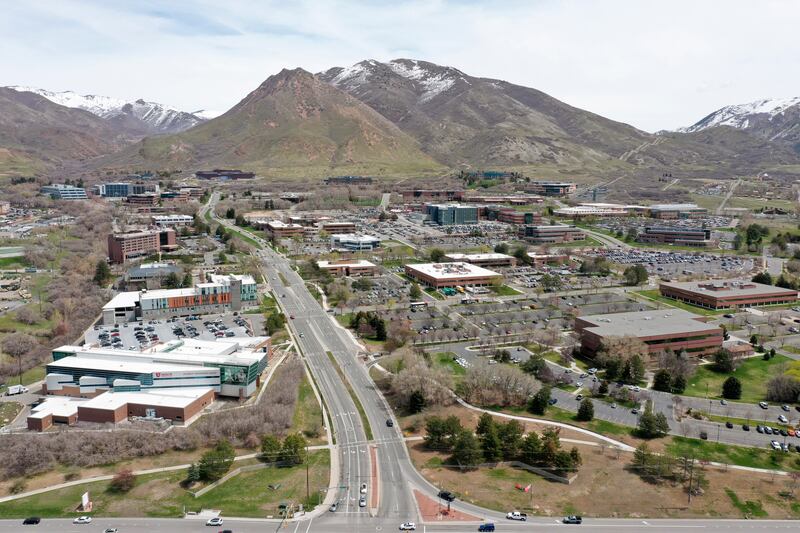
The BLM transferred 593 acres to the university on October, 18, 1968, with a very clear reversionary clause included in the bill’s language.
The intent of that land transfer was that the acreage be used “for purposes of academic expansion of the University of Utah, in Salt Lake City, Utah, for an arboretum, and for highway and utility rights-of-way to serve those purposes.”
That tract of land now contains a whole complex of university buildings used for tech, education and medicine. After reviewing the parcel and the agreement of the transfer, the BLM found that the University was not in compliance with its agreements.
Over the years, the University of Utah did approach the BLM to make amendments addressing how that land has been developed, but it ultimately took Congressional action to prevent further stress and issues for the University of Utah.
Is this similar to another recent land transfer?
This bill is actually the second introduced by this Senate committee transferring federal public land to the state of Utah that did not include payment, land swaps or reversionary language in the first draft.
The other was the Brian Head Town Land Conveyance Act, which passed last year. That land transfer was conducted to help the town of Brian Head develop a new ski resort on an adjacent 24-acre parcel of public land.
In that case, the town of fewer than 200 people struggles to keep up with the 300,000 or so visitors it gets each ski season and the land will allow the city to better manage its seasonal needs.

“It’s a targeted solution to a well-documented, undisputed problem, a problem that the Forest Service agrees exists and a solution that the Forest Service supports,” Lee said to Deseret News at the time.
Consistent in his thinking about both transfers, Heinrich wanted to make sure that public lands were being used for public purposes. “My view is pretty straightforward here,” Heinrich said ahead of that committee vote. “Public lands belong in public hands.”
That bill didn’t just receive pushback from Heinrich. Conservationists and activists were quick to comment.
“The Brian Head bill is a public lands giveaway bill, plain and simple,” said Travis Hammill, the Washington, DC, director of the Southern Utah Wilderness Alliance, in a statement. He added the legislation “would set a precedent for future attempts to give away public lands without public input, appropriate compensation, environmental review or other important legislative components.”
Reversionary language was added before the bill passed, just as it was for the Upper Price River Watershed Project Act of 2025.