


- The Dignity Index reveals a large gap between what Americans value and how they behave.
- A majority say dignity is important, yet three-fourths aren't happy with how we treat each other.
- The authors say there is solution for getting the country out of its 'crisis of contempt.'
Characterizing America as a polarized place with a politics of contempt and grievance is not exactly a divisive suggestion. Rather, it’s one so accepted today that a majority of citizens say it’s an issue nearly as important as cost of living.
“The contempt and divisiveness in this country,” said Timothy Shriver, co-founder of Dignity.us and chairperson of Special Olympics, in a video address, “jumped in terms of relevance to all of us as Americans — Republicans and Democrats and independents alike. We see the issue and we understand its urgency.”
That’s not just speculation, either, but borne out in the results of a new poll released Tuesday called the "Dignity Barometer” from an organization called Dignity.us. It found that 83% of Americans worry about division, which is just shy of the 86% who worry about cost of living.
The authors called America’s political divisiveness a “kitchen-table crisis.” Within the country’s pervasive, divided culture, however, the poll also presented a unifying issue that almost everyone agreed on:
The importance of dignity.
The poll found that 94% of Americans — from respondents across the political spectrum — believe people should be treated with dignity. It defined dignity as “treating (people) in a way that values their inherent worth as a human being.”
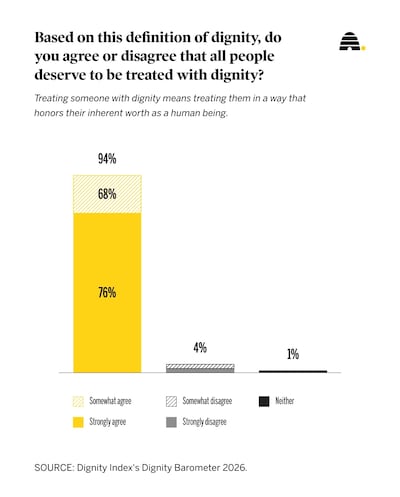
Yet, those same respondents said that less than a third of Americans actually treat each other that way. As a result, nearly 80% are dissatisfied with how we treat one another.
The authors call that dissonance the ”dignity gap," saying it exists because the country is in the midst of “a crisis of contempt.” Despite the evidence for that characterization, the poll also found both reason for hope as well as answers to what might heal national divisions in that shared belief in the importance of dignity.
“These numbers show that our divisions are troubling and destructive, but there is good news in here, too,” according to the report summary. “Americans not only call out the problem, they point to a solution: Perhaps we’re too divided to solve our problems precisely because of the way we’re treating each other.”
Nearly three-quarters of respondents said that healing is possible. The poll found 92% believe that offering each other dignity is a way to build trust. And just a few less folks, 90%, said that, even after contempt tears us apart, treating one another with dignity can bring us back together.
Diving into the data, Shriver said, the most important thing that he found was “that Americans want to change.”
Where does this crisis of contempt come from?
With so many people saying that treating one another with dignity is so important and so few acting on it, it’s no surprise that many Americans are dissatisfied with the state of polarization and divisive society.
But there are specific spheres of influence that people said bear responsibility.
“The barometer sadly reminds us that Americans give us a failing grade on how to resolve corrosive, divisive polarization: we don’t see each other — or ourselves — as doing a good job on this,“ Shriver said in the video. ”We especially, sadly, give our politics and our media failing grades. So, we know where we’re getting it from."
Politics was seen as the ”most contemptuous” area of American society. Only 10% of respondents said people involved in politics treat others with dignity. Almost 60% said they outright treat each other with contempt. More than 80% of people said that politicians and those running for office were responsible.
With politicians, however, the respondents signaled a clear preference for how they want their future leaders to behave when campaigning.
“As of February 2026, 9 in 10 Americans (90%) say they would support candidates who make treating people with dignity a top priority, signaling that voters are at a point where they will reward leaders who offer an alternative to divisive rhetoric,” the report says.
“The Barometer findings send a clear message that voters are looking for politicians who model dignity,” Tami Pyfer, co-founder of Dignity.us, said in a prepared statement. “Americans are bringing dignity into the voting booth.”
As Shriver mentioned, there were other institutions that Americans hold responsible for the divisiveness they cause.
The next group was the media writ large, closely followed by social media with 80% and 79%, respectively, citing the role they play.
The group with the fourth-most agreement on responsibility at 73% was the catch-all “all of us.” That sense of self-recognition was followed by “people who identify as Republicans,” then large corporations and next “people who identify as Democrats.”
What is the way to work through these divisions?
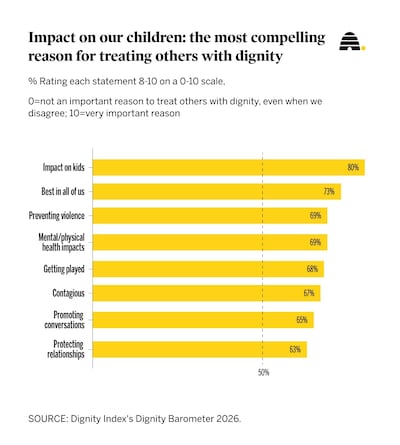
While a large majority — nearly three-quarters — said the most compelling reason to treat each other with dignity was to bring out the best in people, even more pointed to the impact it would have on children.
With those in mind, the vast majority — about 97% — of people said they are willing to treat others with more dignity to model good behavior for young people. Not many fewer, nine in 10, said they’d only vote for candidates who made dignity a priority. A large majority said they’d even stop following divisive or contemptuous entities on social media.
With such a clear consensus of dignity’s importance and a willingness to act on it, the Dignity Index’s authors laid out a pathway to do so.
It drew its conclusions on how to accomplish that from a few points. One was that 77% said that they treat people with dignity, while less than half said that they are treated that way in return. That large gap suggests that folks do not see themselves as others do.
Another was that as people took the survey, the share of those who thought they could make a difference increased by nearly 10%. “One respondent noted, ‘(Taking the survey) makes you want to take a look at how you treat people,’” per the press release.
“For the sake of our own self-image, we don’t want to see our own contempt,” said Tom Rosshirt, another cofounder of Dignity.us, in a statement. “But just talking about dignity and contempt can help us see our role in the problem and in the solution. Change starts with dignity, and dignity starts with me.”
The Dignity Index broke down its approach to change into a three-step pathway:
- First, the authors called out self-reflection on the part of the individual, saying to “shine a light on the blind spot.”
- Second, by reflecting on personal behavior, individuals create space for change by spending less time focusing on how others behave.
- Third, start locally. The spaces where people treated each other with the most dignity are within the family, volunteer organizations, religious and other faith-based groups and schools.
“We’re already more dignified in our local communities, churches, and schools than online or in politics,” according to the group. “Showing that change is already happening.”
Who conducted this poll?
“The Dignity Barometer” is a product of Dignity.us, which is an organization that wants to ensure that within the next 10 years, “‘dignity’ will be seen as a winning strategy in politics and policy-making, and how we treat each other will be seen as a mark of patriotism, a measure of our well-being, and a key indicator of the future.”
The organization was originally formed as UNITE in 2018 to address America’s divisiveness. A few years later, it formed a method for measuring how people interact with each other when they disagree called “The Dignity Index.”
That index was first rolled out during the 2022 midterms in Utah, and subsequently the organization has conducted training for “thousands of educators, students, business leaders, and elected officials.”
This poll is the next iteration of the groups’ efforts, with the intention to collect new data every year around Presidents Day. The online survey was conducted Feb. 10-14, 2026, of 1,503 adults by Hart Research, an opinion polling firm based in Washington D.C.
Shriver reiterated that the results could be used for politics or personal reasons and he wanted the results to “to both awaken each other to the crisis at hand and also awaken each other to our power to make a change.”
That is because, he said, they offer a way out of the contemptuous and divisive behavior that Americans currently endure.
“Stand up for your views while honoring the dignity that we all deserve,” he said. “Why? Because dehumanizing others makes enemies for your cause, and contempt kills our conversations. But dignity lets us keep talking. It helps us stay in the game.”