

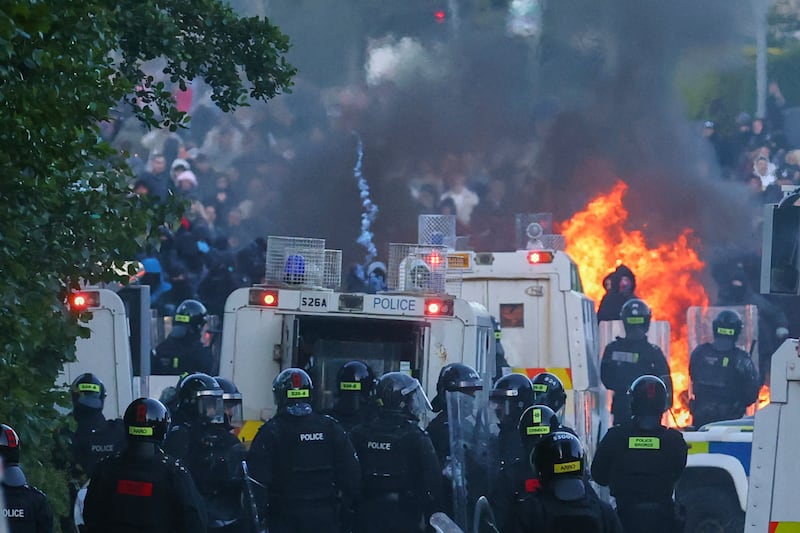

A knife attack that was recorded in the capital city of Northern Ireland spread across social media, sparking two nights of protests and fiery riots in the country.
The attack took place on a road in Belfast on Monday night. Hadi Alodid, 30, was named for the first time in court on Wednesday, where he was charged with attempted murder, threatening to kill a second person and carrying a knife.
The Deseret News examined the graphic video of the alleged assault circulating on social media. It seems to show Alodid on top of 44-year-old Stephen Ogilvie, attacking him until bystanders intervene. At one point, a person is seen hitting Alodid with an object as he appears to tighten his hold on Ogilvie. The audio captures multiple voices suggesting Alodid was attempting to “cut his head off.”
Ogilvie was taken to the hospital, and according to The Telegraph, he “lost his left eye after being stabbed in the face, neck and back” and “also suffered deep head lacerations.”
In a public statement, Ogilvie’s family said he is in stable condition and thanked the people who helped save his life. But they were not pleased with the aftermath that occurred following the attack:
“We have been left feeling disgusted by the scenes that unfolded yesterday across Northern Ireland in the wake of what happened. We want to make it absolutely clear that to do this in response is not supported by our family, and peaceful protest is only ever the way forward,” the statement said. “We do not want this terrible tragedy to be used to divide people or fuel hostility — do not do this in the name of our loved one as we do not share the same values.”
Alodid entered the United Kingdom in 2023, where he was granted refugee status and was given a five-year permit to live there until 2028, according to CBS News.
Law enforcement said a motive has not been determined, but that they do not believe it was an act of terrorism, per The Associated Press.
2 nights of unrest
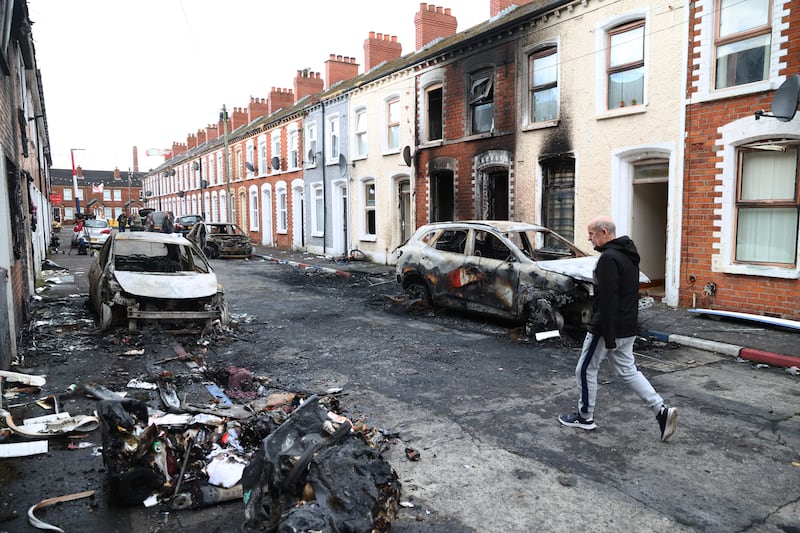
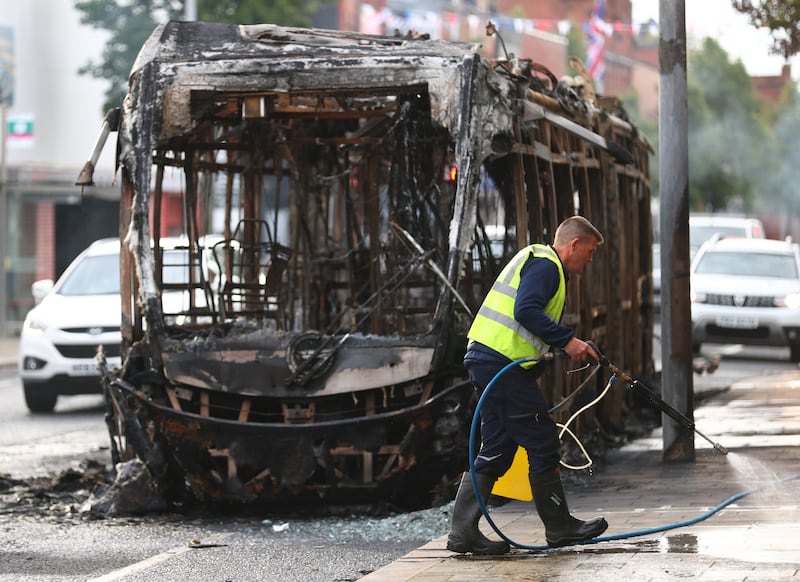
The unrest that followed the attack was in protest against immigration in the country. Videos show masked individuals banging and kicking in doors, public transportation set on fire and vandalism to stores.
The protests are allegedly targeting migrant homes and setting them ablaze.
Northern Ireland Secretary of State Hilary Benn said they saw “less disorder in Northern Ireland” on Wednesday due to the help of water cannons deployed against the protesters who were clashing with law enforcement, per BBC.
He added that he hopes that “people are reflecting on the truly shocking scenes we saw on Tuesday night, with people being burnt out of their homes because of the color of their skin.”
The BBC correspondents for Northern Ireland posted that on the second night, around 200 protesters gathered in a city outside Belfast, where 12 police officers were injured, and 16 people were arrested — still less “disorder” than what occurred on Tuesday night.
Mixed responses to the uprising
The debate over immigration in Europe is whether the unrest is primarily a reaction to genuine failures in immigration policy or a product of racial scapegoating and online radicalization. Most political leaders have emphasized the latter while others seem to resonate with the former.
U.K. Prime Minister Keir Starmer, for example, said on X, “There is no justification for the violence and disorder that we saw threatening our communities, nor for those who encouraged it, online or elsewhere.”
First Minister of Northern Ireland Michelle O’Neill called the the knife attack “heinous and wrong,” but added that the unrests that followed are “attempts to exploit that to target and attack innocent people who are simply trying to live, work and raise their families here,” she said on X. “Racism, intimidation and violence are wrong wherever they occur.”
But U.K. Parliament member Nigel Farage said on “The Jeremy Kyle Breakfast Show” that “immigration is now a national security issue” in the U.K. and that people in the country believe “democracy isn’t working.”
He added, “We have two-tier policing, no matter how much the prime minister denies it. ... Don’t treat everybody the same. Treat ethnic minorities with a higher priority than indigenous British people.” A similar sentiment occurred after police footage was released of the death of British college student Henry Nowak.
Elon Musk voiced his opinion on the events in Belfast, not buying the idea that social media is feeding an anti-immigration sentiment.
He posted, “Murderous migrants beheading innocent people in their home town is what’s making people angry, not ‘social media’!”
U.K. political commentator Paul Embery said citizens are losing their faith in politicians who treat incidents like the Belfast attack as an “isolated incident.”
“That’s why people are angry,” he said on X. “They are sick of the platitudes that get trotted out after each fresh incident. They don’t want to hear them anymore. They know that the decisions of establishment politicians have brought us to this current pass, and they don’t trust those same politicians to fix things, especially when some of them refuse to even recognise that the public’s anger is justified.”