


- A new lawsuit alleges Polymarket staged fake bets and paid for secret ads on social media.
- A consumer protection group claims the company uses "clipping" to make videos go viral.
- Prediction market platforms are embroiled in lawsuits across the country.
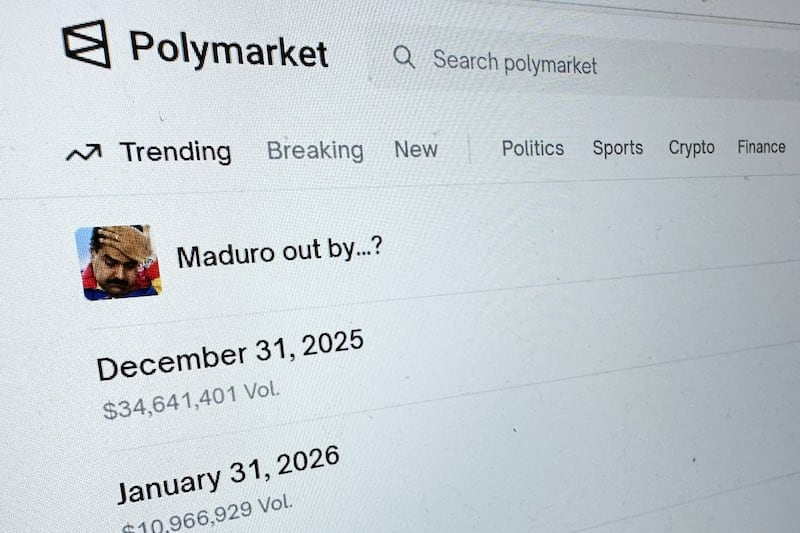
A new lawsuit alleges the popular online betting platform Polymarket staged fake bets on social media, paying for secret ads and aggressively luring college students to gamble while obscuring how likely they are to lose.
The National Association of Consumer Advocates accuses the company of orchestrating a deceptive marketing campaign targeting young people in the complaint filed Friday in the Superior Court of the District of Columbia.
Polymarket paid content creators to film themselves placing bets on fake versions of the platform, then presented the videos as authentic experiences of ordinary users, according to the lawsuit. Many were college-age and were paid $2,000 to $3,000 a month.
The lawsuit cites a Wall Street Journal analysis of 1,105 social media videos from 10 creators associated with the company’s marketing vendor, 70% of which showed a creator placing a bet. The wagers totaled $1.9 million and 118 videos showed creators winning $900,000.
“None of the video bets were real,” according to the lawsuit. “Content creators fake not just their bets, but also their wins.”
Had those same 118 bets been placed with real money, the complaint says, the creators would have lost more than $166,000.
What is ‘clipping?’

The lawsuit also accuses Polymarket of making the “staged” videos go viral using a practice known as “clipping.” The company paid people to cut influencer footage into short clips, post them on newly created accounts designed to look like those of ordinary users and spread them across social media platforms. Clippers were paid $1 for every 1,000 views, according to the lawsuit, and were explicitly required to target people in the U.S.
Clippers were told to not make the videos feel like ads or promotions and were barred from using “Polymarket” or the prefix “poly” in their account names, the complaint says. Also, they coached them to “warm up” new accounts over several days so platforms would treat them as genuine users.
“All of these representations are deceptive,” according to the lawsuit.
One Polymarket clipping campaign paid out $8,892 across 4,700 submissions that generated 9.1 million views, the complaint says. In another example, a single video drew just 151 views on its own before a clipping campaign pushed it to roughly 2.4 million.
Do prediction markets target young people?
The complaint also alleges the company unfairly targets college-age consumers even though college students experience gambling problems at about twice the rate of U.S. adults overall. Beyond hiring college-age creators, the complaint alleges, Polymarket ran recruiting campaigns on college campuses, paying students up to $2,000 and offering fraternities cash for every new user they signed up.
The lawsuit claims Polymarket violated Washington, D.C’s Consumer Protection Procedures Act. It asks the court to order the company to give up the profits earned from its practices and pay restitution to harmed consumers as well as permanently bar it from continuing those practices.
Polymarket is involved in lawsuits around the country. Several states have sued the company alleging it operates an illegal, unlicensed gambling platform. Polymarket has also filed suit against states over laws targeting prediction market platforms.
Senators call out ‘deceptive marketing tactics’
Also Friday, Sens. John Curts, R-Utah, and Adam Schiff, D-Calif., sent a letter to Commodity Futures Trading Commission chairman Michael Selig requesting answers following the Wall Street Journal report that Polymarket used deceptive marketing tactics to promote gambling-style products to Americans. The CFTC regulates prediction markets.
In the letter, the senators argue that the alleged conduct underscores growing concerns that prediction markets are functioning more like gambling than legitimate financial instruments.
“The CFTC has repeatedly asserted regulatory authority over prediction markets and event contracts, including through its enforcement actions and its rules governing event contracts listed on CFTC-registered entities,” Curtis and Schiff wrote.
“Yet with content creators routinely portraying prediction markets as ‘free money,’ there is little basis for treating them differently from gambling. These contracts are not in the public interest and should not be treated as derivative products with hedging value. We remain concerned that the commission is neither enforcing the law appropriately, nor is equipped to serve as a federal gambling regulator.”