



- NASA and INL are targeting a fission-powered Mars mission by 2028 and a nuclear reactor for a permanent moon base by 2030.
- NASA Administrator Jared Isaacman said SR-1 will be the starting point for an “Apollo-like” series of missions aimed at building a nuclear-powered space exploration program.
- Isaacman’s INL visit highlighted growing collaboration between NASA, DOE and private nuclear companies to develop the technology needed for routine deep-space exploration.
- University students came from around Idaho to listen to Isaacman talk about the country's progress in space.
NASA Administrator Jared Isaacman walked with his shoulders bent forward and his head slightly down at Idaho National Laboratory on Friday, as he listened intently to John C. Wagner, the lab’s director, explain the facility’s work to bring nuclear energy to space.
INL and NASA, under the leadership of Wagner and Isaacman, have aligned to accomplish several ambitious goals.
First, that by December 2028, NASA will launch Space Reactor-1 Freedom (SR-1) off the Earth’s crust and send it to Mars. It will travel 140 million miles to the red planet, they hope, by the power of fission.
Second, by 2030, they will deploy a compact nuclear reactor to the moon to power a permanent human base.
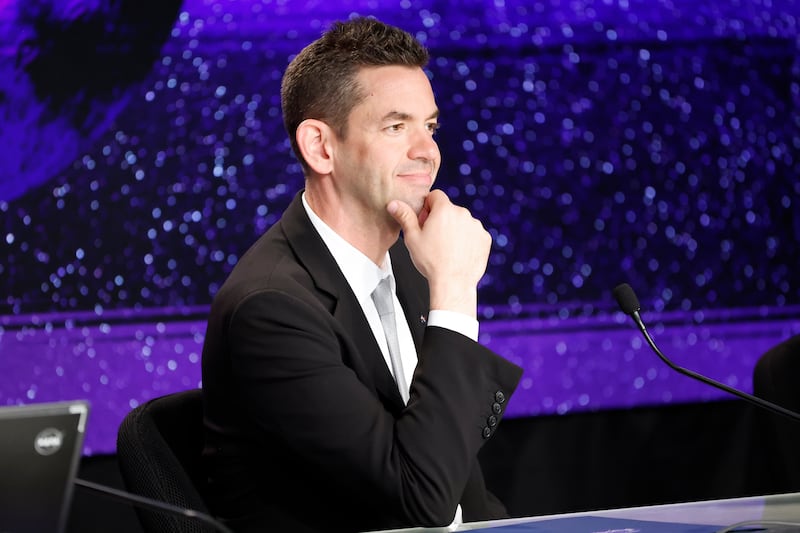
When Isaacman was sworn in by the Senate last December, he promised to focus NASA on accomplishing the near-impossible and bring in private industry to make it happen. His visit to INL on Friday showed that promise becoming reality.
Accompanied by a flock of other NASA officials in suits, Isaacman met with several private nuclear energy developers, all of whom had participated in the Department of Energy’s recent program to take their small modular reactors (SMRs) critical.
Bobby Gallagher, the co-founder of Deployable Energy, stood next to his small cylindrical reactor, smiling, as Isaacman approached. They shook hands in the INL warehouse Deployable Energy has operated from.
Gallagher’s team, mainly comprised of Australian-born engineers, took their reactor from idea to physical reality in 155 days with $8 million in capital. As Gallagher spoke, Isaacman’s eyes worked over the silver reactor and its Sharpied-on signatures arranged in the shape of an American flag.
Many of the companies making small modular reactors had space in mind as they brought their designs to life. In some cases, such as Antares Nuclear, their designs have solved technical problems for NASA and INL. Dianne Ezell, an INL reactor program manager, said on Friday that Antares built a heat pipe that NASA is now using for their SR-1.
There are still concerns about whether putting a nuclear reactor in space would be safe, and whether a reactor could even be securely delivered to the moon, but the tour Friday showed these concerns are top of mind for the scientists working on combining nuclear power and space exploration.
An ambitious, re-invigorated NASA

After visiting Deployable Energy, Antares Nuclear and Radiant Nuclear, Isaacman spoke to a hodgepodge crowd of space and nuclear enthusiasts. He was preceded at the stand by Wagner, Rep. Mike Simpson, Idaho Gov. Brad Little and Deputy Energy Secretary James Danley.
Isaacman referenced U.S. Navy Admiral Hyman Rickover, who directed the very first naval nuclear propulsion program.
Rickover “did not begin by designing the most complicated fleet imaginable and hoping that every unproven technology would work on the first attempt,” Isaacman said. “He started with the USS Nautilus, an imperfect ship, and over time built standout engineering, organization, a culture that demanded excellence, accountability and safety. They tested relentlessly. The organization he created developed the materials, the reactors, operating procedures and workforce necessary to build the nuclear navy.”
NASA, the DOE and INL are at a similar starting point with SR-1, Isaacman said.
“This is our Nautilus, and where we go from here must lead to the nuclear NASA of the future,” he said. “What should follow is an agency-wide Apollo-like endeavor — a series of SR-missions progressively incorporating new technology, higher-temperature materials, better power conversion, higher-performance thrusters, greater autonomy and more.”
Isaacman continued, “Planting a flag on Mars will be just the beginning. ... (the project) should usher in the interplanetary equivalent of a transcontinental railroad. America will win the second space race. We will build. We will return to the moon. We will build the moon base and master the skills needed for where we go next.”
Isaacman: fission will allow people to explore the galaxy routinely

Fission creates an enormous amount of power. A five-inch cube of TRISO (tri-structural isotropic) — one of the most common SMR fuels — holds enough power to send a fully-loaded Saturn V rocket and Apollo capsule to the moon 12 times.
From the stage, Isaacman described this power, the “energy potential within matter,” as a sustainable means for space exploration.
“The outer solar system contains some of the most compelling destinations of exploration: the oceans beneath the ice of Enceladus, a complex environment of Uranus and its moons... The distant worlds and unexplored regions may hold answers to some of humanity’s oldest questions, like are we alone?” Isaacman said.
Destinations like Mars should not be a one-off, he added. “We should be building the capability to explore them routinely, and that requires fission-powered spacecraft capable of traveling farther, operating longer and supporting more power-intensive instruments to help us uncover the secrets of the universe,” he said.
Students drove in from around Idaho to meet Isaacman

After he finished his speech, a swarm of students from various Idaho universities formed around Isaacman.
Waiting in line to speak to the NASA administrator, Angela Trejo, 21, told the Deseret News, “I just love what NASA is doing now, getting us into space using nuclear. I’m very pro nuclear.” She currently studies nuclear and mechanical engineering at Idaho State University.
Last year, Trejo interned for an INL program focused on speeding up the documentation required to take nuclear energy commercial.
Rubicel Trejo, a 23-year-old student at Idaho State University studying computer science and applied mathematics, told the Deseret News he sees NASA’s incorporation of nuclear energy as “another step for humanity.”
“Like Mr. Isaacman said, humans are explorers, and we have to push the boundaries of humanity to explore planets outside our own,” Trejo said. “It seems like Isaacman is pushing us in the right direction, and he knows how to get there. He seems like a good leader.”
Sophia Wolfe, a 20-year-old student at the University of Idaho, added that she wants to be a part of America’s progress in space. “I’m so happy to be here,” she told the Deseret News. “I want to be able to help build the rockets and shuttles that will help us explore.”
An Idaho State University student Wolfe met in line, Avery Benson, added, “I just love the excitement and the goals.”
“It’s so cool to be around this many people who have his (Isaacman’s) goals and see his vision. It’s so cool to be able to meet him,” Benson said.
Space exploration has practical benefits to people on Earth, she continued. “There are so many resources and materials out there that we have yet to discover. Those are things we can bring home.”
“We’re gonna make it to Mars, and we are gonna win the space race,” Benson said, with a laugh.