

SALT LAKE CITY — Sniffling and coughs are increasingly common sounds along the Wasatch Front, and with good reason, as the number of people with respiratory illnesses grows every week.
Intermountain Healthcare’s Germwatch is tracking the prevalence of the most common illnesses and, as is typical at this time of year, the collective level of sickness is rising.
Of note, in addition to influenza, is respiratory syncytial virus, or RSV, which is particularly dangerous for the youngest and the oldest, and the most vulnerable Utahns.
While most healthy people recover from RSV’s cold-like symptoms in about a week, Dr. Per Gesteland, a pediatrician at Intermountain’s Primary Children’s Hospital, said “for young children and older adults, the infection or its complications can be serious.”
RSV, he said, has a greater chance than a regular cold of progressing to the lungs and causing bronchiolitis or pneumonia, which can be deadly.
“Antibiotics won’t help since RSV are viral infections,” said Gesteland, who is also a professor of pediatrics and biomedical informatics at the University of Utah.
The doctor suggests keeping an eye on the body temperature of people who become infected. Should a fever last longer than three days or climb above 104 degrees, it is time to be seen by a health care provider.
“Every child is unique and general health care advice may not always be applicable, so ask your own doctor if you are concerned,” he said. “It is always appropriate to err on the side of caution and seek care early before a medical urgency becomes an emergency.”
Older adults with lung and heart conditions, or otherwise compromised immune systems, are also at higher risk when RSV is concerned.
Symptoms including fever, runny nose, coughing, sneezing, and aches and pains, can be treated using a humidifier, saline drops or increasing fluid intake, as well as age-appropriate doses of non-aspirin pain relievers, such as acetaminophen or ibuprofen.
Germwatch reports the highest RSV activity occurs between January and March, including annual epidemics in Utah. The latest numbers available show that nearly all of the heavily populated counties throughout the state are experiencing moderate or high levels of RSV.
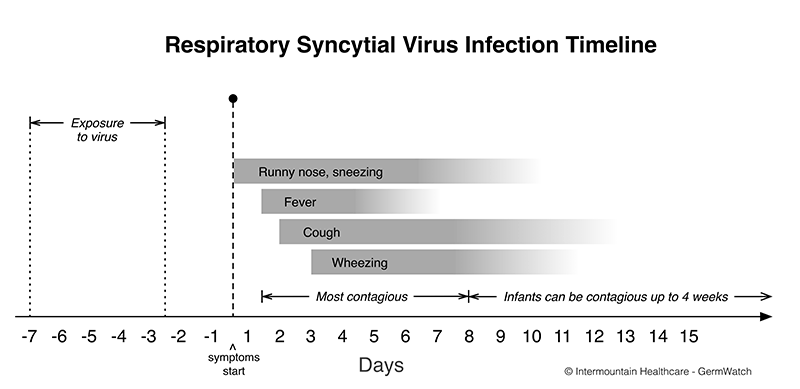
Symptoms of RSV typically develop within a week of being exposed to the virus, which is most commonly transferred by coughs and sneezes and can live up to six hours on surfaces. People infected with RSV are usually contagious for three to eight days, but young infants and people with compromised immune systems can be contagious for up to four weeks.
To prevent spreading germs, Gesteland suggests proper hand-washing hygiene, disinfecting toys, counter tops, doorknobs and other surfaces, but also “limiting baby’s social life,” as the Germwatch website states.
“Keep baby home from the birthday party, away from the church nursery, out of the ball-crawl at Fun World, etc.”
Presence of a fever in any child or adult should prompt staying home from school or other activities, Gesteland said.
“If you have a child at risk, you might consider limiting your social exposure for a while by not going places where there are a lot of people in close quarters,” he said, adding that Intermountain and other health care providers now offer virtual office visits for anyone not feeling up to going outside. Check with providers for more information.
For more information on RSV, visit the Utah Department of Health Bureau of Epidemiology’s fact sheet, at health.utah.gov/epi/diseases/rsv.