


SALT LAKE CITY — Before the new coronavirus changed almost everything about the way people interact with each other, Noel Tholen might not have noticed such a small gesture.
But after being told that she couldn’t accompany her 75-year-old father into the emergency room — after waiting about seven hours to hear what was wrong and what was being done to save him — and after talking with medical personnel wearing head-to-toe protective gear, the fact that one doctor took off his gloves and offered them a bare hand felt like grasping a life preserver while being battered by a raging sea.
“It was heartbreaking,” said Tholen, of the fact that she and her twin sister were not being allowed to accompany her father into the emergency room last Thursday.
“We’d taken him in the week before, and Holly and I were allowed to go with him into the emergency room. In a week, all the protocols had changed. ... They said, ‘You have to wait here, and they took him inside, and we didn’t see him again for about seven hours, until he was up in cardiac ICU. They didn’t even ask us if they could intubate him or what he wanted as far as treatment.”
They waited in a nearly empty waiting room until the cardiologist treating their father came to meet with them.
“The cardiologist came out and he took our hands, without gloves,” she pauses, “when everyone else was being so careful.”
She starts to cry, a mix of gratitude and grief momentarily strangling her into silence.
“He reached out, took our hands, and answered all of our questions,” she said. “He gave us a tiny bit of hope.”
As government and health care officials grapple with how to minimize the impact of the new coronavirus society’s collective health, the precautions have changed just about everything, including the ways we welcome babies into the world and see our loved ones leave this life.
The grim reality of the illness caused by the virus is that people can’t postpone some things that are meant to be special or sacred.
The precautions aimed at mitigating the spread of the virus have stolen much more than sports, graduations and jobs. For some, like Tholen and twin sister Holly Thorson, the precautions stole their last moments with their father.
For people like Whitney Teuscher, they stole the possibility of saying goodbye to the man who raised her.
For couples like Airianne and Braken Hughes, the precautions have stolen the support the young couple was counting on as they prepare for the birth of their first child.
And for families like the Heatons, it’s meant relying on health care and hospice workers to help them maintain a few more moments of connection between generations.
First baby
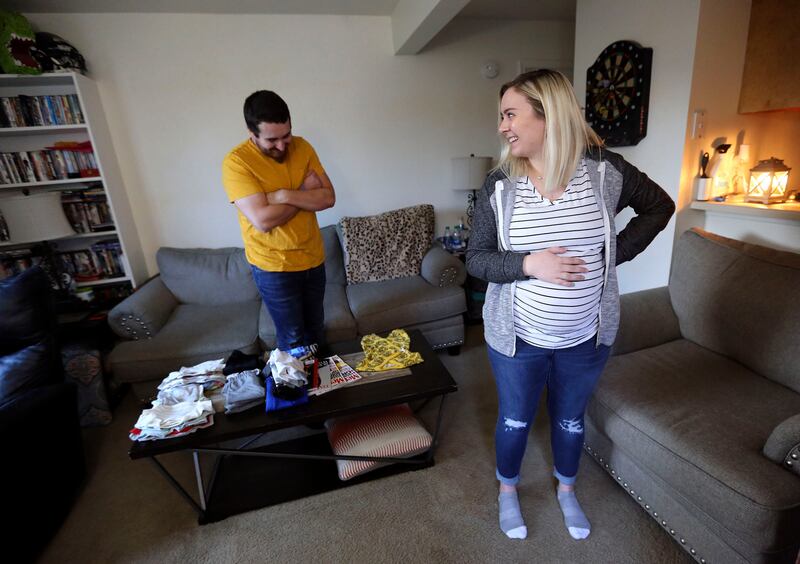
When Bracken and Airianne Hughes began making plans for the birth of their first child a few months ago, their mothers said they’d love to be present for the birth. The high school sweethearts who got married last year said they decided having three moms in the delivery room would be the kind of welcome they wanted for their little boy.
But then new restrictions were imposed as hospitals try to limit the number of people coming in or out.
“They told us only one person can be there,” she said gesturing toward Bracken. “So now it’s just us. ... This is my first baby. I have never done any of it, and I’ve had so many (pregnancy) problems, that I’m scared. I want my mom there.”
The moms were disappointed, but they all understand, and the couple knows they’ll have plenty of support outside the hospital. Airianne Hughes has a tendency to worry, so they’ve tried to focus on all the fun, positive or humorous aspects they can.
“We’re trying to look at it positively,” she said, placing her hand on her stomach. “I mean, since we have no choice, where we get to do it and be together and bond over this simple experience. We get to have the baby all to ourselves the first couple of days.”
Bracken Hughes tries to ease her fears, and he said it isn’t just the birth rules that have thrown them for a loop. Last week, the couple was told that Bracken could no longer accompany his wife to her doctor appointments.
“She just has to go by herself now,” he said. “It still kind of sucks. It’s always nice to be there because (Airianne) always worries or stresses out about doing anything by herself to begin with.”
Airianne Hughes, who is dealing with several potential complications, said each week brings more rules and changes to plans.
“A lot has changed,” she said. “The doctor won’t shake my hand anymore. I lay down so they can listen to the heartbeat, and he used to help me up, but he can’t even do that anymore. I’m like a turtle; I can’t get up.”
They laugh as she demonstrates her technique for rolling off the table.
Bracken said he tries to think through the possibilities because he wants his wife to focus on the joy of this experience. But she admits she can’t help but worry about even worse scenarios.
“My biggest fear is that it gets so bad that I can’t even have him,” she said, joking that she will “cross her legs; (the baby) can stay in there” if it that happens.
Bracken said he hopes those in charge understand what a terrifying and possibly dangerous situation it might be if women were required to have babies alone.
“She is already worried about not having all the moms in there to calm her down,” Bracken said. “So to not have anybody in there, that’s a stressful thing, to have no support.”
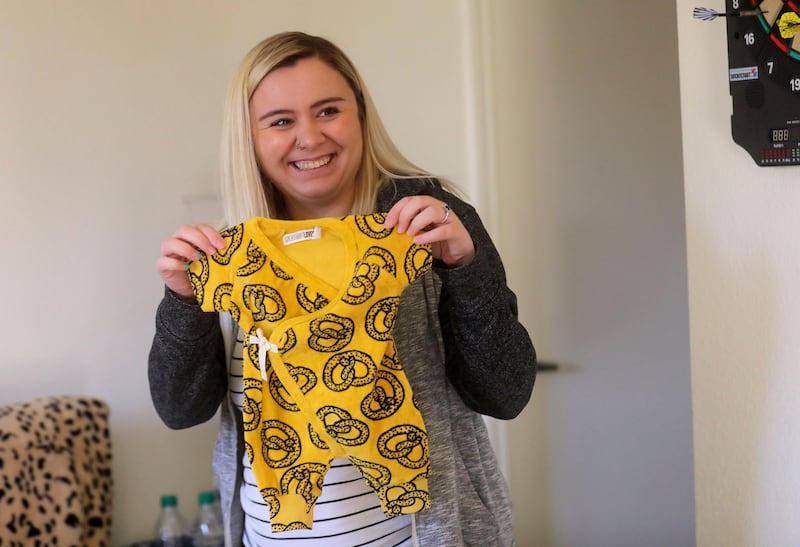
For now, they’re grateful for the gifts they received from their drive-by baby shower, and the stacks of clothes purchased by Grandpa and Grandma Jackson.
“I think if it had been an easy pregnancy, it wouldn’t be as scary,” Airianne Hughes said. Adds her husband, “Yeah, we’re kind of going into this blind. They can offer us tips and everything, but we’re on our own.”
Last weeks
Whitney Teuscher knew something was wrong when her grandmother called. Kathy Garner usually let’s the family grapevine deliver any news.
“She called me and told me my grandpa was going on hospice,” said Teuscher, who was raised by her grandparents, John and Kathy Garner. “She knew I’d be worried and upset.”
The worst aspect of learning her grandfather had deteriorated so significantly and that he didn’t have more than a few weeks to live, is that Teuscher lives in California and cannot travel to her grandparents’ home in Ephraim because of stay-at-home restrictions.
“We have this shelter in place in California,” she said. “And my grandma doesn’t really know technology. She doesn’t have a smartphone and she doesn’t text. I can call her, but she doesn’t answer the phone all the time. ... They don’t have a computer, so it’s been really hard.”
Teuscher said she’s left with the memories — and the regrets — she has.
“I wish I’d spent more time with them when I lived in Utah,” she said. “I wish I hadn’t been such a bratty teenager.”
She takes some comfort in the fact that she’s learning to garden, an activity her grandmother loves.
She cries when she thinks of what they gave up to raise her and her siblings.
“I wish I’d spent more time with them when I lived in Utah.” — Whitney Teuscher
“Hard work,” she said of what they taught her. “Growing up it was very poor, but they made sure I had everything and did everything. I did drill team, and I had all the things teenagers want. They’ve always sacrificed for others. They still do.”
Losing hope
Leroy and Esther Heaton understand why their children can’t visit anymore. The couple said they find hope in the fact that they have each other — and the hospice workers like Abbey Bell and Erin Nolte who come to care for them several times a week.
Their children decided the couple needed the care and support of hospice late last year when Leroy Heaton struggled with pneumonia and his wife broke her hip. They visited with their children regularly until the COVID-19 outbreak forced Spring Gardens, where they live, to close the building to all visitors except hospice and health care workers.
Now people like Bell and Nolte have become much more than caretakers for their patients. They often take pictures and videos or set up phone calls between family members and patients.
Gary Heaton, the fifth of the couple’s six children, said it’s been a great comfort to them that his parents have Bell at a time like this.
“I think having good hospice service is the key to success with all of this,” Heaton said. “Abbey is amazing and my parents really like her. And Spring Garden is really top-notch.”
He said he and his brother have visited with their parents through a window, and all six children call them each day.
“They seem to be doing fine,” he said of his 95-year-old dad and 91-year-old mom.
Bell, who works for Yarrow Hospice and Palliative Care, said the restrictions on visitors has been tough on her patients.
“It’s been heavy,” she said. “Sometimes you’re the only person who can visit, so it’s been a little bit heavy because you’re trying to get as many requests in as you can. It’s hard to watch people decline because they’re no longer able to socialize or have those visits.”
She said many are restricted to their rooms, and if they live alone, they often get depressed and lose hope.
“They lose (mobility), and I’ve seen declines in cognition,” Bell said. “You can kind of see the light going out in them. ... It’s scary, honestly. Connection contributes to their physical abilities and their health.”
“You can kind of see the light going out in them. It’s scary, honestly.” — Abbey Bell
Each facility or hospital decides if it will let hospice workers in to care for patients.
“I think they’re nuts if they’re not letting hospice into a facility,” Gary Heaton said. “It’s harder not having us visit. But if they had even less contact with people like Abbey, it would be really tough.”
Last hours
The hope Tholen felt as the cardiologist explained the fight her father’s heart and lungs had to win to stay alive was just one of the tender mercies she and her sister received in the days after he was admitted to a hospital.
They didn’t realize he’d never leave.
After speaking with the cardiologist, the women were allowed to see their father briefly before leaving.
“We got to spend like 15 minutes,” Tholen said. “We gave him our love ... and we left. They said we could call as much as we wanted. For the next four days, we took turns calling every three or four hours. They knew our names well, and they were so good to give us updates.”
She can’t remember if it was Saturday night or Sunday morning, but at some point, doctors told them that their father couldn’t remain on the ventilator. They planned to take him off, and they said they weren’t sure he’d be able to breathe on his own.
Tholen worried that her father wouldn’t survive and the possibility of not saying goodbye was unbearable. She called the nurse on duty, and asked him if he would print and read an email to her father if she sent one to him.
“He was so kind,” she said. “It was one o’clock in the morning, and I wrote up my thoughts. ... He printed it off and read it to him. It was so comforting.”
When they took her father off the ventilator, they allowed the women to be present, in case his body couldn’t adjust.
“Amazingly enough, he was able to breathe on his own with just oxygen,” she said.
They spent just over two hours with their father, and despite a sore, raspy throat from days of intubation, he was able to express his love for them and his gratitude to doctors.
The doctors gave him insight into what his future might hold if he stayed in the hospital on oxygen. He made the decision not to subject his body to any more life-extending measures.
“He told them, ‘I’m done’,” Tholen said. “He said, ‘I don’t want to do this anymore.’ We didn’t know that. When someone in the family is making a life-changing decision, you expect to be there. But my dad made that choice on his own.”
She thinks he wanted to spare them the emotional weight of the decision because they’d lost a sister three months earlier.
Throughout the day, the nurses gave us updates,” Tholen said. “I just told (one nurse), I really, really need to be there. She waited until he was unconscious, and then they let us come in. We got to spend an hour with him. We didn’t touch him because we didn’t want to interrupt his experience. We felt like it was OK to leave, and an hour later, they called and said he’d passed away.”
The nurse who called them in from the parking lot sat with their father in his last moments. She talked to him, held his hand and comforted him.
Tholen said she learned a lot about value of compassion and connection from her father.
“He loved to go out and eat and connect with people over a meal,” she said, noting he’d hate the COVID-19 restrictions. “He loved to connect with people. He brought family and everyone together. He taught us to be kind, to be accepting of everyone, to reach out to people.”
They’ve put any funeral on hold because they want their large family and his many friends to be able to gather and revel in their memories of and affection for Norm Hansen, husband of Cookie, father to Amy, Noel and Holly.
“We aren’t even running the obituary yet,” she said. “We want to invite everyone he knew and make it a really special celebration of life.”
She will miss the phone calls they shared. Their connection deepened after Cookie Hansen died.
“We never said I love you on the phone before my mom died,” she said. “After she died, before we hung up, we always said the sincerest, ‘I love you.’ I just loved that.”