


As Italy’s Milan Cortina Olympics came to a close Sunday with a ceremonial hand off to the French Alps as the site of the next Winter Games in four years, everyone was looking ahead to Utah hosting in 2034, right?
Maybe not.
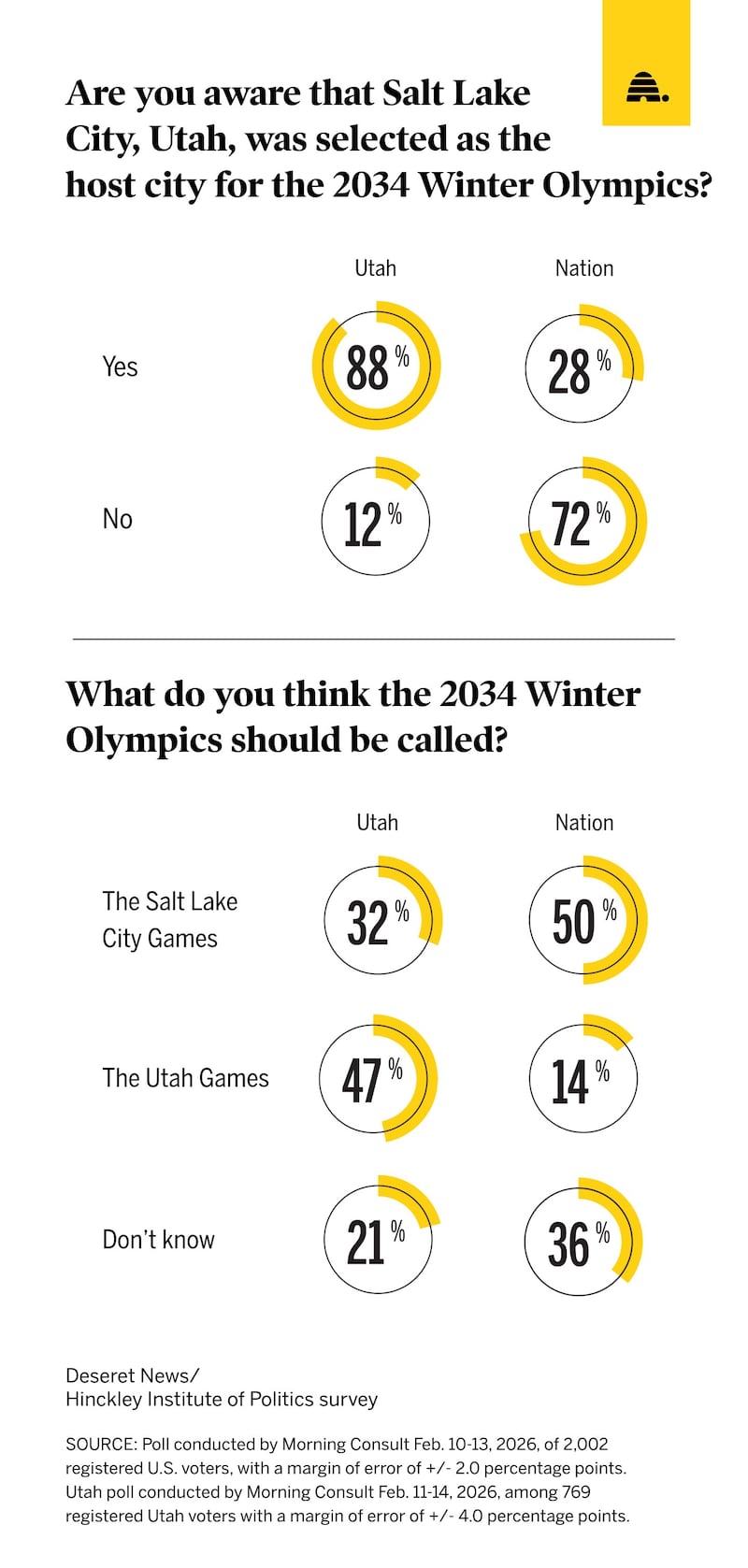
Sure, a new Deseret News-Hinckley Institute of Politics poll found 88% of Utahns know their state is where the “next next” Winter Games will be held eight years from now, a decision made by the International Olympic Committee in July 2024.
But a national poll for the Salt Lake City-based newspaper and the University of Utah institute showed pretty much the opposite. Nearly three-quarters of Americans, 72%, said they weren’t aware that Utah had been selected to host the 2034 Winter Games.
Both polls were conducted by Morning Consult, which polled 769 registered voters in Utah Feb. 11-14 and 2,002 registered voters nationwide Feb. 10-13. The Utah poll has a margin of error of plus or minus 4% and the national poll, plus or minus 2%.
The lack of national awareness doesn’t seem to worry the leader of Utah’s Winter Games.
“It’s understandable,” said Fraser Bullock, president and executive chair of the Organizing Committee for the 2034 Olympic and Paralympic Winter Games, given that the state’s second hosting gig is so far away.
“Over time, we will close the gap on that number and get to a majority,” he said. “Particularly after the French Alps Games, when we’re the next Games, we should see a steady rise over the years.”
Bullock said Utah also can expect “a fair amount of attention” when Los Angeles holds the 2028 Summer Games as the next Olympics and Paralympics for athletes with disabilities being held in the United States.
Utah won’t be able to start selling sponsorships and making other moves in the marketplace until after the LA Games. That’s also when NBC, which holds the U.S. broadcast rights to the Olympics through 2036, is likely to start promoting Utah’s Winter Games.
Building national recognition will take time, said Bullock, who served as chief operating officer for the 2002 Winter Games in Utah. But just how organizers will try to raise the state’s profile as the host of the 2034 Games is yet to be determined.
“Let me put it this way, we’re planning to plan that,” Bullock said. “We know its something we need to do.”
Recognition of Utah at the Milan Cortina Olympics
Utah’s still-small organizing committee did have a presence at Italy’s 2026 Winter Games, including their first formal presentation to the IOC and a news conference where many questions from the international news media were about U.S. President Donald Trump.
Even so, there wasn’t much talk in Milan about the 2034 host, said Robert Livingstone, producer of GamesBids.com, a Toronto-based website that follows the competition to host future Olympics and Paralympics.
“More people were aware of Switzerland (bidding) for 2038 than that Utah had won for 2034,” Livingstone said. “People were talking French Alps and they were like, ‘Who’s after that ... oh, right, Switzerland.’ I heard that a number of times.”
He said in conversations about future Winter Games, people were focused on Switzerland, which was granted a unique status as the sole bidder for 2038 by the IOC, and would “just skip over Utah because they haven’t heard anything about Utah.”
And while the French Alps had the chance to showcase the 2030 Winter Games during Sunday’s Closing Ceremonies in an ancient Roman amphitheater in Verona, the Utah Games won’t have the opportunity to do the same until the end of France’s Olympics four years from now.
One of the few hints that an American city was the site of an upcoming Winter Games came during the Feb. 6 Opening Ceremonies, when Team USA marched third from last in the Parade of Nations, ahead of athletes from France and then Italy, to signify the order of future hosts.
That same order was in place for each country’s flag bearers during the Closing Ceremonies.
Matthew Burbank, a University of Utah political science professor who’s authored two books about the Olympics, said Utah organizers were in effect limited in what they could do in Italy to promote the 2034 Games.
“I don’t think it was the time and place,” he said, noting the IOC’s “script” for future hosts calls for them to “wait your turn, stand in line, do what you’re supposed to do, show up at our meetings ... but don’t call undue attention to yourself.”
The professor wasn’t surprised that Utah’s status isn’t widely known nationwide.
The Winter Games already attracts less attention than the much larger Summer Games that feature more popular sports, Burbank said. So with Los Angeles hosting those in 2028, he said if Americans “are thinking about the Olympics at all, that’s what they’re thinking.”
That’s no doubt the case globally, as well, Burbank said.
“I don’t think most people could name the French Alps as the next Winter Olympics after Milan. So with the one after that, it gets even farther away,” he said, although there’s a possibility that “because Salt Lake has held the Games before, there might be some recognition of that.”
Should 2034 be the Utah Games? Or the Salt Lake City Games?
When attention does shift to 2034, it will be on what’s been renamed the Utah Games.
In 2002, it was Salt Lake City that hosted because the IOC only awarded Games to a city. Now, cities, regions or countries can host, even joining up — as the cities of Milan and Cortina did this year.
Polling found that Utahns are split over what to call the 2034 Olympics, with 47% backing the organizing committee’s announcement late last year that they would be the Utah Games, and 32% behind the Salt Lake City Games name. Another 21% didn’t know which they preferred.
Nationally, the poll results were more clear-cut, with 50% saying the 2034 Olympics should be called the Salt Lake City Games and only 14% supporting the Utah Games name. Those who didn’t know was higher than in Utah, at 36%.
The 2034 Games organizers believe Utahns and the rest of the country will come to accept the switch from the Salt Lake City-Utah tag used throughout the Olympic bid process, which lasted more than a decade.
“The change is fairly recent and it will take some time for people to become familiar with that and accustomed to it,” Bullock said. “It will evolve over time. But remember this is a transition period where we can’t do a full launch of a brand until after the LA Games.”
Announced just before last Thanksgiving along with a new and controversial logo at the unveiling of a massive new installation at the Salt Lake City International Airport, the new “Utah 2034″ name is here to stay even though a different logo is expected in 2029.
“The name element is established,” Bullock said, promising that the 2034 Games will “have a much more comprehensive identity after the LA Games,” thanks to the ability to establish a stronger brand.
That may be a little easier in Utah, where unlike the rest of the country, the population is already overwhelmingly aware that the state is hosting in 2034. Bullock is convinced all Utahns will eventually know they’re going to welcome the world again.
“I’m thrilled that it’s 88%,” he said. “We’ll continue to spread our message, so we’ll get the other 12% that aren’t aware the Games are coming. We’re excited our citizens of Utah are paying attention to our Olympic and Paralympic future.”
What Utah organizers did in Italy during the Olympics
For Bullock, the Milan Cortina Games weren’t about increasing awareness for 2034.
He and the more than 100 other Utahns, including Utah Gov. Spencer Cox, who traveled to Italy for the Olympics largely stayed behind the scenes to get a firsthand look at putting on a Winter Games.
“It’s not our turn on the stage. We respect very much that it’s Milano Cortina’s time to shine in front of the world, as they are doing a great job,” Bullock said. “And that the baton will be handed to the French Alps.”
That meant long days of meetings about topics like technology and hospitality as well as participating in the IOC’s observer program that provides access to the back-of-the-house at Games venues as well as to operations, security, transportation and other functions.
All of it was “incredibly valuable,” Bullock said. “It’s always enjoyable to see the fulfillment of the dreams of a host ... how things come together, how proud they are of the work that they’re doing, how they’re welcoming the world in their unique way, reflecting their people and their culture.”
That will happen for Utah 2034, too, he said.
“We’re just biding our time,” Bullock said. “Because we know our time will come.”