

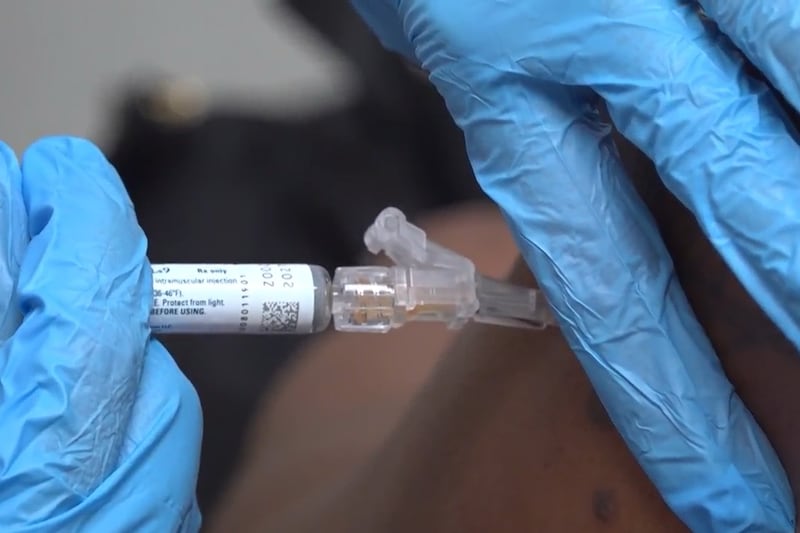

- Defense Department has updated its annual flu shot policy for U.S. troops.
- Defense Secretary Pete Hegseth said the modified vaccine policy protects service members' medical autonomy.
- The Marine Corps issues beard guidance for personnel with razor bumps.
American military personnel will now have the freedom, or “medical autonomy,” to choose whether or not to receive the flu vaccine — but not the personal freedom to grow a beard, even for medical reasons.
Last week, Defense Secretary Pete Hegseth announced that service members will no longer be required to receive the annual influenza vaccine — calling the mandate “overly broad and not rational.”
Days later, the Marine Corps reported that its personnel must meet Department of Defense grooming standards such as being clean-shaven — or face possible separation from the service.
The “no beard” rule extends to those Marines diagnosed with pseudofolliculitis barbae, aka “razor bumps” — a fairly common chronic skin condition that disproportionately affects Black men.
The Marine Corps’ formal grooming announcement follows Hegseth’s direction last September that all troops be clean-shaven — or face the possibility of discharge.
“The grooming standard set by the U.S. Military is to be clean shaven and neat in presentation for a proper military appearance,” wrote Hegseth in a DOD release.
Hegseth: Biden administration waged ‘unrelenting war on our warriors’
Utilizing his X account, Hegseth said last week that his department is “once again restoring freedom” to the U.S. Military.
“Under the disastrous Biden administration, this Pentagon waged an unrelenting war on our warriors on many fronts, including when it came to denying them simple medical autonomy and the freedom to express their religious convictions,” he said, referencing the DOD policy requiring all Armed Forces personnel to receive the COVID-19 vaccine during the pandemic.
Men and women in uniform, he added, “were forced to choose between their conscience and their country — even when those decisions posed no threat to our military readiness.”
That “era of betrayal” is over, said Hegseth.
“Under President Trump, the War Department continues to take decisive action to once again restore freedom and strength to our joint force. We’re seizing this moment to discard any absurd, overreaching mandates that only weaken our war fighting capabilities.
“In this case, this includes the universal flu vaccine and the mandate behind it.”
Requiring every service member to receive the annual flu vaccine, Hegseth added, is far-reaching and irrational.
“Our new policy is simple: If you, an American warrior entrusted to defend this nation, believe that the flu vaccine is in your best interest, then you are free to take it. You should.
“But we will not force you — because your body, your faith and your convictions are not negotiable.”
Scrapping the mandatory flu vaccine policy is good common sense, he concluded.
“Rest assured that under President Trump, the War Department will always honor our brave warriors and do everything we can to restore the American people’s trust in their military for generations to come — and that’s why I’m proud to sign this new policy.”
The DOD’s new flu shot policy is prompting response from some in the public health community.
Dr. Amesh Adalja, a senior scholar at the Johns Hopkins Center for Health Security, told HuffPost that the decision is anything but common sense.
“It is the opposite of common sense,” said Adalja. “The influenza vaccine is an essential component of force protection and force resiliency. By removing influenza vaccine requirements in the military, (Hegseth) is weakening the military by making it more susceptible to influenza.”
Hegseth’s memo announcing the flu vaccine update notes that DOD services can submit requests for exemptions to the new policy.
U.S. military and vaccines: A long, recently divisive history
Vaccinations and the U.S. military share a long history — going back to the American Revolution.
But vaccinations became a contentious political issue during the pandemic, when more than 8,000 troops were forced out of the military for refusing the COVID-19 vaccine, according to the DOD.
Thousands of others reportedly sought religious and medical exemptions.
Congress agreed to rescind the mandate, which the Pentagon dropped in January 2023, after roughly 99% of active duty troops in the Navy, Air Force and Marine Corps had gotten the vaccine, and 98% of those in the Army.
The Trump administration then spent months crafting a policy to allow service members who refused to take the mandatory COVID-19 vaccine to reenter service with back pay. While only a tiny fraction have taken the Pentagon up on the new policy, Hegseth’s team has spent the past several months personally highlighting them, according to an NBC News report.
The Pentagon stated in March that 153 service members who were separated under the COVID-19 mandate had been reinstated or “re-accessed.”
Marine Corps articulates ‘no beard’ policy
But while the decision to receive — or not receive — the flu vaccine will be a service member’s choice, such personal autonomy reportedly doesn’t extend to growing a beard for medical reasons.
Last week, the Marine Corps announced that the DOD’s uniform and grooming standards must be met within a year’s time, regardless of medical conditions.
Marines who require exemptions for more than 12 months will be evaluated for administrative separation, which the Corps says it is revising the timeline for, Military Times reported.
“This change provides our leaders the necessary time to ensure updated policies, training, and educational materials are fully implemented, and that all affected personnel are properly counseled before any final administrative action is taken,” the Marine Corps memo reads.
In the statement, commanders are tasked with following specific steps for the administrative separation process:
Commanders are first directed to conduct initial counseling after six months of noncompliance with the established grooming or uniform standard, which will be formally documented to notify the Marine of the possibility of separation from the Corps, according to Military Times.
After 12 months, commanders will then evaluate the Marine for continued service and consider discharge if the service member’s medical condition has not improved, is not classified as a disability and “affects good order and discipline.”
Hegseth has made troop fitness and appearance a DOD priority.
In 2025, he ordered a department-wide review of existing standards set by U.S. military branches pertaining to physical fitness, body composition and grooming — including beards.
“We must remain vigilant in maintaining the standards that enable the men and women of our military to protect the American people and our homeland as the world’s most lethal and effective fighting force,” wrote Hegseth. “Our adversaries are not growing weaker — and our tasks are not growing less challenging.”
U.S. troops, he added on social media, “will be fit — not fat.”