

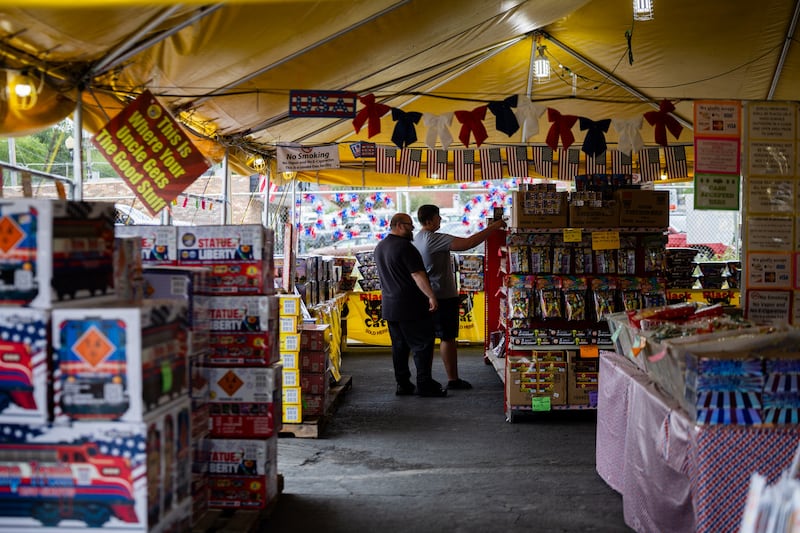
Gov. Spencer Cox issued a “hybrid” fireworks policy on Monday, which allows some cities to ban personal fireworks during the upcoming Pioneer Day weekend over wildfire concerns
The policy differs from a statewide ban he issued for the Fourth of July, instead allowing municipalities to use their typical fireworks maps to determine where fireworks are permitted within city limits. However, it also allows cities with ongoing elevated fire danger to work with the state forester to “request additional restrictions beyond their existing authority,” according to the governor’s office.
While monsoon showers have led to much-needed moisture across parts of the state, Cox noted earlier Monday that those have failed to reach every part of the state. That’s created ongoing fire danger in the places without rain.
“The Wasatch Front has not had much moisture at all,” he said after leading an annual cattle drive through downtown Salt Lake City to the Days of ’47 Arena for the holiday rodeo. “We’re still as bad or maybe worse than we were on July 4 in some cities; much better off in others. We have some cities that have received more water than they (normally) receive in two or three months, so it’s safe to have fireworks in those places.”
Utah allows residents to light fireworks during the Fourth of July and Pioneer Day weekend. The latter period is 11 a.m. to 11 p.m. from Wednesday through Saturday, with fireworks permitted as late as midnight on the holiday itself, Friday.
Cox ordered a blanket ban for the previous window over extreme fire danger. More than 550 fires have burned over 378,000 acres of land in Utah this year, making it the state’s worst season in terms of acres burned since 2018.
However, monsoonal moisture has helped slow down the spread of fire, especially in central and southern Utah. It’s helped firefighters gain greater containment of large wildfires, like the Cottonwood and Babylon fires in southern Utah.
While this week’s order loosens restrictions on fireworks, Cox said residents should still be “extra, extra cautious” even in areas where they are permitted. Nearly 95% of the state is listed as being in severe or worse drought, according to the U.S. Drought Monitor.
“Let’s be very thoughtful about it (and) be prepared for any scenario,” he said. “Even if you’re in a place that’s had an inch and a half of rain within the last week, still be very prepared.”
It’s been a different story for Utah’s northern half. Extreme drought now covers two-thirds of Salt Lake County and a quarter of Utah County. Some parts of Box Elder County remain listed in exceptional drought, which is the worst drought category.
Although storms have developed in the mountains over the past week, most have failed to drift into many of the Wasatch Front communities as hoped, said KSL meteorologist Matt Johnson. There haven’t been upper-level steering winds that typically push storms that develop in the mountains into the valley communities, which is also why there has been more localized flash flooding in mountain areas.
There’s still a chance for some thunderstorms in the region over the next few days, but he said it’s unlikely to reverse fire conditions this close to the holiday.
Jamie Barnes, director of the Utah Division of Forestry, Fire and State Lands, and the state’s forester, said municipalities requesting additional restrictions will coordinate directly with the division. Local officials will announce any specific fireworks change before the Pioneer Day holiday, she added.
“This process gives communities flexibility while ensuring we can quickly implement additional restrictions where local fire conditions warrant them. We encourage everyone to check with their city before using fireworks,” she said.
As always, fireworks remain banned on all federal lands and on state and unincorporated lands. Illegal and negligent use of fireworks can result in “significant” civil and criminal penalties, Utah Department of Public Safety officials added.