

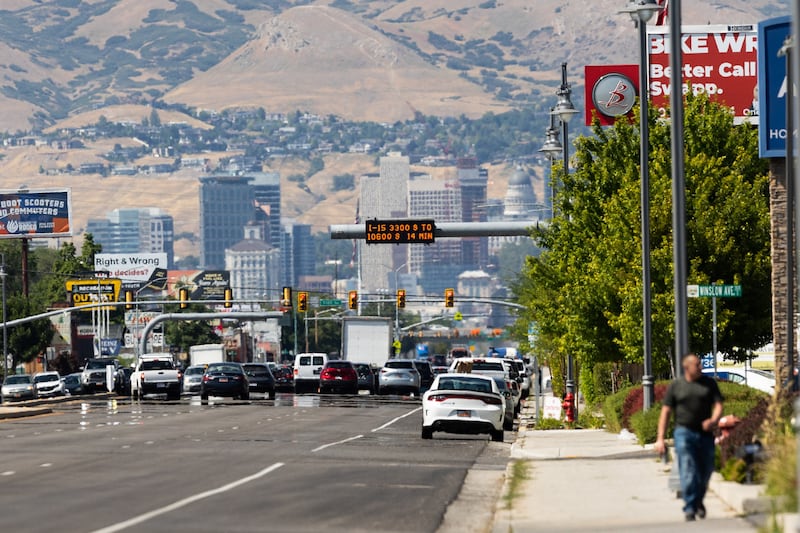
SALT LAKE CITY — Temperatures in Utah are expected to skyrocket through the week, reaching at least 100 degrees Fahrenheit during the day and low 80s at night, right as a heat dome begins affecting the Central United States.
Sam Webber, a meteorologist at the National Weather Service’s Salt Lake City office, said heat advisories issued on Sunday were in response to an area of high pressure affecting Utah.
“We have an area of high pressure, pretty broad over the Four Corners region of the United States right now,” he said, adding that most of the heat is coming from the desert southwest as winds blow a lot of heat towards the state.
High temperatures along the Wasatch Front reached the low 100’s on Sunday and are expected to stay that way throughout the rest of the week. Although people should prepare for the heat, Webber said those daytime temperatures are not what people should be worried about.
“The more impactful part of this is the overnight low temperatures, which are really, really struggling to cool off, really at all,” Webber said.
Overnight lows could hit around 80 degrees mainly in lower elevations, like in the lower parts of the Salt Lake Valley. Other parts of the Wasatch Front are likely to see overnight temperatures in the mid to upper 70’s, according to Webber.
The very hot conditions continue with most valleys seeing highs in the 100-105°F range. Low temperatures in the 70s to around 80 will provide little relief from the heat. Stay inside in air conditioning if you can and stay hydrated! #utwx pic.twitter.com/ZziHT898Ew
— NWS Salt Lake City (@NWSSaltLakeCity) July 26, 2026
“We’re talking like 75 to 77 degrees, which is still really, really warm,” Webber said. “And this is only, you know, just before sunrise when temperatures are at their coolest. So, we’re talking most of the night being in the 80s.”
Salt Lake City’s coolest day is on Wednesday with a temperature projection of 98 or 99 degrees. Heading into the weekend, Webber said it looks like Utahns will see a resurgence of those warm temperatures, with lows expected to be in the low 100s and overnight lows again sitting in the mid-70s.
“It’s really a prolonged stretch. It’s not just, you know, for today and tomorrow; it’s the whole week where we’re going to be dealing with these abysmal high temperatures and overnight low temperatures,” Webber explained.
Potential loss of power
Jonathan Whitesides, a Rocky Mountain Power spokesman, said equipment like fuses and transformers can fail when temperatures are this high. He said the odds of power equipment failing go up when people run air conditioning units overnight, and temperatures remain high around 80 degrees.
People can close blinds and shutters to help keep houses cooler so AC units don’t have to work overtime, according to Whitesides. Stress on AC units also goes up when people use an oven or stovetop, so choosing to grill food instead can help because it keeps temperatures in the home from increasing.
Whitesides also said people can wait to do laundry late at night or early morning when it’s cooler to avoid adding stress on an AC unit.
Rocky Mountain Power provides Utahns a rebate on smart thermostats, which can help control the temperature of your house while you’re away through an app, Whitesides explained. He also said it’s important to keep furnace filters clean in order to provide better airflow.
Whitesides added that Rocky Mountain Power prepares for possible power outages by continuously checking on its equipment. It also has a team of meteorologists on hand to help predict which areas may face issues.
For up-to-date information on power outages, Whitesides advised people to take a look at Rocky Mountain Power’s outage map, which is connected to the power company’s system to show the latest information. He said reporting power outages also helps get problems checked, especially when a customer is on their own circuit.
Practice heat safety
Webber advised people to limit all outdoor activities until the morning hours, when temperatures are coolest. Avoid any outdoor activity during peak heating hours of the day, usually between noon and 5 p.m.
“If you can find access to air conditioning, please do so,” Webber said. “And recognize the signs of heat-related illness, heat stroke and just heat stress in general.”
Signs of heat stroke:
- High body temperature
- Hot, dry skin
- Rapid and strong pulse
- Person may be unconscious
Webber advised people to make sure there are no pets or children in cars, even if you’re just making a quick trip into a store.
“Oftentimes, yeah, it might be 100, 102 outside, but inside your car could get an excess 120 to 130 degrees depending on how long that car is parked there," Webber explained.
Contributing: Tammy Kikuchi, KSL