



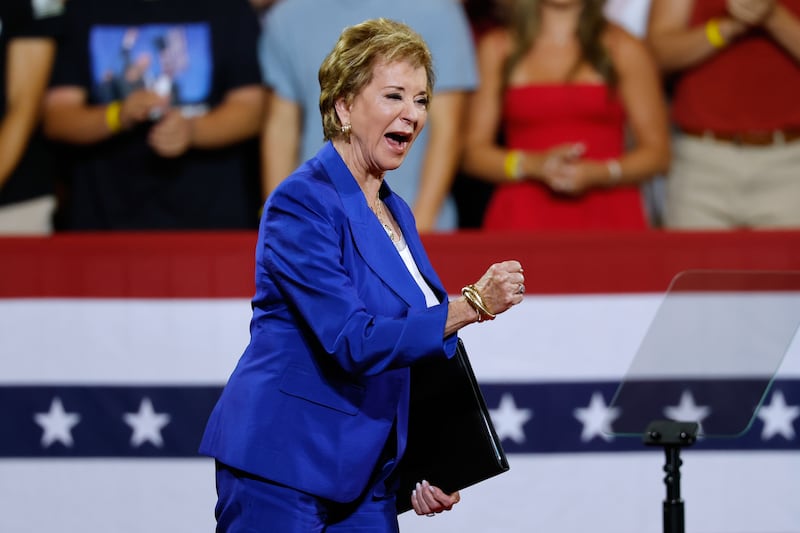
- Education Secretary Linda McMahon has sent a "National Call to Action" letter to American university leaders.
- U.S. college presidents are being asked to post their institutions' "statements of principle" on school websites.
- Initial responses to McMahon's "call to action" from Utah universities.
Just days before the start of a new academic year at most U.S. colleges, Education Secretary Linda McMahon is issuing a “call to action” to university presidents and board members — and giving them a homework assignment.
In a letter issued this week entitled “A National Call to Action,” McMahon implored university leaders and governing boards “to reaffirm their commitment to serving the American people.”
Many of the nation’s storied universities were founded almost four centuries ago — performing a key role in forging America’s political leaders, institutions and public culture, wrote McMahon.
American colleges have long been entrusted to exploring truth, advancing science and spawning industry. “Yet, as higher education has drifted from the principles that built up so much public esteem, Americans’ trust in universities has reached record lows,” asserted the Education secretary.

McMahon then gave a “homework” assignment to university leaders — but without stating explicit consequences for failing to complete:
“Before the end of 2026, I call on every postsecondary institution to describe to the American public your commitments to rigorous teaching, pathbreaking research, and national service — commitments that make our universities a bedrock institution of the American republic,” she wrote.
The requested “statements of principle,” she added, should be posted prominently on institutional websites. “Only full candor and transparency can begin to strengthen the bonds between higher education and the American people.”
Several university leaders, added McMahon, have already recognized the need to “chart a new course” to build public confidence.
“In May, Yale’s Committee on Trust in Higher Education boldly acknowledged that the dilution of academic standards, opaque admissions policies, and a domineering monoculture have badly eroded public trust.”
Scholars at Vanderbilt and Washington University, she added, have also documented “the politicization of the humanities and humanistic social sciences.”
A truce between universities and the Trump administration?
While McMahon’s “call to action” letter was heavy on expectations, there was no explicit warning of, say, withholding federal dollars to institutions who do not articulate and post the secretary’s requested declarations.
This week’s letter from the Education Department, noted Forbes, strikes “a noticeably different tone” from the administration’s previous attempt last year to compel universities into signing its “Compact For Academic Excellence in Higher Education,” which outlined requirements for how it wanted admissions, tuition, hiring, governance, grading, athletics, foreign students, and campus speech to be handled at the nation’s institutions.
In exchange for signing on to the compact, institutions were promised they would receive “multiple positive benefits,” including preferential treatment for federal funding. No major university agreed to do so, rejecting the implicit threats to research independence and academic freedom contained in the compact, Forbes reported.
Meanwhile, an opinion piece posted Thursday by the digital news site Inside Higher Ed called for a truce between universities and the Trump administration.
While agreeing with McMahon’s demands for transparency and accountability, the column argued that such expectations must be reciprocated.
“Under McMahon’s boss, Donald J. Trump, the federal government has eroded many of the same values that she calls on universities to protect,” the article asserted. “And trust in the government has fallen to a near-historic low.”
Inside Higher Ed also issued its own “call to action.”
“As per McMahon’s request, universities will publish statements about how they will bring their practices into accord with their principles. And the Trump administration will do the same.”
What key points is McMahon asking for?
In her letter to university presidents, the Education secretary posed seven “central questions” to be answered in each university’s “conversation with the American people.”
- Transparency and merit in admissions: How, asked McMahon, will “your institution ensure admissions decisions are based on merit, achievement, and your university’s educational purpose?”
- Free speech and open inquiry: What is each university doing to protect the free exchange of ideas, wide-ranging debate, and “openminded campus discourse? And what are schools doing to address “unruly and violent protestors” that harass students, disrupt classes and campus operations?
- Intellectual pluralism and academic vitality: Are faculty hiring and evaluation practices supporting “academic vitality” — and is campus research dedicated to advancing knowledge “and serving the American people who fund it?”
- Affordability, value and student outcomes: How are higher education institutions ensuring that families can access affordable, high-return degrees?
- Academic standards and rigor in the age of AI: Are institutions incentivizing rigor in the age of AI — while combating grade inflation and prioritizing excellence in teaching and learning?
- Safeguarding research integrity from malign foreign influence: How is each university protecting academic programs from foreign influence?
- Prioritizing American interests: And finally, what is each institution doing to advance American security interests, while delivering academic programs that meet workforce needs and “contribute materially” to American prosperity?
Early responses to McMahon’s letter from Utah universities
While McMahon is requesting that American universities formally articulate their “public commitments” to the public by year’s end, some Utah higher education institutions are already responding to the education secretary’s request.
“As Utah’s flagship public university, we welcome the opportunity to demonstrate how we serve the people of our state through excellence in education, research, health care, and public service,” noted a University of Utah statement.
University leadership, that statement added, will consult with faculty, the Board of Trustees, and the Utah System of Higher Education and carefully review the issues raised in McMahon’s letter and submit a formal response by the requested deadline.
“The University of Utah remains steadfast in its public mission: preparing students for lives of leadership and service, advancing discoveries that improve lives, delivering world-class health care, fostering rigorous inquiry and viewpoint diversity, and creating lasting value for the students, families, taxpayers, and communities we are privileged to serve.”
In a statement to the Deseret News, Utah Tech University President Shane Smeed said his school takes McMahon’s calls seriously.
“As an open, comprehensive polytechnic university, we remain committed to providing a high-quality, affordable education that prepares students to meet workforce needs through rigorous academics, open inquiry and hands-on learning,” said Smeed.
“We will continue working to build public trust by focusing on student success, responsible stewardship of public resources, and meaningful service to our community.”
Utah Valley University spokesperson Sharon Turner said McMahon’s query regarding admissions is not applicable at the state’s largest university because UVU is an open-enrollment institution.
The Orem-based university, added Turner, prioritizes hosting diverse speakers and scholars. “We’ve had a lot of events on campus that focus on dialogue and sharing your thoughts, even when you’re not in alignment with another party.”
UVU also provided Thursday this guiding institutional statement:
“Our work is guided by a commitment to exceptional care, exceptional accountability, and exceptional results. We provide a high-quality education that is both affordable and accessible.
“From certificates to master’s degrees, UVU offers flexible, relevant programs grounded in hands-on learning and real-world experiences, ensuring that students graduate with career-ready skills and are ready to receive a strong return on investment.”